

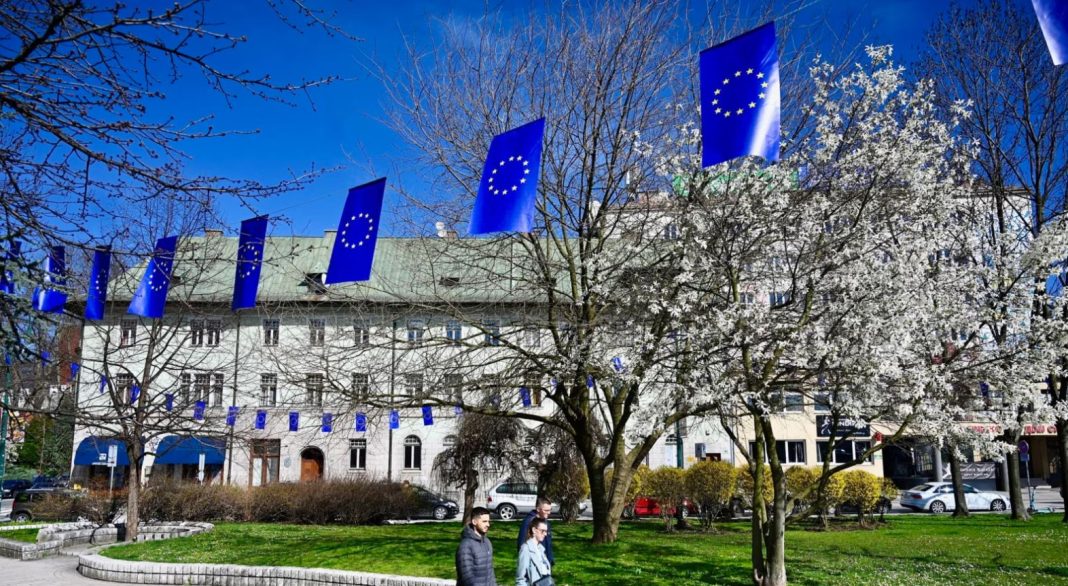
The European Union has entered the phase of the electoral process, in which some of the key figures of the EU institutions are actively involved.
The President of the European Commission, Ursula von der Leyen, who is the lead candidate of the European People’s Party (EPP) to secure another five-year mandate at the helm of the EU executive, will also be on the campaign trail.
Also on the campaign trail will be the outgoing chief of staff, Björn Seibert, as well as some staff members of the Commission, who, to avoid conflicts of interest, have taken unpaid leave during the campaign.
Several other commissioners will also be campaigning for their respective parties.
On April 24, the European Parliament will hold its final plenary session in this composition, while the elections will take place from June 6 to 9.
The end of the work of the European Parliament, on the eve of the elections, also marks the beginning of the institutional transition phase in the EU.
That is because, after these elections, the new Parliament will be formed, then the new President of the European Commission will be elected, as well as the High Representative for Foreign Affairs and Security Policy, and also a series of other institutional leaders in the EU.
All this, say diplomats in the EU, could also impact the engagements of the EU in the Western Balkans.
They assess so because, to complete all key positions in the EU institutions, a not-so-short period will pass, from spring until the end of the year, depending on the readiness of the member states to reach an agreement on the distribution of posts.
Formally, there will be no institutional vacuum, because all current commissioners will remain in their posts until their successors are confirmed.
However, politically, during this period, the EU may refrain from making any significant political, financial, or institutional decisions.
How much this will impact engagements in the Western Balkans will largely depend on how quickly and efficiently those appointed to these positions are nominated and assume their new functions.
Nevertheless, some diplomatic sources of Radio Free Europe (RFE) in the EU said that the majority of decisions regarding the Western Balkans region have already been approved and things can progress regardless of the transition in the EU.
Recently, an agreement was reached between the European Parliament and the European Council on a financial package of 6 billion euros for reforms and economic development in the Western Balkans.
This agreement was reached under time pressure, almost at the last minute, and it may be confirmed in the final plenary session on April 23 and 24.
After the decision is made, the fate of this plan will no longer depend on the European Parliament, except for its supervisory role in the future.
Furthermore, accession negotiations, which have been opened with some countries in the region, may advance if there is consensus in the Council, and in this case, there will be no need for the European Parliament’s role.
Hungary, which will assume the presidency of the EU from July 1 this year, aims to open some chapters of accession negotiations with Serbia, close some chapters with Montenegro, start negotiations for the first chapters with Albania and North Macedonia, and possibly start accession negotiations with Bosnia and Herzegovina.
These intentions were expressed by the representative of the Hungarian government in a debate in the European Parliament several weeks ago.
Hungary also believes that the first payments for some countries in the region from the Western Balkans growth fund can be made in the second half of this year.
All these actions will depend entirely on the will of the EU member states.
A process that could be affected by the institutional transition in the EU could be the dialogue between Kosovo and Serbia, which, according to some EU diplomats, has not progressed as it should have.
The EU Special Representative for the Dialogue, Miroslav Lajčák, has already been selected to be the EU Ambassador to Switzerland from September 1 this year.
His successor in the role of facilitator of the dialogue has not been appointed.
Before determining who will have that role, the EU must decide how it sees the process and its role in it.
This will also depend on who will head the European External Action Service (EEAS), which is the High Representative for Foreign Affairs and Security Policy.
Ideally, the name of the successor to Josep Borrell, who holds this position, could be known in summer.
And this is conditional on the member states agreeing in June on who the next President of the European Commission will be, then that person gaining the support of the majority in the European Parliament in the early sessions in July.
In that case, with the proposal of the European Council, with the agreement of the President of the Commission, the High Representative for Foreign Affairs and Security Policy may also be appointed.
This person has a dual role because, on the one hand, they are the head of the EU’s common diplomacy representing the member states, and on the other hand, they automatically become a member of the college of European commissioners as a vice-president of the Commission.
Since the Lisbon Treaty entered into force, three people have been in this position, and all three have played a key political role on behalf of the EU in the dialogue between Kosovo and Serbia.
The dialogue began during Catherine Ashton’s mandate, continued with Federica Mogherini, and is now taking place under the auspices of Josep Borrell.
Although some EU countries would like to know Lajčák’s successor by the end of August to ensure continuity without any vacuum in that position, there are also those who think that person should not be appointed by Borrell, but his successor should be awaited in the position of High Representative for Foreign Affairs and Security Policy.
However, the majority agree that the dialogue between Kosovo and Serbia and engagement in Bosnia and Herzegovina – as the two biggest challenges for the EU in the region in terms of security – require continuous attention even during the transition period in the EU, due to the European elections.




