

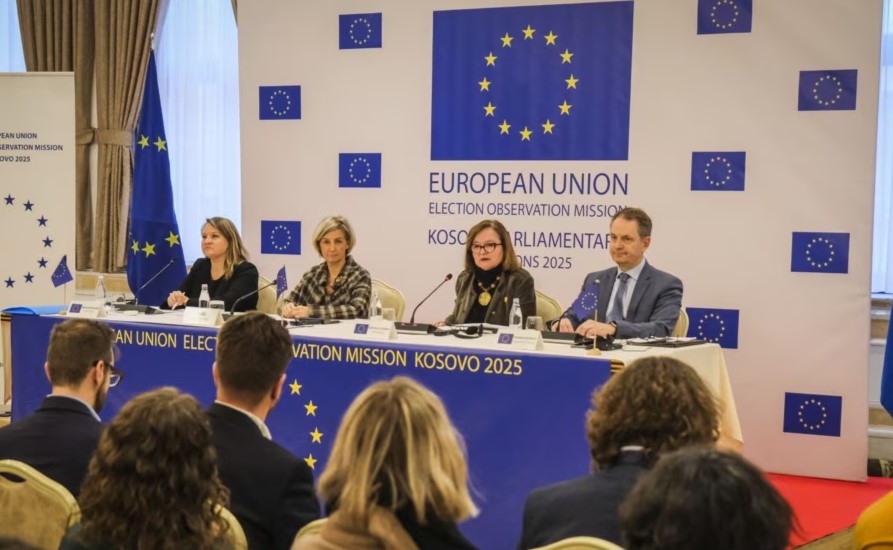
The European Union (EU) observer mission has assessed the February 9 parliamentary elections in Kosovo as positive and peaceful but with some shortcomings.
The ruling party’s negative and inflammatory rhetoric towards the media and judiciary, Serbia’s interference through pressure on Kosovo Serb voters, and criticism from a U.S. official toward Prime Minister Albin Kurti during the campaign were some of the issues mentioned at a press conference on Tuesday in Pristina.
Nathalie Loiseau, head of the EU observer mission in Kosovo, stated that initial findings indicate that election day was calm, voters had good conditions to cast their ballots, and the campaign was highly competitive.
“These are signals that the citizens of Kosovo are committed to democracy,” said Loiseau.
Approximately 40.59 percent of the more than 1.9 million eligible voters in Kosovo cast their ballots on February 9, excluding overseas and conditional votes.
Prime Minister Albin Kurti’s Vetëvendosje Movement won 40.83 percent of the votes, leaving behind opposition parties: the Democratic Party of Kosovo (22.15%), the Democratic League of Kosovo (17.59%), the Alliance for the Future of Kosovo and Nisma coalition (7.47%), and the Serb List (4.43%).
Inflammatory Rhetoric and Media Boycott
However, Loiseau noted that the ruling party, Vetëvendosje, used negative rhetoric against the media and judiciary during the month-long campaign, which lasted from January 11 to February 9.
“This was also reflected on social media. We have observed with concern the negative language from the ruling party against the media and the judiciary. The boycott of specific media outlets and debates has reduced voters’ opportunities to make better choices,” she said.
In early January, international and local non-governmental organizations urged Vetëvendosje to abandon its boycott of certain media outlets.
Vetëvendosje stated that it was not boycotting the media but rather “excluding” three specific channels and that such a decision “did not affect Kosovo’s rich and diverse media landscape.”
The party did not mention names, but previous media organization reactions indicated that the boycott involved major television stations in Kosovo, such as Klan Kosova, TV Dukagjini, and T7.
Loiseau added that polarization and deep divisions were evident in the campaign rhetoric of political parties.
The Election Complaints and Appeals Panel imposed fines amounting to thousands of euros on various political parties throughout the campaign due to their inflammatory language.
Serbia’s Interference via the Serb List
The EU mission chief emphasized that the number of Serbian political parties participating in the February 9 elections was a positive step, but she added that Serbia interfered by supporting only the Serb List – the largest Serbian party in Kosovo, which has traditionally enjoyed backing from Belgrade.
“Many interlocutors reported pressure from Serb List members on voters, and there was ongoing and repeated interference from Serbia,” she said.
A few days before the elections, a Serbian parliamentary candidate told Radio Free Europe that he lost his job after opposing the Serb List.
He claimed that a member of the temporary municipal authority in Skenderaj, Nebojša S. Tomašević, told him on January 27 that “he would ensure he never received another salary from Serbia’s budget because he was a traitor.”
Marta Temido, head of the delegation of European Parliament members, said at Monday’s conference that Serbian authorities interfered by supporting the Serb List.
“We understand that Serbian authorities have seriously interfered by supporting one of the six Serbian parties. Our interlocutors reported that there was pressure on Serbian voters. The lack of genuine political pluralism within the Serbian community is unhealthy,” said Temido.
According to preliminary results, the Serb List won 9 out of 10 reserved seats for the Serbian minority in the Kosovo Assembly, while Nenad Rašić’s Freedom, Justice, and Survival Party secured the remaining seat.
Other Serbian political entities failed to enter the Kosovo Assembly.
U.S. Official’s Criticism of Kurti
Loiseau also mentioned in the preliminary report the criticism directed at Prime Minister Kurti by the U.S. special envoy for specific missions, Richard Grenell, during the election campaign in Kosovo.
“During the campaign, we also witnessed the intervention of the U.S. envoy for special missions, Richard Grenell, on social media, where he criticized Prime Minister Kurti. This could be described as undiplomatic,” she said.
In a post on X on February 3, Richard Grenell stated that the United States needs reliable partners in the Balkans and that Prime Minister Kurti’s government, in his view, was not one of them.
Kurti’s cabinet has not responded to Radio Free Europe’s request for comment on these statements. However, speaking to a Kosovo media outlet, Istogu Channel, he reiterated that relations with the U.S. were at their best level – to which Grenell responded again, saying they had never been lower.
Loiseau also addressed other findings in the preliminary report, such as the difficulties faced by the Central Election Commission during the vote count, as its software repeatedly crashed.
She stated that the EU mission would publish its final report in about two months, including a full analysis and recommendations.




