

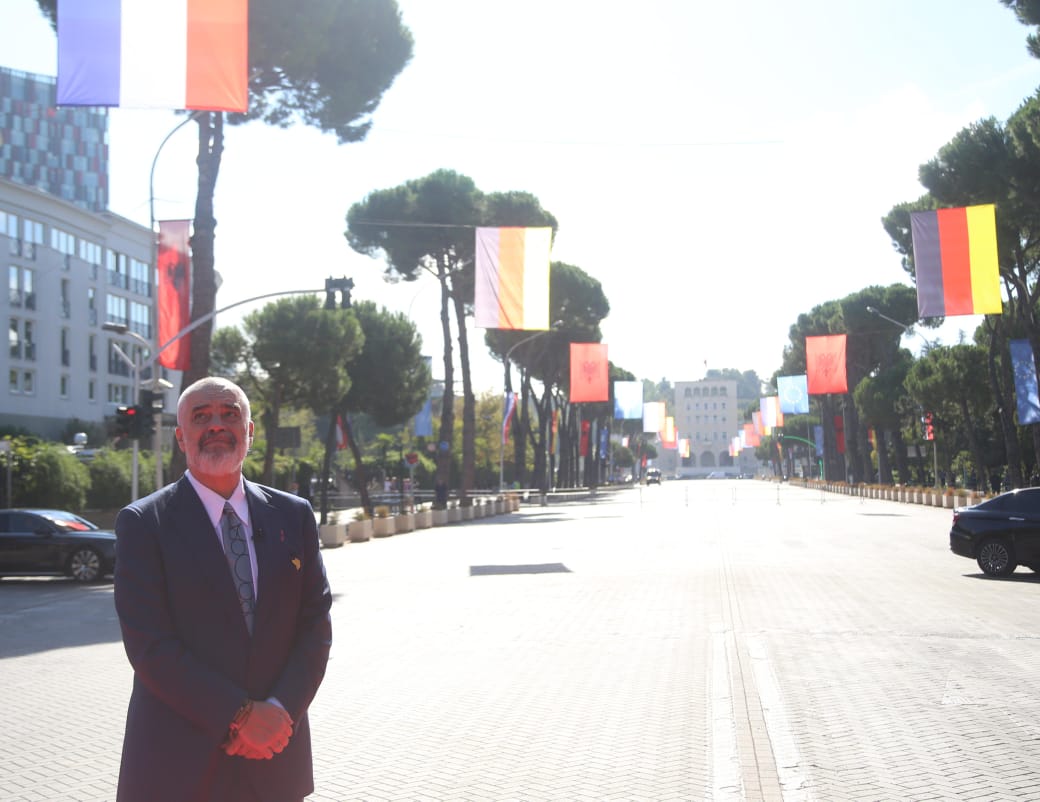
In Tirana, on October 16, the Berlin Process Summit is being held, during which, in addition to presenting a new package of investments from the European Union, discussions are taking place regarding the attack in northern Kosovo on September 24.
The “new growth plan” is a comprehensive investment package by the European Union, which is expected to be unveiled during the proceedings of the Tirana Summit in Albania.
“This plan has the potential, if properly implemented, to double the size of your economy within this 10-year period. The principle is that, in certain specific areas, you will have access to the EU common market, but this requires reforms, and these reforms will be accompanied by investments. This opens the door to our market, to the common regional market in the Western Balkans. Of course, this will be accompanied by financial investments, but reforms will be essential,” stated the President of the European Commission, Ursula von der Leyen, on October 15.
Prior to the summit, von der Leyen said that the meeting would convey a strong message.
“This is a very special summit we have today. I believe it conveys a strong message about how committed we are to the enlargement [of the EU]. One of the key themes will be the economy of the Western Balkans. For this reason, I have presented the growth plan. We want to provide access to the European common market. For this, reforms are needed in the Western Balkans, and those willing to reform will receive financing from the European Union. It is a stimulus for those who genuinely want to move forward. Our doors are open, so let’s work on pushing this growth plan forward,” said the EU Chief.
Charles Michel, President of the European Council, expressed hope that this summit would increase cooperation between the countries in the region, and the EU is concerned about the situation between Kosovo and Serbia.
“We cannot let bilateral conflicts hold us back. The recent tensions between Kosovo and Serbia have brought this to the forefront. There is no cooperation without an agreement. This requires political courage with a focus on the future. This will be the spirit of the next summit in Brussels,” he said.
Dutch Prime Minister Mark Rutte also stated that he would discuss this issue with the Prime Ministers of Kosovo and Serbia.
“We seek a de-escalation of the situation. I spoke with President [of Serbia, Aleksandar] Vučić a few weeks ago. Today, I have the opportunity to speak with the Prime Minister of Serbia [Ana Brnabić] and the Prime Minister of Kosovo [Albin Kurti]. We hope that we can all contribute to de-escalation,” Rutte said.
This is the first time a Berlin Process meeting is organized outside the EU borders. In addition to EU officials and those from the Western Balkans, the German Chancellor, Olaf Scholz, and the President of France, Emmanuel Macron, are also participating in the summit.
The official opening of the summit was made with speeches from the Prime Minister of Albania, Edi Rama, the head of the European Commission, Ursula von der Leyen, and the President of the European Council, Charles Michel.
After the first session, which will focus on the integration of the region into the EU common market and improving convergence with the EU, a working lunch will be held to discuss good neighborly relations and bilateral issues: “Towards a new European paradigm”.
At this working lunch, the tensions between Kosovo and Serbia will be discussed, as an armed group of Serbs attacked Kosovo’s Police on September 24, resulting in the death of officer Afrim Bunjaku.
This attack, for which Kosovo accuses Serbia – but for which Belgrade claims no involvement – has been strongly condemned by the EU and the United States.
On Sunday, the President of the European Commission, Ursula von der Leyen, declared in Tirana that “Kosovo and Serbia must return to dialogue, and the only way to normalize relations is the Ohrid Agreement”.
She referred to the Agreement on the normalization of relations reached in February in Brussels and in March in Ohrid. Kosovo and Serbia reached an agreement on its Implementation Annex.
The Berlin Process Summit is expected to include the signing of a regional agreement for the mutual recognition of professional qualifications.
In the late afternoon, at 17:30, a joint press conference will be held, featuring the Albanian Prime Minister, the German Chancellor, and the President of the European Commission.
The Berlin Process, initiated in 2014 by former German Chancellor Angela Merkel, aims to support the economic development of the six Western Balkan countries and bring them closer to the European Union.
This initiative serves as a platform for high-level cooperation between official representatives of the Western Balkans Six, which includes Albania, Bosnia and Herzegovina, Montenegro, Kosovo, North Macedonia, and Serbia. The process also involves EU institutions, international financial organizations, and civil society in the region.




