

The European Union reiterated Thursday that no sanctions or restrictive measures have been imposed on Kosovo, emphasizing the need to respect the established framework and procedures within the EU.
Instead, temporary measures and instruments are being employed to demonstrate the seriousness of the EU’s efforts in reducing tensions.
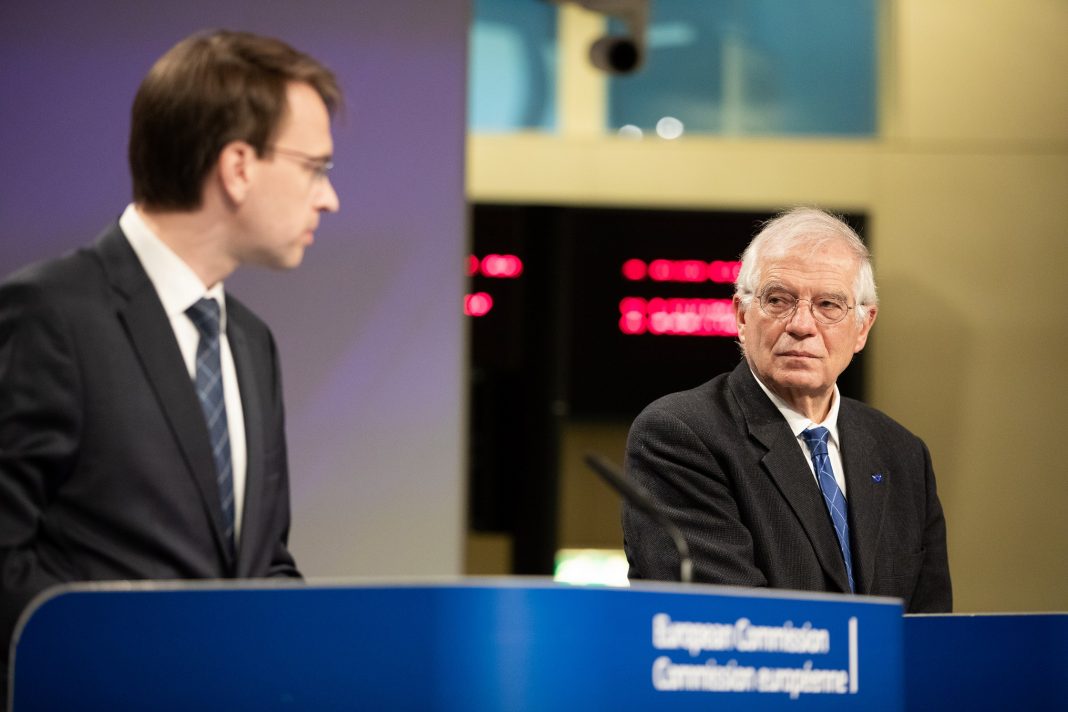
Peter Stano, the EU Spokesperson for Foreign Affairs and Security Policy, made these remarks during a press conference at the European Commission headquarters in Brussel.
Stano reiterated that these measures are temporary and will be lifted from the agenda once Kosovo’s Prime Minister Albin Kurti takes the necessary steps to deescalate tensions. He acknowledged that some of these measures were not easy for the EU to approve, but they were undertaken because “it was observed that there were no steps towards de-escalation”.
“These are instruments we use to demonstrate that the EU is serious when it says it expects the situation to de-escalate and reacts when such de-escalation does not occur,” Stano stated.
When asked about the EU’s responsibility for not fulfilling its promises to ensure the participation of the Serb List in local elections, considering that Kosovo had agreed to postpone them and accepted the Annex on the implementation of the agreement during the Ohrid meeting, Stano replied that the focus should now be on de-escalation and that such developments are not observed on the ground.
Regarding the Agreement and Annex reached in Ohrid, which President Vučić stated he would not fully implement, Stano stated that “High Representative Borrell made a statement after the Ohrid meeting, with which both parties agreed, and it has never been withdrawn”.
Therefore, according to Stano, the implementation of the Ohrid Agreement and Annex remains an obligation.
“There is a clear link between the implementation of the Annex and the European path. If the parties’ statements on whether they accept the agreement or not are followed by actions, this will be reflected in their integration process into the EU. If we are unable to break free from this circle of tensions, then the consequences will affect both parties,” he said.
The European Union has prepared initial measures, including sanctions against Kosovo due to the government’s failure to respond to the immediate steps requested for de-escalating tensions in the north.
Tensions in the north have escalated since May 26th, when the Kosovo Police assisted Albanian mayors of the municipalities of Zvečan, Zubin Potok, and Leposavić in taking control of municipal buildings, despite local residents’ resistance.
Tensions reached their peak on May 29th when local Serbs clashed with NATO’s Kosovo Force (KFOR) soldiers. Dozens of people were injured from both sides as a result of the clashes.
The Albanian mayors were elected on April 23rd in elections that were boycotted by Serbian parties and the local population.




