

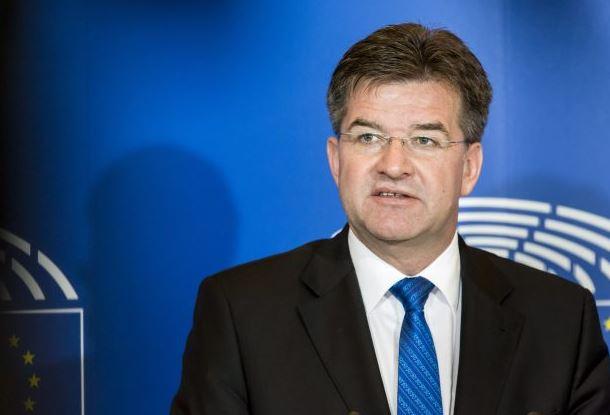
The Special Envoy of the European Union for the dialogue Miroslav Lajčák is expected to visit Kosovo and Serbia this week, possibly starting from Tuesday, in an effort to de-escalate the situation in northern Kosovo and persuade parties to return to dialogue.
This information was reported by Radio Free Europe, although it has not been officially confirmed by the EU yet.
In Pristina, Lajčák is expected to meet with Prime Minister Albin Kurti, and in Belgrade with Serbian President Aleksandar Vučić.
The EU continues to reiterate calls for both parties to take immediate steps to de-escalate the situation and return to the dialogue for the normalization of relations, mediated by Brussels. These calls were also made during the recent summit of EU leaders held last week in Brussels.
The EU demands the withdrawal of special units of the Kosovo Police from the vicinity of municipal buildings in the north, parallel to the withdrawal of Serbian protesters. Additionally, the European bloc is requesting the withdrawal of the newly elected mayors from municipal buildings, the announcement of elections in the north, and a public commitment from Serbs to participate in the elections.
Due to the non-compliance with these requests, the EU has initiated several punitive measures against Kosovo. However, the EU has stated that they are “ready to take measures against Serbia as well if we assess that it is not acting as expected”.
EU officials have stated that they communicated the punitive measures to Kosovo on 28 June. These measures include the temporary suspension of the work of bodies created under the Stabilization and Association Agreement, the non-invitation of Kosovo to high-level meetings, and the suspension of bilateral visits, except those focused on addressing the crisis in northern Kosovo within the framework of the EU-facilitated dialogue.
Other measures also include the cessation of programming funds for Kosovo from IPA 2024 (Instrument for Pre-Accession Assistance). Kosovo’s proposals within the framework of the Investment Framework for the Western Balkans have also not been submitted for consideration by the board on 29 and 30 June.
Since tensions escalated in the north at the end of May, there have been no dialogue meetings between Kosovo and Serbia.
Kurti and Vučić have had several “crisis meetings” in Brussels, but they have not held bilateral meetings. Separate meetings between the leaders of Kosovo and Serbia with EU’s High Representative for Foreign Affairs and Security Policy Josep Borrell have concluded without concrete results.
Tensions in northern Kosovo, predominantly inhabited by Serbs, began on 26 May when newly elected Albanian mayors of Zvečan, Zubin Potok, and Leposavić entered municipal buildings under the escort of the Kosovo Police. The Serbs opposed this and have since been protesting, demanding the withdrawal of the new mayors and special police units.




