

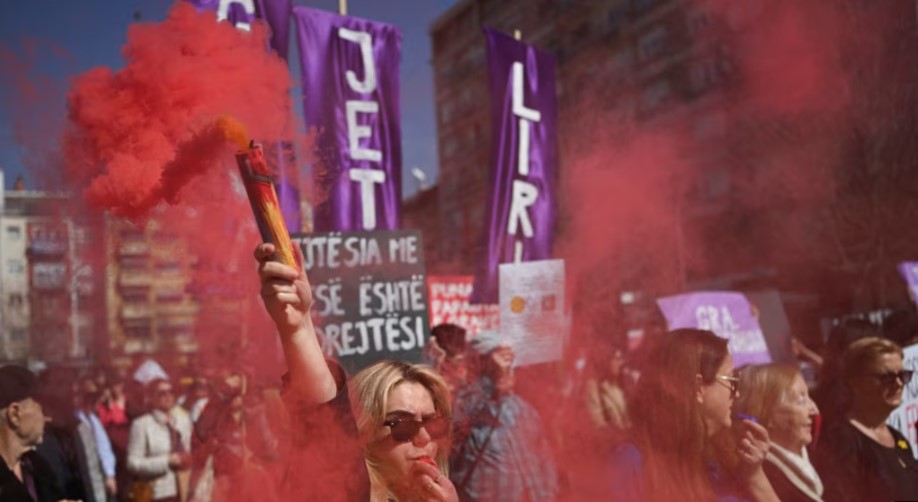
With the slogans “We march, we don’t celebrate. We protect one another,” a group of people protested on Sunday in Pristina on International Women’s Day, demanding more rights, equality, and justice for women.
The protesters marched at midday from Zahir Pajaziti Square toward the Kosovo Prosecutorial Council, the Kosovo Police, and the Judicial Council, ending in front of the Government of Kosovo building in Skanderbeg Square.
The organization “We March, We Don’t Celebrate”, which organized the protest, said that March 8 is a day that recalls the revolutionary origins of the women’s movement and the need to continue efforts against inequality and violence.
They said there is still much work to be done to fight femicide and the different forms of violence against women: physical, emotional, economic, and sexual.
In their statement, the organizers also mentioned domestic violence, sexual harassment in public spaces, and the distribution of intimate photos online without consent as some of the problems women in Kosovo face.
They also criticized institutional decisions that, according to them, limit the rights of women and girls.
The protest took place at a time when women in Kosovo continue to face challenges in the labor market, property inheritance, and protection from violence.
According to data from the Kosovo Agency of Statistics (ASK), about 80 percent of women in Kosovo are not part of the labor market. The same data shows that men are employed at significantly higher rates than women.
Similar inequalities are also seen in property ownership. According to the Kosovo Cadastral Agency, less than one fifth of properties in the country are registered in women’s names.
Meanwhile, according to estimates from the United Nations, one in three women worldwide experiences violence during her lifetime, and every 10 minutes a woman is killed.
In Kosovo, around 60 women have been killed since 2010, and in most cases the perpetrators were their husbands or former husbands.
According to organizations dealing with women’s rights, light sentences for abusers often send “encouraging” messages to perpetrators of violence.
On International Women’s Day, commemorative activities were also held in Pristina.
The Speaker of the Assembly of Kosovo, Albulena Haxhiu, together with deputies from the Vetëvendosje Movement, paid tribute at the “Heroinat” memorial.
Haxhiu said that on this day the remembrance of survivors of sexual violence during the war in Kosovo becomes even deeper.
“Let us also remember the sacrifice of survivors of sexual violence during the last war in Kosovo, as well as all the women who have contributed to the Republic of Kosovo before, during, and after the war,” Haxhiu said.
Similar to Pristina, protests and marches for equal rights were held in many places around the world to mark International Women’s Day on March 8.
This day is marked by protests and activities focusing on gender equality, reproductive rights, and ending violence against women.
Among other demands, protesters call for fighting femicide, protecting reproductive rights, equal pay, and greater representation of women in politics.
International Women’s Day has its roots in labor movements of the early 20th century, including the 1908 protests of textile workers and the “Bread and Peace” march in Petrograd in 1917.
In many countries, protests are also accompanied by symbols of the feminist movement. In some Latin American countries, for example, protesters wear green scarves to symbolize support for women’s reproductive rights.




