

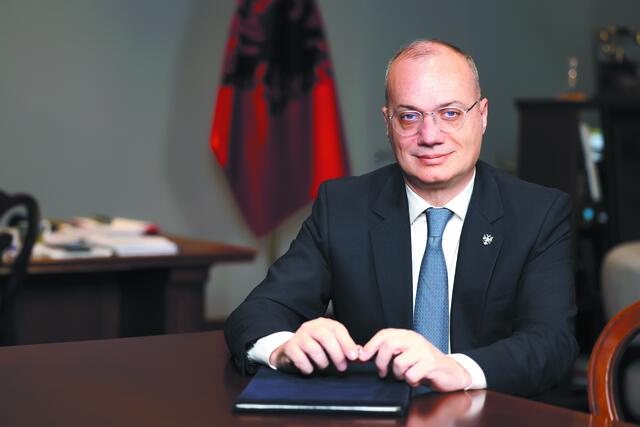
The Minister for Europe and Foreign Affairs, Igli Hasani, gave an interview to the Greek newspaper “Tanea” ahead of his upcoming visit to Athens, which is expected to take place next Tuesday.
In this interview, Hasani emphasized that Edi Rama’s government is “open and fully committed to fostering dialogue on all unresolved bilateral issues.”
He expressed optimism about the future of Greek-Albanian relations, highlighting the readiness for dialogue and cooperation.
Regarding the issue of delimitation of maritime zones, the minister emphasized that the Albanian government engages in discussions in a spirit of mutual respect and with the aim of reaching fair and sustainable solutions that reflect shared interests for good neighborly relations and regional stability.
Concerning Edi Rama’s electoral victory, Hasani noted that the strong support from Albanians living in Greece is a testament to their continued trust in the Prime Minister’s leadership and the government’s commitment to deep reforms, as well as in the shared vision for Albania’s European future.
Full interview
How do you attribute the high percentage of votes that Edi Rama received through postal voting from Albanians living in Greece?
The strong support from Albanians living in Greece reflects their continued trust in Prime Minister Rama’s leadership, the government’s commitment to deep reforms, and our shared vision for Albania’s European future. It also highlights the unshakable bond between our diaspora and the country’s democratic and developmental progress.
Is it true that the issue of maritime zone delimitation will be at the top of the agenda in your upcoming meeting with your Greek counterpart in Athens on June 3? Should we expect the next step to be, as agreed in 2020, the submission of this dispute to the International Court of Justice in The Hague?
The Albanian government remains open and committed to advancing dialogue on all unresolved bilateral issues. We engage in these talks with a spirit of mutual respect, aiming to reach fair and sustainable solutions that reflect our common interest in good neighborly relations and regional stability.
Through ongoing dialogue and constructive engagement, we believe it is possible to address all relevant issues in accordance with international norms — based on the deep historical ties and geographical proximity that have connected our peoples for generations. These enduring connections have helped shape a relationship that must continually be guided by cooperation and mutual understanding.
What other issues do you consider unresolved in Albanian-Greek relations, and will you address them during your official visit to Greece?
Albanian-Greek relations must continue to develop in a positive and forward-looking spirit, rooted in strategic partnership, close cooperation in NATO, and our shared European aspirations. Greece remains an important partner for Albania, and we value the progress achieved so far.
Our peoples have lived alongside each other for centuries, sharing borders, experiences, and countless social and cultural exchanges. This closeness has created a deep human connection that transcends politics and underscores the importance of resolving all issues through dialogue.
My visit to Athens on June 3 is an opportunity to build on this foundation and reaffirm our shared commitment to open and constructive dialogue. By continuing to engage in good faith, we believe that unresolved issues can be addressed in a way that reflects our shared values and contributes to regional stability and integration.
In which areas have you received the most support from Greece in recent years, and which new areas of cooperation would you like to develop during Edi Rama’s fourth term?
Albania and Greece enjoy strong cooperation across various sectors. We especially value Greece’s long-standing support for Albania’s European integration, as well as cooperation in energy, trade, regional initiatives, and multilateral platforms.
Looking ahead, we see great potential to deepen this partnership. With Albania at a key stage of EU accession — with four negotiating clusters already opened — this is the right moment to strengthen ties not only in the European context but also in areas such as infrastructure, renewable energy, and people-to-people exchanges. Continued support from Greece will remain essential as we work to bring our countries and societies closer together.
Do you believe it is possible for Albania to become an EU member even before 2030? In which areas do you think the greatest progress needs to be made in the near future?
Albania is on a secure path toward EU membership. Following deep reforms, we are now in a decisive phase of the accession process, with four negotiating clusters already opened. Progress in key areas — such as the rule of law, democratic governance, and public administration — has laid a strong foundation.
We are committed to accelerating reforms, particularly in judicial integrity, economic modernization, and institutional strengthening. Our goal is to begin closing chapters soon and to complete negotiations by 2027, preparing Albania for membership in 2030.
While the process is demanding, it offers a transformative framework for modernizing our institutions and economy, as well as for building a resilient democratic society. More than two decades after the Thessaloniki promise, the time has come to inject new momentum into the enlargement process — not just for Albania, but for the entire Western Balkans. This is a strategic necessity for both the EU and the region.




