

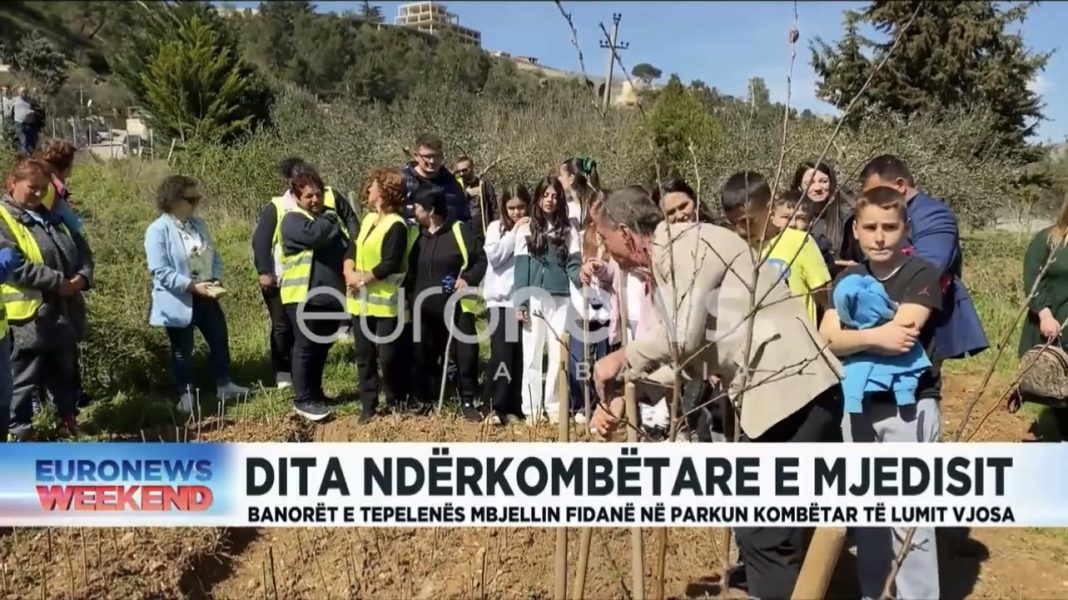
On the International Day of Forests, reforestation and planting of new trees has started in the Vjosa River National Park.
Inhabitants of the city of Tepelena, school students, representatives of the local government, environmental specialists, etc., as a symbolic sign have started the cultivation and planting of new seedlings along the banks of Vjosa, bringing more value to nature and ecotourism.
The project with the logo “ReForestVjosa” aims to start reforestation in 10 key points by enabling the planting of trees on an area of 12 hectares of the Vjosa National Park.
“To bring back the alluvial forest and the coastal forest along the Vjosa river, of course this is an idea that requires work, requires commitment and definitely requires sufficient training time, to regenerate the forests and we have started it right here in Tepelena where we have set up a nursery, which will produce seedlings suitable for planting in Vjosa Park”, said Olsi Nika, environmental expert.
“I think that the impact will be very big for the ecotourism of the area. Tepelena Municipality has already started and we are probably the gateway and we have said it often and we have almost become a tourist destination for family mountain tourism. I think that there will be a very special importance and an added value of ecotourism in the entire territory of the Tepelen Municipality”, said Tërmet Peçi, mayor of the Tepelen Municipality.
The reforestation of the Vjosa river avoids human damage to the tree-lined areas along the park and would stabilize the erosion situation in the river bed, which is problematic for the erosion of agricultural lands.
“It will affect the minimization of erosion in which the Vjosa, being a dynamic river, we know, we are witnessing that it has a very high level of erosion and precisely the installation of the coastal forest would stabilize this phenomenon and then a series of effects that extend to the coast” said Olsi Nika, environmental expert.
“This project as its object has the banks and the bed of Vjosa in those areas where floods accumulate alluvium and suitable conditions are created for the installation of vegetation. We have selected 10 such objects in which the forest is currently missing, but historically the forest has existed on these surfaces, but the human factor with its abusive actions has caused them to disappear and we want to restore the forest”, – Mihallaq Qirjo, environmental expert.
Vjosa and its main branches have a length of about 400 km, while they are ecosystems of considerable biodiversity and are home to over 1100 species of animals. The Vjosa National Park is an important resource for the development of tourism in the south of the country.