

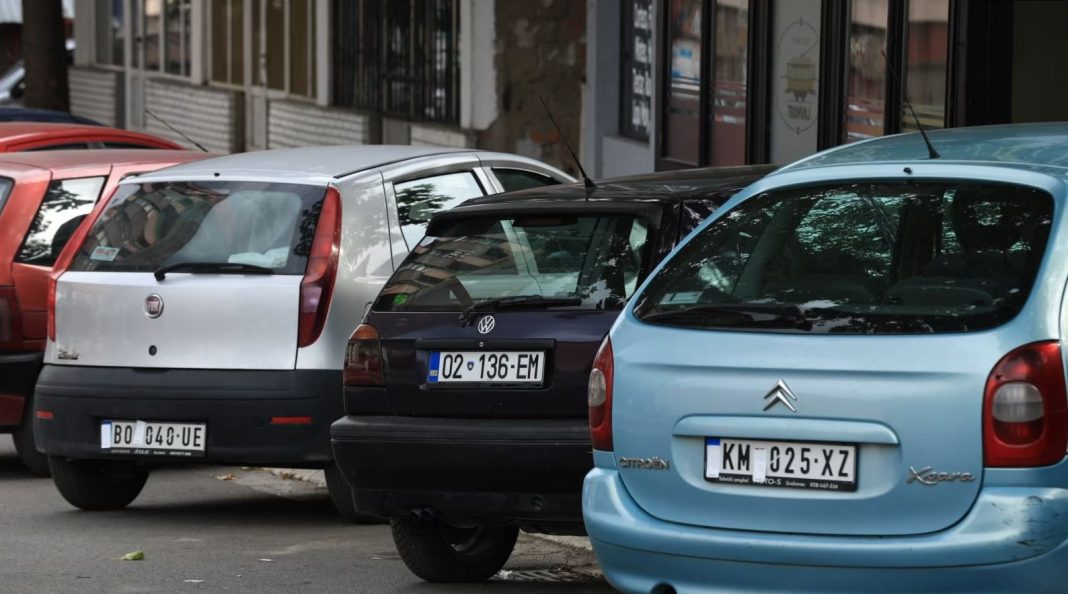
Starting from December 16, citizens who have not registered their vehicles in RKS – the Republic of Kosovo, will not be allowed to circulate within the territory of Kosovo with license plates bearing Serbian acronyms, which the state considers illegal.
Today marks the last day for all owners with plates such as KM, PR, PZ, DE, UR, and others to return them as plates of the Republic of Kosovo, confirmed Nora Fetoshi, spokesperson for the Ministry of Internal Affairs, to Radio Free Europe.
“After the end of this deadline, that is, after December 15, citizens who do not register their vehicles even after the decision determined by the Government of the Republic of Kosovo will be considered owners of unregistered vehicles, and their vehicles will not be allowed to circulate in the territory of the Republic of Kosovo, including border crossings as envisaged by the current legislation. The vehicles will be stopped by the traffic police, fined for traffic violations, and the plates will be removed from the vehicle. If the same vehicle is found in circulation again, it will be confiscated,” said Fetoshi.
The deadline for converting license plates should have ended on December 1, but the Government of Kosovo had extended it for an additional 15 days after long lines were observed in front of registration centers.
License plates with acronyms such as KM and other Serbian acronyms for the cities of Kosovo have been issued by Serbian authorities and are considered illegal by authorities in Kosovo.
According to the Government of Kosovo, from November 1 to December 14, 3,405 citizens have converted their license plates to RKS, and the municipalities with the highest number are North Mitrovica and Leposavic.
“Meanwhile, from the entire process since last year, there have been a total of 4,210 plate conversions,” Fetoshi announced, emphasizing that “in addition to financial facilitations, in the previous period, we also changed the administrative instruction so that citizens of our Serbian community in the north can register their vehicles with the plates of the region at all Vehicle Registration Centers regardless of their residence or location”.
According to the Government of Kosovo, this entire process aims at legality and traffic safety.
The circulation of vehicles with such plates has been tolerated so far in the north, while in areas inhabited by Serbs in the south of the Ibar, they had been removed from use more than ten years ago.
According to estimates from the Serbian civil sector, in the municipalities in the north of Kosovo, predominantly inhabited by Serbs, there were around 10,000 vehicles with KM plates.
The issue of KM plates has caused a crisis in the north, leading to protests, the withdrawal of Serbs from institutions, and the setting up of barricades.
Tensions in the north escalated on September 24 of this year with an armed attack against the Kosovo Police by a group of local Serbs, resulting in the death of one Kosovo police officer and three Serb attackers.




