
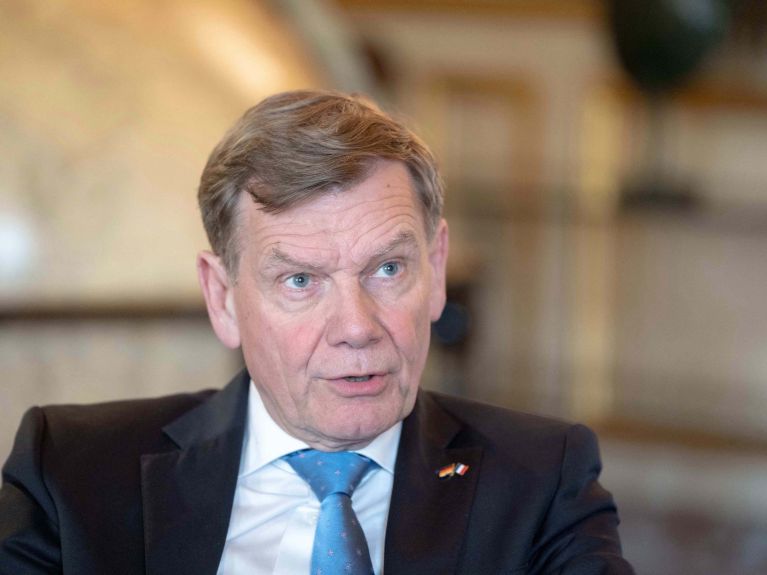
The German chief diplomat, Johann Wadephul, has called for Kosovo to have, as soon as possible, a government capable of acting both domestically and internationally.
After meeting with Kosovo’s President Vjosa Osmani, the German Foreign Minister said that such expectations after the February parliamentary elections are reasonable. According to him, for some in the region, Kosovo is considered a symbol of democracy and a strong civil society.
“In order for this success to continue, Kosovo needs to have a government that can act both internally and externally as soon as possible. Voters have been waiting for its formation for eight months. They have reasonable expectations that these democratic processes should conclude positively, and this includes having a stable government,” he said.
His call for a new government comes just one day before the constitutional deadline expires for Glauk Konjufca of the Vetëvendosje Movement to present the composition of the new executive before the Assembly.
Konjufca, who is the second nominee tasked with forming the Government, needs 61 votes to establish the new cabinet. The leader of his party, Albin Kurti, had previously failed to secure these votes in the Assembly.
Wadephul said that Germany supports the dialogue for normalizing relations between Kosovo and Serbia, but admitted that the process has recently stalled.
“It is extremely important for concrete progress to be made soon. The Ohrid Agreement, which contains all the relevant elements for normalization, must be implemented quickly and in full. We expect this from both sides, and it requires more engagement from Kosovo and Serbia,” he stated.
Kosovo and Serbia reached the Agreement on the path to normalization, known as the Ohrid Agreement, in 2023, but the pact has not yet been implemented. Although the agreement was not signed, the European Union insists that it is binding for both parties.
According to the EU’s chief diplomat, Kosovo is expected to take steps towards establishing the Association of Serb-Majority Municipalities. Regarding the dialogue, President Vjosa Osmani said that the country remains committed to the process.
“As long as Kosovo remains under EU-imposed measures, the EU-facilitated dialogue cannot be considered balanced, principled or equal,” she said.
Osmani requested the lifting of the punitive measures the EU imposed on Kosovo in the summer of 2023 due to tensions in the northern, Serb-majority areas, as well as Germany’s support for the country’s European integration.
Wadephul, who is visiting countries in the Western Balkans region, pledged that Germany will continue to support Kosovo on its European path, stating that EU enlargement is a “geopolitical urgency.”
“All of us, whether EU members or not, must make it clear to Russia that destabilization, disinformation and manipulation have no place on our continent. We respond to destabilization attempts with a united Europe. In this context, EU enlargement is now a geopolitical urgency. For the first time in many years, there is a realistic perspective,” he said.
Among the countries in the region, Kosovo is the only one that has stalled in the EU integration process, as it remains the only country without candidate status. Kosovo applied for EU membership in December 2022. However, the application has not yet passed even the first formal stage—review by the EU Council and then referral for an opinion to the European Commission. /RFE/