

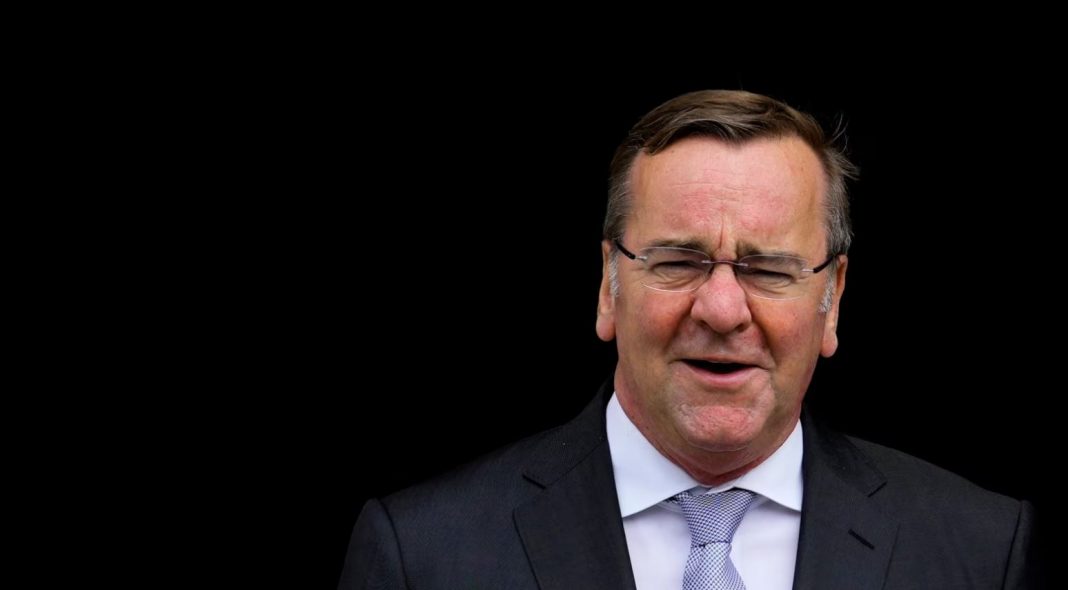
The German Minister of Defense, Boris Pistorius, said on Monday that Kosovo has the right to enforce legality by adopting the euro as its sole currency, but, according to him, time should be given for the implementation of the regulation of the Central Bank of Kosovo (CBK).
Pistorius, who is staying in Kosovo for an official visit, spoke at a press conference in Pristina, alongside Kosovo’s President, Vjosa Osmani.
The CBK regulation – which came into force on February 1 – stipulates that the sole currency for payments in Kosovo shall be the euro.
In this way, Kosovo Serbs are prevented from using the dinar.
“I believe it is better to implement the regulation, but to give a longer period for its implementation,” the German minister said.
According to him, the establishment of the euro as the sole currency should be communicated appropriately, “so that no one is afraid and uninformed”.
On the other hand, Kosovo’s President, Vjosa Osmani, said “our allies have never been in favor of the Serbian dinar, and they have not been against the rule of law”.
She said that the CBK regulation is not against the dinar.
“I don’t see anything abnormal in the cooperation between the institutions of the Republic of Kosovo and our international allies in finding very effective ways through which the citizens of the Republic of Kosovo will be informed about how the CBK regulation will be implemented”.
The German minister called for a de-escalation of the situation between Kosovo and Serbia, urging a return to the dialogue mediated by the European Union.
“We, considering the current tensions with Serbia, and the Serbian minority in Kosovo, make a clear call for maturity and care,” Pistorius said.
He added that “Kosovo must contribute to the de-escalation of the situation, but also the role of Serbia is a special one”.
Pistorius said that calls for dialogue and de-escalation will also be made during his visit to Serbia.
“As for the relations between Serbia and Kosovo, the demand of the day is de-escalation. Chancellor [German, Olaf Scholz] has emphasized that the future of the Western Balkans is in Europe, but this presupposes as a condition the dialogue and no one should and cannot have an interest in further tension of the situation”.
During Monday’s press conference, Osmani said Serbia’s state policy “constantly challenges the territorial integrity of Kosovo and engages in acts of aggression against Kosovo”.
She added that “to prevent these attacks in the future, we need the support of Germany, as well as other Euro-Atlantic allies and partners”.
Osmani said it is time for Kosovo to join NATO, starting with the Partnership for Peace.
“Such a step would have a positive impact on security, peace, and stability throughout the entire Western Balkans region,” she said.
In Pristina, Boris Pistorius promised support for Kosovo on the European path while emphasizing that visible progress is needed in Kosovo-Serbia relations.
“This is important for the region, Kosovo, and all of Europe”.
Pistorius said that Germany, after the United States, is one of the largest supporters of Kosovo both civilly and militarily.
“And, this will be the case in the future, I assure you,” he said.
Meanwhile, Osmani mentioned the attack on September 24th in Banjska, north Kosovo, when last September a group of armed Serbs attacked the Kosovo Police, killing officer Afrim Bunjaku.
She said that since then, Serbia has not stopped supporting terrorist and paramilitary groups.
“All the evidence we receive from our security institutions shows that Serbia continues to plan new attacks. What I want to assure the citizens of Kosovo is that Serbia will not succeed,” Osmani said.
In the exchange of fire in Banjska, three Serbian attackers were also killed.
Milan Radoičić, former deputy chairman of the Serb List – the main party of Serbs in Kosovo supported by Serbia – has taken responsibility for the attack.
Kosovo accuses Serbia of being behind the attack, which official Belgrade denies.




