

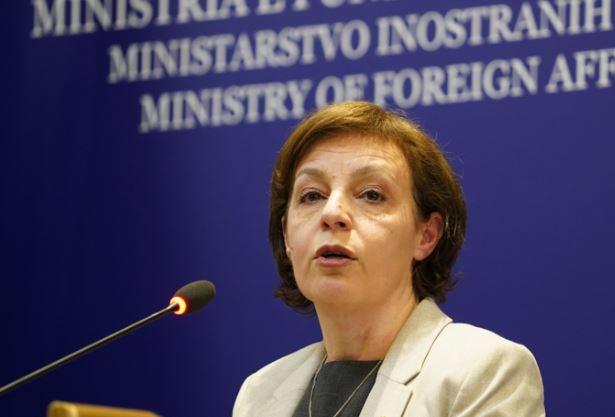
Kosovo’s Foreign Minister Donika Gërvalla-Schwartz stated in an interview with Voice of America that accepting the Ohrid Agreement, which secures Kosovo’s recognition “de facto” and not “de jure”, is the biggest compromise Kosovo has made. However, she emphasized that there hasn’t been any assessment of this compromise. Minister Gërvalla mentioned that Kosovo’s institutions have expressed dissatisfaction internally regarding how the European Union envoy, Miroslav Lajčák, has been leading the negotiations with Serbia, but she added that “the cup has run over” last week.
Part of the Minister’s interview with VOA
Voice of America: Mrs. Gërvalla, the European Union has made a clear and unequivocal call to Kosovo to start the work on establishing the Association of Serb-majority Municipalities without delay and without conditions. What are your Government’s plans?
Donika Gërvalla-Schwartz: The Government of the Republic of Kosovo, in fact, the institutions in general, have committed and accepted a proposal, initially called French-German, which implies the de facto recognition of Kosovo by Serbia. This agreement that we have agreed upon, both in Brussels and later in Ohrid, both parties, Serbia and Kosovo, this is our guide towards an agreement for normalization. Now, if Kosovo remains the only party that insists on implementing this agreement, which we agreed to, with all the hesitation we had about its content, then we remain the sole party defending this agreement. We ask ourselves where those who proposed it are and why the strategy changed along the way? Why are there now new demands and plans, and why aren’t we seriously implementing this agreement, which has been termed a historic agreement by some commentators?
Voice of America: Nevertheless, Mrs. Gërvalla, in the Ohrid Agreement, which your Government agreed to, there is no provision for Serbia to recognize Kosovo. Is this a change in your stance?
Donika Gërvalla-Schwartz: Yes, exactly. The fact that we initially agreed to proceed with an agreement that establishes de facto recognition, not de jure, of the Republic of Kosovo is the biggest compromise we have made. However, so far, we haven’t seen any assessment of this compromise we have made. This strengthens our position that we should be very cautious about the promises we make and the agreements we reach, their content, and the various guarantees provided around these agreements.
Voice of America: Mrs. Gërvalla, after the failure of negotiations last week, the European Union announced stricter punitive measures against Pristina. Are you concerned about this?
Donika Gërvalla-Schwartz: It’s not last week or the first time that the European Union’s representative in the dialogue, Miroslav Lajčák, has shown a clear bias in a dialogue process where the European Union should be impartial to ensure that both parties feel represented. We have expressed our dissatisfaction internally several times about how Miroslav Lajčák leads this dialogue. Last week, the cup ran over. So, there has been a very open stance by Lajčák in favor of Serbia. Documents presented as if they belonged to the EU were actually Serbian. Therefore, for us, it has become impossible to continue this process in this form. We have called on the European Union several times through our channels to be more careful so that this dialogue has a chance of success. So far, we haven’t seen the necessary diligence.
Voice of America: Mrs. Gërvalla, when you said that the cup has run over, do you mean that Pristina would not negotiate with Serbia anymore if Mr. Lajčák remains the mediator? Are you seeking his removal from the negotiations with Serbia?
Donika Gërvalla-Schwartz: We have never given ultimatums to anyone, especially not to our partners and allies. We seek a strategy in the dialogue that promises success because going to Brussels to achieve nothing is not the right approach. The institutions of the Republic of Kosovo in the 2021 elections pledged to offer a different climate for economic development, rule of law, fight against corruption, and economic growth. These are our primary goals. Of course, it would be ideal if we could normalize relations with Serbia as well because we are not naive, and we see the increasingly tense geopolitical situation in Europe. However, normalization implies that both parties are interested in it. We don’t see that interest coming from Serbia. On the contrary, we see an interest in using the Kosovo issue to hold onto power in Serbia. On the other hand, from the European Union mediator, we don’t see the necessary determination to find a solution acceptable to both parties.
Voice of America: Mrs. Gërvalla, your Government has taken steps to ease tensions in the north, such as reducing the presence of special police units and expressing readiness for elections. But the European Union has called them insufficient. What more can we expect from you, and are you willing to do so?
Donika Gërvalla-Schwartz: This is also part of the problems we have with Lajčák because if we accept commitments and say that they are sufficient for easing tensions, and then along the way, they change their mind, then we don’t know what the European Union’s strategy is. In fact, we haven’t received clear and specific demands regarding what easing tensions in the north of our country means. If you go to the northern municipalities today, you will see that the situation is calm; it is not tense at all. People have moved away from the streets; institutions continue their work, and we have opened the way for new elections. Now it’s up to Serbia, up to the Serbian representatives in Kosovo, up to the European Union and our partners to fulfill what has been requested. We have done everything necessary from our perspective. We have not only fulfilled but over-fulfilled the requirements we have been given. If not, then we don’t need general statements about the need for easing tensions; we need specific points on what easing tensions means because we are receiving different ideas and views from various channels, which only complicate the situation.




