

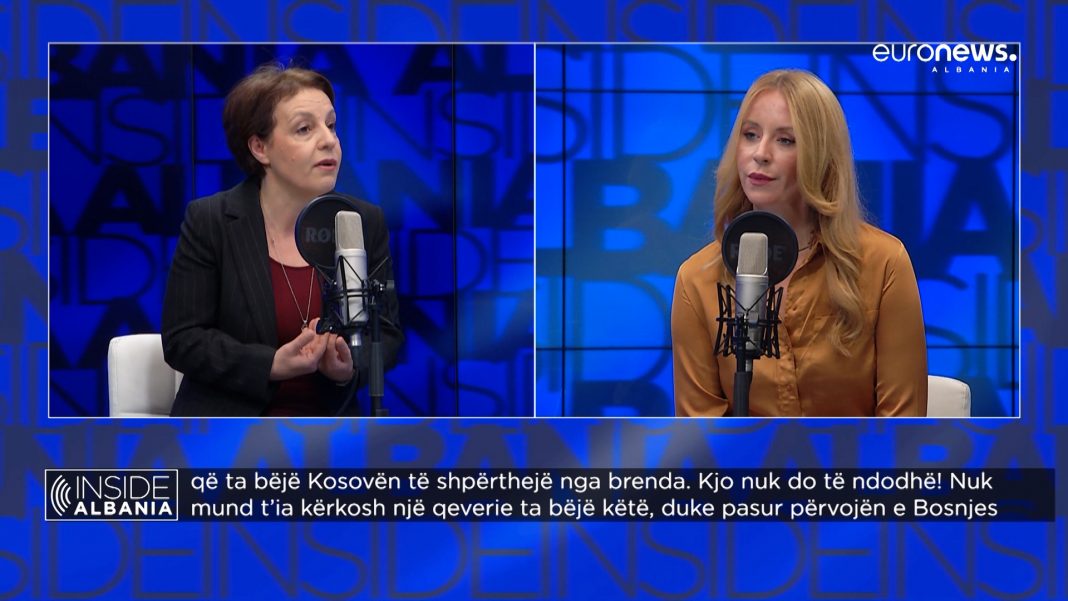
Kosovo’s Foreign Minister Donika Gërvalla-Schwarz declared in an interview to “Inside Albania” by Alice Taylor on Euronews Albania that the September 24 attack in Banjska was an open aggression from Serbia towards a neighbor country and that should not go unpunished.
On September 24, armed groups situated in the northern region of Kosovo launched an assault on Kosovo’s Police forces, resulting in the tragic death of officer Afrim Bunjaku.
Five days following the attack, responsibility for organizing it was claimed by Milan Radojičić, the former deputy leader of the Serb List, which is the largest Serbian political party in Kosovo.
In the interview for “Inside Albania”, Minister Gërvalla highlighted that despite Serbia not showing efforts in the dialogue to normalization, it remains the only solution for Kosovo.
The head of the Kosovar diplomacy reiterated her disappointment at the EU’s special envoy for the Kosovo-Serbia dialogue, Miroslav Lajčák.
Regarding the proposal of Albanian Prime Minister Edi Rama for the dialogue to be elevated to an international conference level, Gërvalla described it as “dangerous”.
September 24 was an “open aggression from Serbia”
Euronews Albania: The European Union came out with a statement; they didn’t initially refer to what happened on Sunday as a terrorist attack. You reacted quite strongly to that, you criticized Borrell for this. And then in a subsequent statement, they did call it a terrorist attack. From what I see the US has not so far called it a terrorist attack. What I want to understand from you is what are the international community saying to you about the incident on Sunday? Have you spoken to U.S. colleagues about the terminology they’re using as well?
Donika Gërvalla: I will start with Sunday. It was a clear terrorist attack on Kosovo, on our sovereignty. It was an open aggression from Serbia. And it was not a surprise for us, because we have seen the moves all these months, we have tried to talk to our partners, allies and friends, so that they would help us to prevent such actions. What happened on Sunday is sad, because one police officer lost his life on duty.
But what happened on Sunday is really no surprise at all, for our institutions. Maybe not the amount of weapons that have been found, maybe not the amount of the uniforms that have been found. But it was clear for us that Serbia is not interested at all, in being active in the process of dialogue in Brussels, that they are acting to be interested and at the same time blocking every progress in this dialogue process, so that they could continue with the other plans that they had.
I hope and believe that Sunday has made clear for everybody, that this kind of dialogue, this kind of one-sided pressure put all on Kosovo, and having so much understanding for the inability of Serbia to be positive on this process, will end and should end.
It’s clear. Kosovo is not interested in having war with anyone. The answer can only be dialogue, but how this dialogue is designed is very crucial for the progress and for the success that we want to achieve.
The United States refrain from calling the attack “terrorist”
Euronews Albania: But in terms of the U.S. who have not yet used as far as I’m aware, so far, the word “terrorist” when describing the incident. Have you had dialogue with them about this about pushing them to use this term to call it what it is?
Donika Gërvalla: The Ambassador of the United States to Kosovo has been a very clear voice at the morning of Sunday, in telling everybody what is happening in Kosovo. I have seen no doubt in his voice and in his words. There was a second statement of the same ambassador. And again, he has left no space for doubts. You are right. The first statement of Mr. Borrell was really a terrible one. You cannot ignore the facts and just put out a statement. And the problem is that it’s not the first time that Mr. Borrell is doing that, or his team is doing that for him. There are no “both sides” on Sunday. It was a clear attack on our state, on our country. And it should be named like that. I do not know how the terminology will develop. But I have a profound trust in our partners and friends, that they will be able to name the developments of Sunday with the name that they deserve. Sunday has definitely changed everything for us.
“Lajčák does not have a plan or strategy for the Kosovo-Serbia dialogue”
Euronews Albania: I want to talk a bit about the dialogue and the criticism that’s been levied against Miroslav Lajčák, Josep Borrell, requests for Lajčák in particular, to be removed or replaced from his position due to bias. You are pushing as well, for Lajčák to be removed or replaced. In the context of Sunday, what happens now?
Donika Gërvalla: You cannot, on the one side, say that this dialogue has failed and Sunday was the last proof that the dialogue has failed, and at the same time to try to continue business as usual. I am not the person to tell the European Union, Brussels or the member states of the European Union, who are the persons that represent them in this process. But it has not been the first time that Mr. Lajčák has shown not having a strategy or a plan how to lead this dialogue, how to facilitate it. So that I believe that the member states will think about that. And I hope that we will have a process of dialogue that will be able and capable to bring progress.
Continuing like in the past has shown really being not. Because what can Kosovo do more? We have gotten proposals, French-German proposal, we have accepted that. We had our doubts about the content, but at the end we have said okay as a move between now and the mutual recognition, this can be a good way. Serbia has accepted verbally but not done anything on that. And now it’s strange that we are the only side sticking on implementation of that proposal, that agreement. That is really not what we wanted from the start.
I still believe that only mutual recognition, only when Serbia recognizes the reality in the Balkans, only when Serbia recognizes that the borders in the on the Balkans will not change anymore, only then it will be possible with Serbia to live as neighbors. I do not accept to become friends but there are ways how we can have a life as neighbors without intervening in each other’s internal affairs.
What Serbia is doing not only with Kosovo, they are doing that with Bosnia-Hercegovina, they are doing that with Montenegro. If you see the six countries in the Western Balkans, five of them came out of the former Yugoslavia. And the problem is that even with the countries that Serbia has recognized, they are dealing like with territories who need to be brought back to Serbia again. And this is not good, this does not promise a good future for our region. We need to do something about that.
What happens to the Association of Serb-majority Municipalities after the Banjska attack?
Euronews Albania: This brings me on to the next question to do with the Association of Serbian Municipalities. Obviously, this has been pushed for very much by the EU, it was agreed in 2013. It was then ruled unconstitutional in that form. When we see what happened on Sunday, and the reports that they were essentially trying to seize control of the north of Kosovo… what context does this give now to this association?
Donika Gërvalla: Kosovo has the most progressive constitution with minority rights, that you need to look in other European countries and would not find that. So we are able, and we are ready to give our minorities the rights that the Constitution is reserving for them. And there is no doubt on that. But if something like this association is the model to achieve those rights for the Serbs in Kosovo, I have my doubts. Because in every discussion with Belgrade, we do not see that they aim to make the life for Serbian citizens in Kosovo better. It is always only about strengthening the influence of Belgrade, over the institutions in Kosovo and over the citizens of Kosovo.
We are ready to discuss with our citizens, if there is a need on improving their rights on a certain way, then this is something that we need to think about. But 2015 was a clear violation of our Constitution and you cannot ask a democratically elected government to violate their own Constitution. What we have discussed in Brussels, and what we have discussed with our partners as well, is that if there’s a need to have some kind of association, then there are some preconditions that this mechanism needs to fulfill.
First of all, that can be nothing more than a coordinating role. And if you see the op-ed of Chollet and Escobar there is very clear, it is a coordinating role of this body. The second one is it cannot be a body that violates the Constitution of Republic of Kosovo, because it is in the territory of the Republic of Kosovo. And the third one is the functionality of the Republic of Kosovo cannot be violated, because if you look to Republika Srpska in Bosnia Herzegovina, you will see that it does not violate the Constitution, but it makes Bosnia a nonfunctional state, and we will not continue repeating the mistakes of the past.
And if you look on Sunday, it has shown exactly what Serbia wants to have in Kosovo. It does not want to have something that is coordinating the needs of the of the Serbian citizens of Kosovo, it is something that can make the Republic of Kosovo implode from inside and this will not happen.
“Our partners are not ready to listen to our concerns” on arms smuggling in the north
Euronews Albania: I’ve been trying to unpick it. How on earth did that amount of ammunition armored vehicles, personnel and a plan of that type? How was it able to unfold under the nose of KFOR? What is their role there? Why were they not more aware of this?
Donika Gërvalla: Since months, we are telling our partners and allies that and we have had some of police actions in stopping vehicles which were full with arms, we had not the feeling that they were ready to listen to our concerns. Our feeling was that they wanted to interpret them for themselves as if we want to find a way out of the dialogue process. And not seeing that Kosovo was the only serious, the single serious party in this dialogue, interested to find a solution and not for the government, but for the future of the citizens.
Euronews Albania: Just to add one thing, I’ve heard from sources in Brussels as well, on the condition of anonymity that they think this as well, “They’re just making a big scene out of it, because they want to get out of the association”, etc.
Donika Gërvalla: That was my feeling as well. No one believed that the institutions of Kosovo, that the police of Kosovo can address these problems in a proper way, and Sunday has shown that it is the case. We are not afraid, we are prepared. We are very vigilant because we know that maybe won’t be the first and the last time. We know that until Serbia gets a clear response from the international community, they will not stop their attempts to destabilize not only Kosovo, but the other countries in the region as well.
“Euro-Atlantic path is the only way forward for Kosovo”
Euronews Albania: Shouldn’t NATO to be doing more?
Donika Gërvalla: In Kosovo, because of our experience in the past, and because of our security issues, NATO is in the mind and in the heart of every one of our citizens. We have a support of more than 90% of our citizens in favor of NATO membership and the EU membership. So I believe that NATO should show a signal towards the citizens of Kosovo in opening the door for Kosovo. A NATO membership of Kosovo is one of the most important steps that will make our region more peaceful and more stable. There are no ways on achieving this with Serbia only. All governments of Kosovo have had this orientation only to the European Union. We have not made any experiments. Here in Albania, Open Balkans was experimented. We never had a doubt what our way and orientation is, we never had an alternative to the European Union.
Some of the politicians comment this as something very naive, but we are very straight in telling what we want and what we do not want. Our way is the Euro-Atlantic way. We need to make a step towards NATO, and the structure of NATO a step towards Kosovo, so that the whole region is not running into a new war. Now that we have seen what can happen, and what will happen if we do not react, we expect the European Union to be clear, and to take some measures, sanctioning the both organizations who are declared as terrorist organizations in Kosovo and from where most of this terrorism on Sunday came from. Terrorist organizations should be labeled as what they are.
“Dangerous idea to upgrade dialogue level to conference”
Euronews Albania: I want to talk a bit about Albanian Prime Minister Edi Rama. He has been very vocal about what has happened. And he, for the first time, has defied the foreign policy stance of the EU. Do you think there should be more support coming from other countries in the region in terms of Kosovo? And as Rama mentioned, maybe the dialogue should be upgraded to a regional conference with a peace theme to it? Do you think this is something that Kosovo would consider as well?
Donika Gërvalla: I’m afraid when I hear conferences, because I’m reminded what happened in the 90s. From conference to conference, while the people in Bosnia Herzegovina were dying. So this is a very dangerous proposal. We do not need international conferences; we are sovereign states and we need a process that is honest and sincere and that opens real ways and doors for Kosovo and Serbia to have the chance in normalizing their relations. In my view, international conferences are a question of the past, not of the present. That’s why I hope that not only the Prime Minister Rama, but the others in the region as well, will be stronger in looking for real solutions and not for what is so easy to say, but does not have any impact on the ground.




