

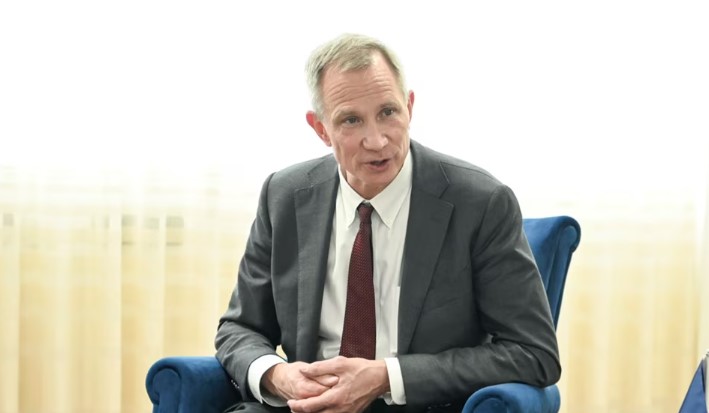
The Assistant Secretary General for Operations of NATO, Thomas Goffus, has said that the increase in the number of troops of the peacekeeping mission of the alliance in Kosovo is not a solution for peace and stability, and called on Pristina and Belgrade to engage in the Brussels dialogue to resolve the issues.
In a press release following the conclusion of a visit to Sarajevo and Pristina from August 28-30, Goffus said the purpose of the visit was to reiterate NATO’s long-term commitment to peace and stability in the Western Balkans.
During his stay in Pristina, Goffus met with the president of Kosovo, Vjosa Osmani, and with the prime minister, Albin Kurti.
“During the last year, we have increased the number of troops in Kosovo, unfortunately due to a greater security challenge and repeated tensions. While it is unfortunately necessary for now, the addition of troops is not the solution for long-term peace and stability in Kosovo,” he said.
The north of Kosovo remains tense since the beginning of 2023, when protests were held against the installation of Albanian mayors in municipalities with a Serbian majority in that part. The situation became even more tense after the killing of a Kosovo Police officer by a group of armed Serbs later that year.
The Kosovo government was criticized for this year’s decisions to ban the Serbian dinar, for closing some branches of the Serbian Post in the north, and for its intentions to open this time the main river Iber, which divides the Albanian-majority Mitrovica into south and the Serbian majority in the north.
Goffus said that the solution is “political”, and added that “it is essential” that Pristina and Belgrade engage constructively in the dialogue mediated by the European Union, to resolve the issues between them.
“As we have seen, uncoordinated and unexpected actions, especially in the north, can increase the risk of violence, which undermines the security of all people in Kosovo and increases the risk faced by KFOR troops,” he added.
He underlined that such actions add to the concerns of NATO’s allies and partners for the stability of the region, for the security of Kosovo and for the security of their troops.
The Government of Kosovo announced at the beginning of August its intentions to open the bridge over the Ibër river for vehicle traffic, as it is only open for pedestrians. This was opposed by the United States, the EU, but also the mission of the military alliance, KFOR.
But this week, Prime Minister Kurti said that his Government is continuing consultations and discussions with allies regarding the opening of the bridge.
Goffus said that “effective and timely” coordination with NATO and the international community is “vital”.
“I have emphasized this to all my interlocutors today. This also applies to many issues, including the bridge over the Iber, where KFOR is present”, he added.
On May 29, 2023, the Serb protests in the north of Kosovo, against the placement of Albanian mayors in the four municipalities there, culminated in clashes with KFOR members.
During the clashes, 93 members of KFOR were injured, some of them with serious injuries.
Speaking about this, Goffus said that “the men and women of NATO suffered unacceptable and unprovoked attacks”.
In September of that year, a group of armed Serbs attacked the Kosovo Police in the village of Banjské in Zveçan, killing Sergeant Afrim Bunjaku. In the ensuing fighting, three Serbian attackers were killed.
The responsibility for the attack was later claimed by Millan Radoicic, the former vice-president of Serb List, the largest party of Kosovo Serbs, which enjoys the support of official Belgrade. Kosovo blames Serbia for the attack, but Belgrade denies any involvement.
Goffus emphasized that he expects those responsible for these attacks in Zveçan and Banjska to be held accountable.
“NATO has made this clear to both Belgrade and Pristina”, he underlined, writes Radio Free Europe.
In the end, he reiterated, uncoordinated and ill-timed actions, along with divisive rhetoric, incite tensions and endanger stability and peace in Kosovo.
“At this critical time for European security, we must make sure we work together reliably. NATO will play its role”, he concluded.




