

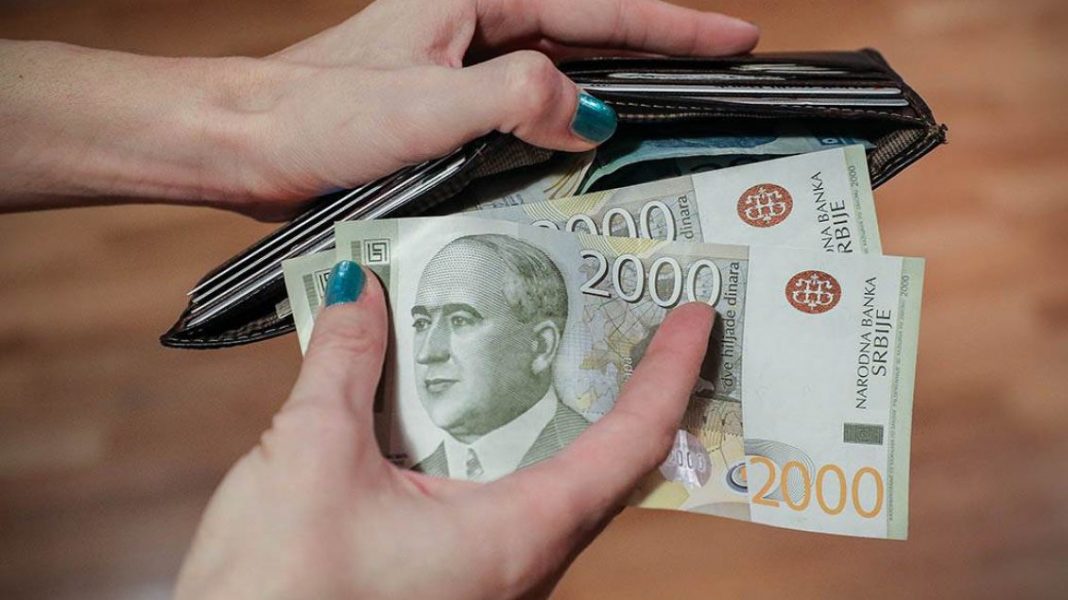
The Central Bank of Kosovo made a decision a week ago that payments in the country will only be made in euros. With this decision, the use of the Serbian dinar in Kosovo will also be prohibited from February 1. This decision has sparked numerous reactions.
The Governor of the Central Bank of Kosovo, Ahmet Ismaili, denies the postponement or annulment of the regulation that prohibits the circulation of the Serbian dinar in Kosovo from February 1 of this year.
He emphasized that all rules set by the Central Bank of Kosovo must be enforced.
When asked if this decision will be postponed, he said that the same might have a transition, adding that Serbian citizens are welcome to join Kosovo’s financial system.
“As for delays, postponements, who will be responsible if it is postponed, who will say from tomorrow a vehicle can enter without regulations, unauthorized, who can take this responsibility, is there anyone from the Central Bank of Kosovo who can handle this. This might have a transition time, we are not dealing individually with Serbian citizens. They are welcome to join Kosovo’s financial system”.
He also stated that all rules set by the Central Bank of Kosovo must be enforced.
“The position of the Central Bank of Kosovo is not political. We establish rules and they must be enforced. If a reasonable time is needed for the implementation of the rules, it’s a matter of these rules for us. Until yesterday, there were all kinds of statements saying that it had been regulated, until yesterday and today, and by the end of January, vehicles could enter Kosovo with cash and as they wish. Unfortunately, even the bank that was licensed, Komerciana Bank, which is now in the process of closing, has been used as an excuse for transportation, but in fact, based on the data declared to the Central Bank of Kosovo, they do not match the volume of the transaction declared. So, it means that the Central Bank of Kosovo has not been able to effectively monitor the operation of its bank that operated at that time”.
Kosovo’s President, Vjosa Osmani, also spoke today about the Regulation of the Central Bank of Kosovo, which excludes the Serbian dinar from circulation starting February 1.
She said that regarding practical implementation, a series of options are being discussed that would, on one hand, respect Article 11 of the Constitution of Kosovo, but on the other hand, leave time for informing citizens in the north so that it can be implemented without any problems and with the full support of allied states.
“As for the dinar, yesterday with Mr. Lajčák, we did not discuss this because we had many topics for dialogue… Article 11 of the Constitution requires Kosovo to have only one currency in circulation and use. It is regrettable that this has not been implemented as required by the Constitution. The Central Bank has done its job in accordance with the principle of independence. As for practical implementation of these principles, a series of options are being discussed that, on one hand, would respect Article 11 of the Constitution, but on the other hand, leave time for informing citizens and the transfer to new and other accounts so that it can be implemented without any problem and with the full support of allied states…”
Regarding the decision of the Central Bank of Kosovo to prohibit the use of the Serbian dinar in Kosovo, economic expert Safet Gërxhaliu says that this is a well-timed decision but under wrong circumstances.
Gërxhaliu says that there should also be a dialogue with the EU and the US on this issue.
“We must understand that legally Kosovo has the right to enforce the law and regulations. The fact that we are in a supervised dialogue process by the EU and supported by the US means we need coordination with our allies when Kosovo is under sanctions, and in relation to the EU it has increased dissatisfaction, decisions like these without coordination with international partners are damaging Kosovo. We are not talking about clean economic processes in Kosovo-Serbia relations without politics, this political correlation is turning Kosovo to point zero”.
Former Governor of the Central Bank of Kosovo, Fehmi Mehmeti, also declared on this issue a few days ago.
He said that the dinar has always been illegal, euro is the official currency of Kosovo.
“The circulation of the dinar is illegal, unconstitutional, and anti-legal, and any anti-legal action must be punished, but also in this specific case, you have a reason and legal basis to confiscate it. For this reason, the possibilities for action are based on the Law and the Constitution of Kosovo”.
After the decision of the Central Bank of Kosovo that as of February 1, the Serbian dinar would be removed from circulation, there have been many reactions.
The US State Department has stated that Kosovo should offer more time and consult with the affected communities regarding the decision of December 27 by the Central Bank of Kosovo.
Meanwhile, the US ambassador to Kosovo, Jeffrey Hovenier, after meeting with the governor of the Central Bank of Kosovo, has requested the postponement of the decision to prohibit the use of the Serbian dinar in Kosovo.
“We expect the Constitution in its entirety to be fully implemented. In this case, we believe that these regulations may have consequences that have not been fully considered. We request the postponement of the implementation of some provisions to give some time to ensure that they have made preparations to ensure that the affected populations are not negatively affected”.
The ambassadors of the QUINT countries have requested that Kosovo suspend the implementation of the regulation of the Central Bank of Kosovo, which stipulates that the sole currency in Kosovo for cash transactions is the euro.
Through a joint statement, the ambassadors of the QUINT said that the suspension of the decision should be made to “allow a sufficient transition period and for clear and effective public communication”.
“The issue should be further discussed within the framework of dialogue facilitated by the European Union,” the statement said.
A few days ago, Washington also demanded that Kosovo review the decision, which would prevent Serbs living in Kosovo from using the Serbian dinar to make dinar transactions.
Meanwhile, the European Union has said it has sought clarification from Kosovo on this decision.
In Kosovo, in all Serbian-majority settlements, the population uses the Serbian dinar for payments, and those working in Serbian institutions in Kosovo also receive their salaries in dinars.
Pensions are also paid in dinars, according to the Serbian system, as well as child benefits and social assistance.
In commercial facilities, in areas where Serbs live in Kosovo, besides euros, the dinar is also used. Against this decision of the Central Bank of Kosovo, which would prevent the use of the dinar, the Serb List, the main party of Serbs in Kosovo, supported by official Belgrade, has come out. According to this party, the decision of the Central Bank of Kosovo jeopardizes the survival of Serbs in Kosovo.




