

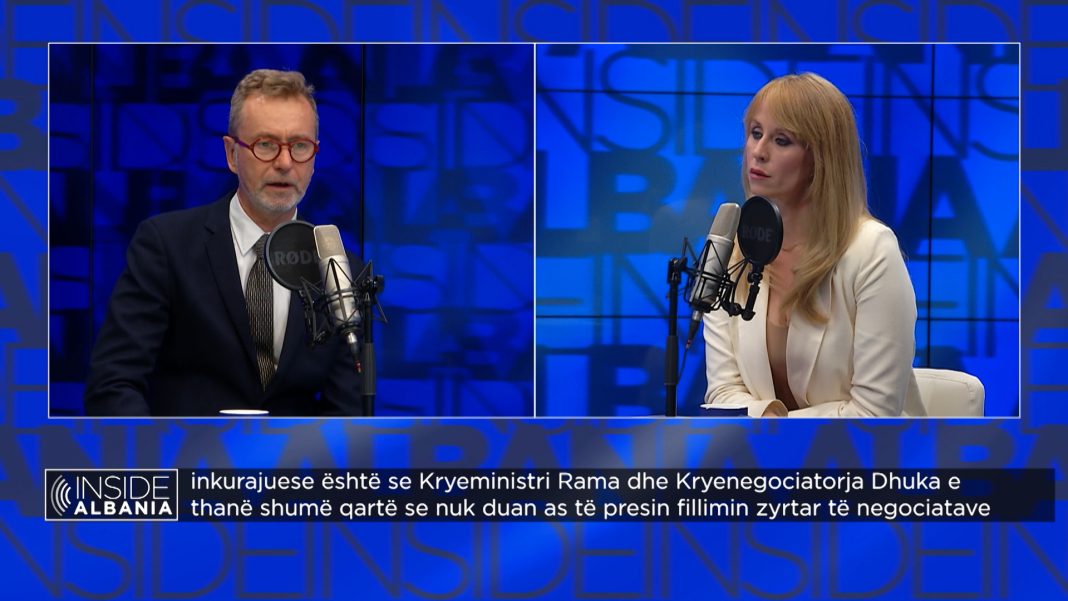
Speaking on “Inside Albania” podcast with Alice Taylor, the European Union ambassador to Albania, Silvio Gonzato, acknowledged that Albania and the Western Balkans have waited a long time to become part of the European bloc.
Discussing whether a gradual accession to the EU is fair to Albania, Gonzato put an emphasis on the reforms that the country has to deliver in order to be ready to join the bloc.
“We now are at the stage where all the elements for starting the negotiations are being finalised and what is encouraging is that Prime Minister Edi Rama, chief negotiator Majlinda Dhuka said very clearly that they don’t even want to wait for the official start of the negotiations to start engaging and exploring the reforms that can be adopted. I’m confident that we can maintain the momentum.”
Albania, said the ambassador, should carry on with reforms despite not having an exact date for the opening of negotiations on chapters.
“In addition, the Reform and Growth Plan that has been adopted by Brussels very recently, foresees the allocation of a very substantive amount of money for Albania, but it is conditional upon very concrete steps, which are relevant for Albania’s accession. There again we have incentives for Albania to carry out the reforms regardless of the exact opening of the negotiations on the different chapters. It is important that we maintain this momentum and I am hopeful that the last hurdles to the formal opening will be removed very soon.”
The ambassador mentioned the justice reform as one of the most important ones Albania has undertaken in its EU integration path, but also called for a change in the way corruption is perceived among citizens.
“When it comes to fighting corruption, organised crime, you really have to achieve a systemic change, actually a societal change. I don’t want to sound preaching, but the level of tolerance in the population is too high, in the sense that sometimes they think that if they don’t pay a little bribe, they will not get a certain service. You really have to change that and in order to do it, the first step is the one that we achieved in 2016. Independence of the judiciary and to see that the judiciary now is starting to deliver, to indict and convict people who are guilty of corruption. It’s a very powerful signal to the Albanian people.”
Getting back to EU integration and a timeline for Albania’s accession, Gonzato said Charles Michel’s 2030 deadline should be seen as an objective from both sides.
“I think it’s very useful because one needs to have an objective, a target and that applies for both sides, not just for the candidate countries but also for us. We need to factor that in. This also gives Albania a target, which seems to be taken very seriously from the government. Brussels understood that the Big Bang also doesn’t make sense. When I say Big Bang, I mean that you wait until all the formalities, accession treaties are ratified etc. and then you’re finally a member of the EU and suddenly you have 100%! Now the idea is to have a gradual approach. You start benefiting from some of the advantages of being a member state of the EU before you become a member. That is also the logic of the Reform and Growth Plan.”
Regarding the upcoming European elections, which are predicted to bring about a change in the composition of the new European Parliament, Gonzato said that, “There is a lot of talk about the elections bringing about a drastic change in the political composition of the European Parliament. I spent 24 years working there, so it’s an institution I’m very familiar with and still very much attached to. My personal opinion, and please take it as such, is that I don’t think there will be such a massive change. In any way, the European Parliament has always worked on the basis of varying coalitions. This practice will continue, and I know some parties made a pact not to work with the far right.”
Whether parties will collaborate with the far right on highly sensitive issues such as enlargement, Gonzato reminded that, “The opening and closing of chapters is a decision that has to be taken by consensus by all Member States. I don’t see an immediate impact and I think there will be a realisation that in fact what we are talking about is not really enlargement. We’re not enlarging the EU towards the Western Balkans. We are completing the European integration process, because the Western Balkans belong in Europe.”




