

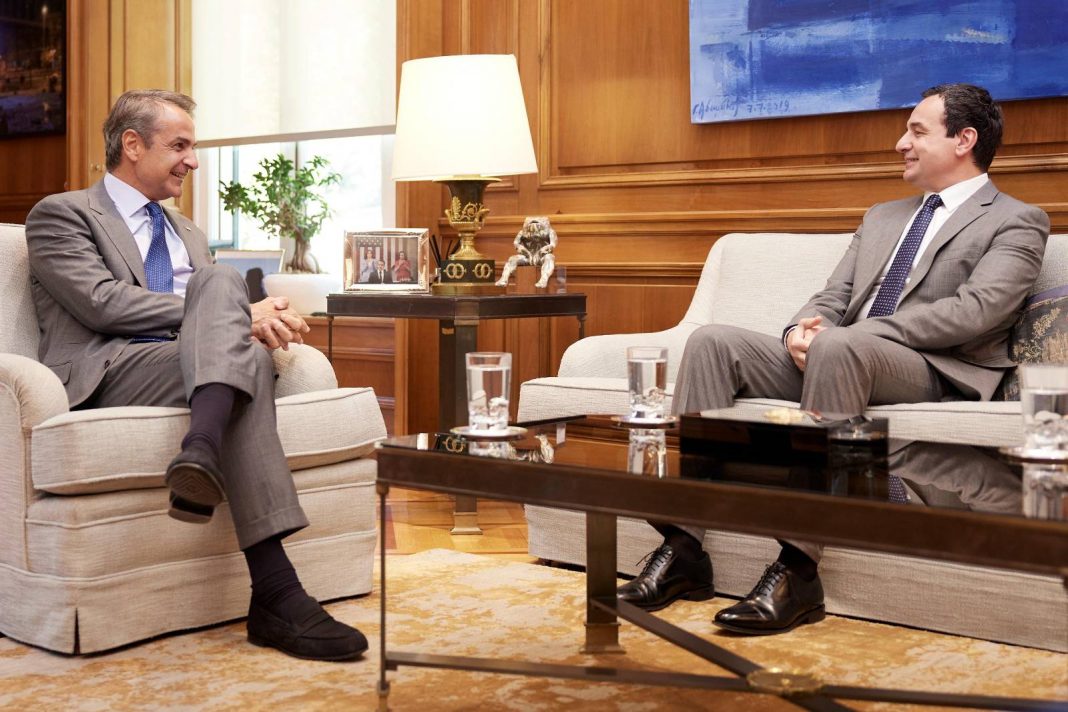
Greece has denied it could change its stance on recognition of Kosovo, stating its position remains unchanged, following comments from Prime Minister Albin Kurti that Athens is “closer” to recognition than other EU-non recognizers.
On Sunday, Kurti told Polish media that “We have worked hard in the diplomatic aspect so that they join the majority of the EU countries. Greece is at the forefront of these countries, which is closer to recognizing Kosovo’s independence. This is also shown by the status of our Office in Athens.”
Cyprus, Greece, Romania, Slovakia and Spain do not currently recognize Kosovo’s independence from Serbia, declared unilaterally in 2008 after the 1998-1999 Kosovo War.
While Kosovo’s Economic and Commercial Affairs Office in Athens was upgraded to an Office of Interest in 2021 and can issue visas, it does not have diplomatic status.
When asked by EURACTIV about Kurti’s comments, a source within the Greek government said “the Greek position remains unchanged”.
In March 2023, then-Greek Foreign Minister Nikos Dendias visited Kosovo for the sixth time, sparking rumors of possible recognition. But these were swiftly laid to rest by President Katerina Sakellaropoulou who when visiting Belgrade, said nothing would change.
“There is always pressure at the diplomatic level, but this has not affected our position; we have consistency in politics,” Sakellaropoulou said after meeting Serbian President Aleksandar Vučić.
But following Kosovo’s application to join the Council of Europe, both Greece and Slovakia abstained from the vote, in a move seen as a change of stance.
In his interview with Polish media, Kurti said Kosovo is ready to join the EU and fulfils the values, standards, and principles of the bloc.
“We need the help of the countries that have recognized us to recognize the countries that do not recognize us,” he said mentioning the 22 of the 27 EU members, 26 of the 30 NATO countries and 34 of the 46 Council of Europe countries.
“Our inclusion in the EU does not only serve our interest and our wellbeing because we also want to contribute. The European Union is the most important historical and political project for peace and prosperity since the Second World War”, he added.
“With the EU, we have signed the contractual Stabilization and Association Agreement and since the Thessaloniki Summit in 2003, the perspective of the integration of the Western Balkans into the EU has become a policy of the European Union. We will become part of the EU as soon as possible, and we think that the EU integration process serves our country.”




