

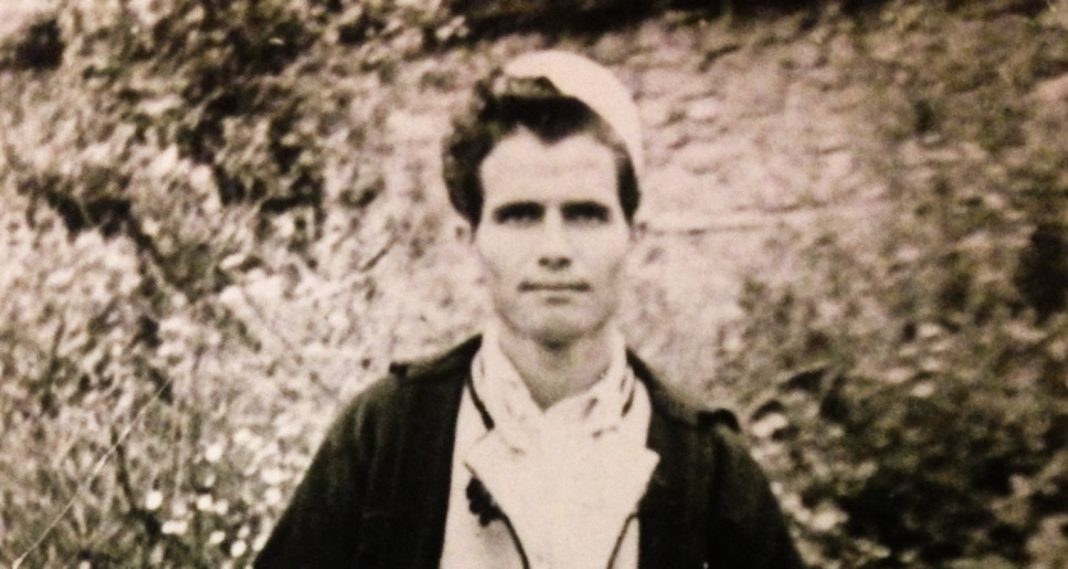
Former Prime Minister Sali Berisha participated this Friday in the ceremony held in remembrance of the 35th anniversary of the hanging of poet Havzi Nela by the communist regime.
In his speech, Berisha stated that Havzi Nela was a champion of freedom and also a shining symbol of intellectual thought.
The former prime minister emphasized that the poems of Havzi Nela reveal a genius of human courage.
“Havzi Nela and all of you who are here today, in a time much like this, nearly identical, prison was certain. But if certain boundaries were surpassed even through words, some standards that the dictatorship penalized with capital punishment, there was also capital punishment. In this context, Havzi Nela was a genius of human courage. In the journey of an intellectual between conformity and resistance, he chose resistance and remained unbeaten in every circumstance. I was born and raised in Tropoja, but my books spoke about Mongolia and not a word on Kosovo. Forbidden, there were no words. His elegy, ‘Let’s Mourn for Albania’, is one of the most beautiful elegies in our literature. Such is also ‘Saharaja’ by Vilson Blloshmi. What strikes you is that in the syntheses they create, they boldly strike and both pay with their lives for all aspects of that regime. Total isolation, the absence of freedoms. Havzi Nela is the genius of courage,” said Berisha.
On August 10, Albania commemorated the 35th anniversary of the politically motivated execution of Havzi Nela, a prominent poet and educator.
On August 10, 1988, Havzi Nela was sentenced to death by hanging by the communist regime, a mere two years before the collapse of the dictatorship.
Official documents framing his murder label him as a “staunch enemy of the communist authority”.
Havzi Nela spent 21 years behind bars due to his vocal opposition to the communist regime. His vocal critiques against the prohibition of religion, the forced collectivization of property in villages, and cooperatives led to his eventual death sentence.
Although three and a half decades have elapsed since Havzi Nela’s execution, his widow, Lavdije Nela, still bears the scars of this tragic loss. She vividly recalls the harrowing persecution her husband faced during their brief five-year marriage.
“He confided that signs were indicating his imminent arrest after debates at a party meeting with delegates, and he would flee to Kosovo. Despite acknowledging the suffering he was causing me, he refused to abandon me, fearing they would intern me. It all began in Topojan, where he was a teacher; they ordered him to demolish the mosque, which he staunchly declined. This marked the onset of his blatant persecution,” Lavdije recounts.
Numerous authors, including Petrit Palushaj and Rexhep Shahu, have penned accounts of his life and work. Moreover, Florin Zyberaj, a dedicated researcher, compiled a comprehensive monograph detailing Havzi Nela’s case files after five years of diligent work. According to Zyberaj, Havzi Nela was an authentic idealist and anti-communist.
“Havzi Nela publicly emerged as a regime opponent during the Shishtavec assembly on April 26, 1967. He vehemently criticized the ongoing reforms implemented by the Party of Labor. He openly denounced the destruction of religious structures, the alteration of traditional attire, and the communalization of properties and assets within villages,” Zyberaj elaborates.
Following dramatic gatherings in Shishtavec and Topojan, where he steadfastly stood by his anti-communist views, Havzi Nela and Lavdije fled to Kosovo in the spring of 1967. However, Yugoslav border authorities deported them back to Albania after ten days, exchanging them for prisoners from Kosovo.
“We were detained in Prizren for ten days in a hotel and interrogated. Before returning us to Albania, they led us through barracks to show us the horrific prisons awaiting Havzi. The police claimed that they had orders from Enver Hoxha and could sentence escapees; however, they declared that both of us would return to Albania, while they would take ten Kosovars and execute them. We were exchanged for ten Kosovars,” Lavdije reveals.
Lavdije received a ten-year prison sentence for her role in the escape, while Havzi was handed a 15-year term. Additional sentences were later added. After serving 21 years, Havzi Nela, at the age of 54, was sentenced to death.
Lavdije shares that she was in internment when Havzi was hanged in the heart of Kukës.
“The 20th century witnessed the poet’s hanging in the midst of the city, his call for free speech, press freedom, protection of churches and mosques, opposition to dictating youth attire, and his outcry ‘The people are suffering; do not take their land, wealth, livestock.’ For these convictions, Havzi Nela was condemned,” Lavdije emphasizes.
Besim Ndregjoni, the head of the International Union for the Integration of Prisoners and Political Persecutes, organized a commemorative event this year in honor of Havzi Nela.
“This 35th anniversary of his death serves as a wake-up call for Albanian society, as the human freedoms he sought are still not fully realized. The condemnation and dissociation from the dictatorship have yet to be fully achieved,” Ndregjoni asserts.
“Regrettably, even after 32 years of democracy, Albanian society remains divided between persecuted anti-communists and the privileged from the dictatorship era, who reap the benefits of democracy. Meanwhile, the agents of the dictatorship, those responsible for Havzi Nela’s execution, have never faced justice. On the contrary, they were fueled by political forces, ascending in their careers, thereby institutionalizing political enmity against the class that opposed the communist regime,” he laments.
Havzi Nela’s biography reports that 118 literary, historical, and political books were seized from his residence upon his arrest, a testament to his profound knowledge.
This, he posits, propelled Havzi Nela to fight openly for freedoms and human rights.
Posthumously, Havzi Nela’s rich literary legacy was unearthed, securing him a revered place among Albanian poets.
“During his protracted imprisonment, Havzi traversed Tirana, Elbasan, Vlorë, Spaç, Rrëshen, Ballsh, Qafë Bari, and Arrë. He weathered a prolonged ordeal within prisons and camps, leaving little of his physical form, yet his ideas and thoughts kept Havzi Nela’s spirit alive,” Zyberaj highlights.
The communist regime shuttered Havzi Nela’s chapter with animosity, bloodshed, and terror.
Ramiz Alia, the final leader of the communist dictatorship, dismissed pleas for clemency. Havzi Nela was executed on August 10, 1988, in Kukës, and his lifeless body was displayed in the city to instill fear.
He was buried without any distinguishing mark in an open pit intended for electrical poles, and eventually, his decapitated remains were discovered years later.
Despite three and a half decades since the execution of poet Havzi Nela, the wounds of this tragedy continue to reverberate throughout Albanian society.
His contributions have been recognized with the title “Nation’s Honor” by the President of the Republic, and a local school bears his name.




