

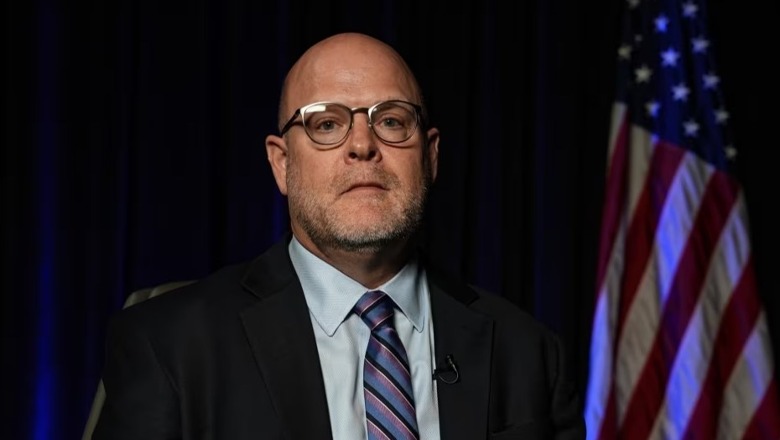
United States Ambassador to Pristina Jeffrey Hovenier emphasized in an interview with Radio Free Europe that the United States expects Kosovo and Serbia to fulfill all their obligations and commitments outlined in the Ohrid Agreement for normalizing relations.
According to him, Kosovo should take the initiative to advance the Association of Serb-majority Municipalities, considering it as one of the initial steps.
“We believe it must fully comply with Kosovo’s current Constitution and the Constitutional Court’s decision. We do not believe it should possess authorities or executive competencies,” Hovenier articulated.
The American Ambassador acknowledged that Serbia appears to have a different perspective, but this should not deter Kosovo from progressing with an association that addresses the concerns of Kosovo’s Serbian community.
“Serbia may seek more concessions, but ultimately, the United States and the international community are prepared to view this as acceptable,” Hovenier affirmed.
He expressed optimism that Kosovo’s Prime Minister Albin Kurti will collaborate with European Union representatives to achieve this “strategic goal”.
However, Hovenier cautioned that there would be consequences if he does not take such action.
“We are deeply committed to Kosovo’s advancement, but our commitment cannot exceed that of the Kosovo Government,” Hovenier underscored.
The American Ambassador also underscored the strong trust that the United States has in European mediators facilitating the Kosovo-Serbia dialogue.
Part of Jeffrey Hovenier’s interview to Radio Free Europe
Radio Free Europe: Last week, Kosovo and Serbia held discussions in Brussels, yet no progress was made. From the U.S. perspective, is there one party that bears more responsibility for this stalemate?
Jeffrey Hovenier: Certainly, you’ve likely seen our public statement following the meeting between the two leaders, facilitated by the European Union, on September 14. From the State Department, we expressed our disappointment at the lack of progress.
We broadly support the EU-facilitated dialogue and stand by the facilitators’ conclusions – in this instance, EU High Representative [Josep] Borrell and EU Special Representative [Miroslav] Lajčák. Several facts are pertinent here. Notably, a meeting took place, strenuous discussions were held, and concerted efforts were made to forge an agreement on a structured plan for implementing the Ohrid Agreement.
I want to make it clear that, from the U.S. perspective, we anticipate both parties fully honoring all their responsibilities and commitments outlined in the Ohrid Agreement, including the Implementation Annex.
As EU High Representative Borrell also noted in the media statement at the end of the day, he proposed a compromise that Serbia ultimately accepted, while Kosovo did not. This is regrettable. Our hope is that the Kosovo Government will collaborate with EU facilitators to find a mutually agreeable path forward.
Radio Free Europe: However, what transpired on Thursday? Why couldn’t the Kosovo Government find a common ground?
Jeffrey Hovenier: Providing a precise answer is challenging; I was not present, and there were no American officials involved in that particular round of discussions. Sometimes, we have a clearer view from afar. Therefore, I cannot respond to that question directly.
Based on my understanding, the Kosovo Government had specific concerns regarding the timing of initiating a credible process for negotiating the status of the Association of Serb-majority Municipalities. The U.S. has been urging and expecting the Kosovo Government to initiate this process promptly. It’s a pressing aspect of implementing the Ohrid Agreement.
Once more, I want to emphasize that we expect both parties to fully fulfill their commitments under the Ohrid Agreement and the Implementation Annex. It’s no secret that we have been emphasizing for some time that one of these commitments is the advancement of the Association, which should be addressed with a sense of urgency. That’s our hope.
“Kosovo must progress with the Association”
Radio Free Europe: What is the U.S. stance regarding the sequencing of steps in the plan’s implementation? Is Kosovo now being asked to establish the Association first and then secure de facto recognition from Serbia, or should both of these happen simultaneously? Prime Minister [of Kosovo] presented this as part of the plan on Thursday – first there should be de facto recognition, and then the Association…
Jeffrey Hovenier: If you carefully listen to what the High Representative, Borrell, stated after the meeting… He mentioned that as a way forward, he suggested two parallel tracks. The urgent need to move forward with a credible process for drafting the Association’s status is one part of this. This is the most challenging yet essential aspect that we have been urging Kosovo on, concerning the Ohrid Agreement’s implementation. Simultaneously, political matters should be addressed, and commitments for normalizing relations should be fulfilled.
From an external observer’s perspective, this appears to be a rational approach – parallel processes, parallel tracks. You give a little and take a little. We could spend a lot of time discussing who does what, when exactly, and in what order… But, let’s be honest, ultimately, both elements need to be achieved. Kosovo should take steps forward with the Association.
Radio Free Europe: So, this should be one of the initial steps?
Jeffrey Hovenier: Indeed, this should be among the first steps. We’ve been emphasizing this for quite some time. There’s a sense of urgency. Furthermore, we also expect Serbia to fulfill its commitments according to the Ohrid Agreement.
Radio Free Europe: However, [Kosovo’s Prime Minister Albin] Kurti disagrees with this…
Jeffrey Hovenier: I am aware that Prime Minister Kurti did not accept the proposal put forth by the High Representative [Josep Borrell] during the meeting. From our viewpoint, this is unfortunate.
This also provides me with an opportunity to address something, as I have noticed many concerns and criticisms regarding the European Union facilitators. I must clarify that, from the U.S. perspective, we do not concur with these criticisms. This does not align with our evaluation of the situation.
Miroslav Lajčák enjoys substantial trust from both the European Union and the United States of America. He made a statement about this two days ago, along with the High Representative. We have collaborated with him in different contexts, both here and elsewhere. It is essential to note that we do not perceive him as pushing Serbia’s demands or compromising in any manner.
We view him as a highly skilled diplomat, competent, making sincere efforts to find a viable path forward and capable of reaching agreements between two highly contrasting sides on numerous sensitive issues. We commend his work.
“My expectation is that the Kosovo Government will work with the appointed EU representatives”
Radio Free Europe: Considering what you’ve said, that the U.S. supports the EU, Borrell, and Lajčák, nevertheless, Kurti believes that Miroslav Lajčák is leaning towards Belgrade and stated that he is biased, not neutral, and unfair. What happens if Prime Minister Kurti decides not to cooperate further with Mr. Lajčák?
Jeffrey Hovenier: I prefer not to speculate on hypothetical scenarios. My hope and expectation are that the Kosovo Government will collaborate with the designated EU representatives to jointly pursue this strategic objective.
Once again, let’s ask ourselves why we have the Ohrid Agreement?
From the U.S. perspective, the primary objective of this strategy is to realize a vision, a vision that envisions Kosovo becoming more deeply integrated into European and Euro-Atlantic structures. This entails Kosovo’s progression toward the EU and NATO, while addressing historical impediments. The sole means of achieving this is through progress in dialogue.
The U.S. supports the normalization of relations between Kosovo and Serbia, which is the fundamental aim of the Ohrid Agreement, representing a pivotal stride toward our long-term goal: mutual recognition.
However, we believe this is the most viable option currently, and it must materialize, as Kosovo’s European journey is impeded without it. I’ve brought along the EU statement published two days ago. There is a section I find vital to underscore. In the final paragraph, it states, “The EU reminds both parties that Kosovo’s and Serbia’s European path goes through EU-facilitated dialogue and the normalization of their relations. Both parties risk missing the opportunity to make progress on their European paths”.
We concur wholeheartedly with this stance, viewing dialogue as the way forward.
You can watch the full interview of U.S. Ambassador Jeffrey Hovenier to Radio Free Europe here.




