

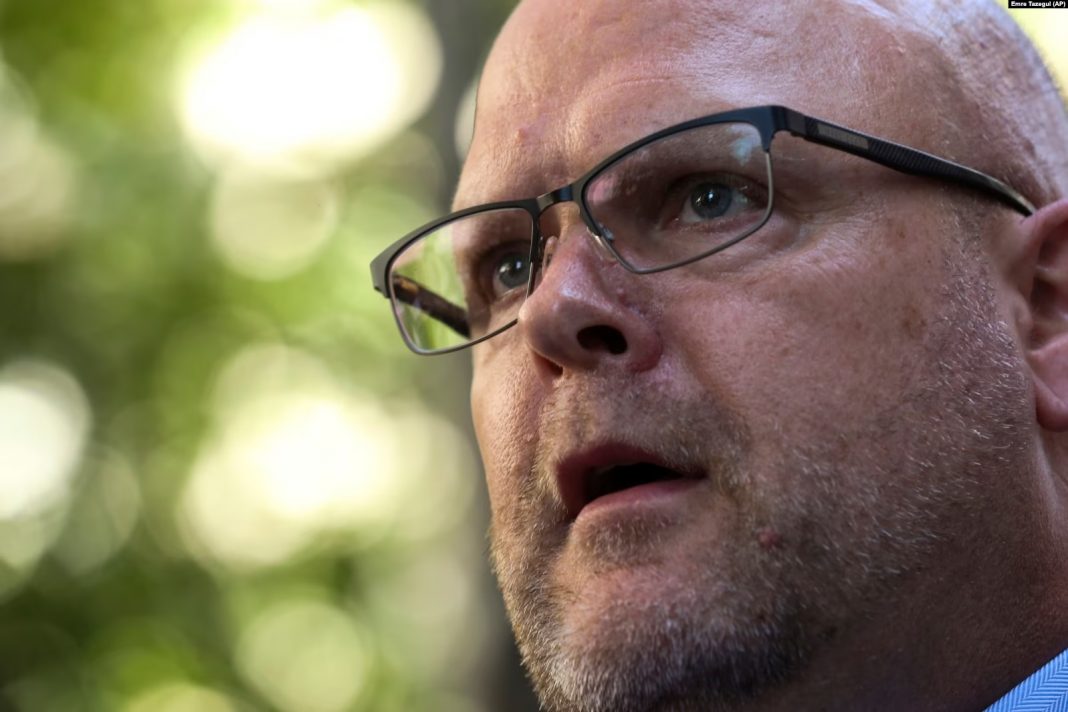
On Wednesday, United States Ambassador to Kosovo Jeffrey Hovenier announced that the U.S. stands ready to provide guidance to Kosovo in formulating the statute for the Association of Serb-majority Municipalities.
However, he emphasized that ultimately, the responsibility for this matter rests with the European Union, acting as the mediator in the dialogue between Kosovo and Serbia.
In an interaction with journalists at the embassy, Hovenier expressed that the U.S. would be receptive to any proposal put forward by Kosovo concerning this issue, provided it is deemed “credible and reasonable”.
He further clarified, “In the end, the resolution of this matter will fall under the purview of the EU-mediated dialogue. Nevertheless, if Kosovo seeks consultation with us or others on how to navigate this issue more effectively, we are prepared to offer guidance”.
This represents Ambassador Hovenier’s initial response to the matter, following Kosovo President Vjosa Osmani’s recent statement that Kosovo should collaborate with the United States in preparing a draft statute for the Association of Serb-majority municipalities.
The history of this Association dates back to 2013 when Kosovo and Serbia initially reached an agreement, followed by further agreements in 2015 outlining its foundational principles.
However, in 2015, Kosovo’s Constitutional Court ruled that these agreements were not entirely aligned with the country’s constitution.
Serbia continues to call for Kosovo to implement the previously reached agreements, while the Kosovo Government has voiced opposition to the creation of an ethnically-based association.
In recent times, the international community has heightened its pressure on Kosovo to expedite the formation of this Association.
U.S. diplomats have consistently underscored their belief that the Association should fully adhere to Kosovo’s Constitution.
“The issue of responsibility for the attack persists beyond Radojičić’s declaration”
When asked if the United States possesses information regarding the plans of the armed group in Banjska, Zvecan, and whether official Belgrade was involved in the attacks against the Kosovo Police in any capacity, Ambassador Hovenier stated that the United States is still in the process of gathering more information about the situation.
Following the attacks on September 24, a Kosovo Police officer named Afrim Bunjaku was killed, and during the exchange of gunfire, three Serbian attackers also lost their lives.
On September 29, Milan Radojičić took responsibility for organizing and executing the attack in Banjska, located in north Kosovo.
“This process takes time. The situation has been quite complex, and it will require time for us to fully comprehend all the details”.
Nevertheless, Ambassador Hovenier emphasized that the United States does not view the attack as a spontaneous event. Instead, the armed group appeared to be “coordinated and sophisticated”, utilizing military-grade weaponry, a significant portion of which had Serbian origins. Their aim was to destabilize north Kosovo.
He asserted that he does not believe that the matter of responsibility for the attack on the Kosovo Police can be conclusively resolved solely based on Milan Radojičić’s statement acknowledging his role in organizing the attack.
“I would suggest that the appropriate course of action for our security services and other partners is to continue their efforts to understand the full scope of what transpired. The United States has been unequivocal in its stance that those accountable for the attack must be held responsible. This position remains unchanged. We will persist in our endeavor to comprehend the events, identify those responsible, and ascertain the reasons behind the incident”.
Milan Radojičić was questioned by Serbian authorities on October 3 concerning the developments in Banjska and was subsequently released from custody on October 4.




