
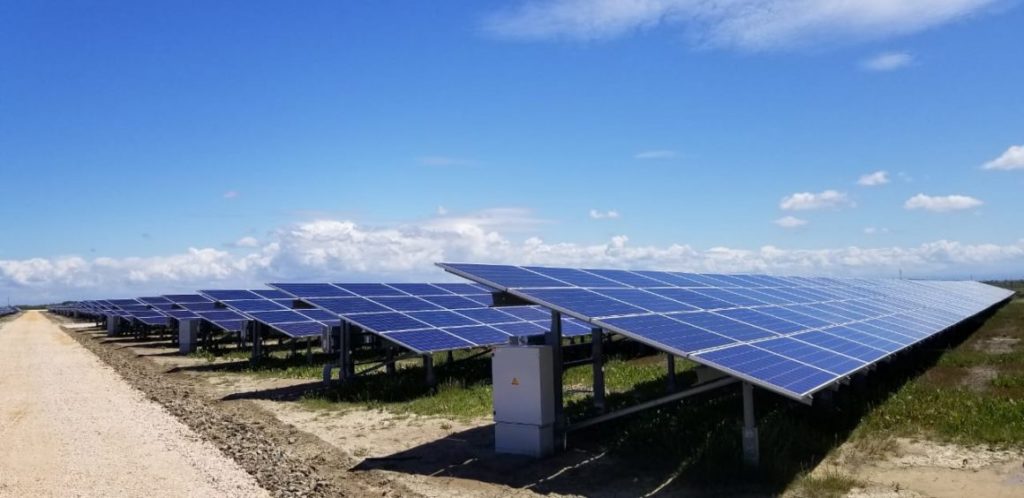
Approximately one year after the start of construction on the solar energy park in the Karavasta area, the first rows of solar panels are being installed on the barren and salty land.
The activity is being carried out by French company Voltalia, and the Karavasta project is considered the largest foreign investment in Albania this year, with a construction volume of around 150 million dollars.
“In Karavasta near the city of Fier, Voltalia is implementing a large photovoltaic park on approximately 200 hectares of land secured by the government. We are installing a capacity of 140 MW according to a long-term concession agreement signed in 2021. Since 2022, we have been constructing this power plant, and it will generate the first electricity by the end of this year [2023]. The plant will provide energy to around 220,000 households,” says Dr. Constantin von Alvensleben, manager of Voltaila in Albania.
Alvensleben further states that the company is expected to build another solar energy park in Spitallë, near the city of Durrës.
“Through a similar competitive tender process, Voltalia was also selected for a solar park in Spitallë, near the city of Durrës. This is also a very large project, but still at an early stage. Construction will begin in 2024, and we aim to deliver energy to Spitallë by the end of 2025.”
When asked about the challenges and the future of this sector in Albania, Alvensleben says:
“We believe that renewable energy has a great future in Albania! The government has set a target to cover 54% of Albania’s total energy needs from renewable energy sources by 2030. This will require a large number of additional solar and wind energy projects to achieve this objective. However, implementing such projects comes with a series of challenges. Often, the biggest problem for a developer is finding suitable land and reaching an agreement with the landowners. Often, the land ownership situation is unclear. Moreover, the permitting processes can be lengthy, which extends the project realization timeframe. In any case, we believe that Albania offers many opportunities, and with the government’s support, further projects can be successfully realized.”
In the interview with Voice of America, Alvensleben also emphasizes the importance of “green projects” for Albania.
“Our goal is always to minimize the environmental impact and achieve the most positive result possible for biodiversity. Similarly, we aim to minimize social impact. For both of these components, the environmental and social ones, we have our teams that work with environmental and social experts who ensure that the environmental impact is limited,” he says.
The Energy Regulatory Entity licensed 22 new energy production entities last year. Fifteen of them belong to solar energy, with a production capacity of over 227,000 MW.
The number of photovoltaic plants reached 27 last year, but their production is still low, generating around 50,000 MWh of energy out of a total production of 7 million MW in Albania in 2022.
Sadik Llapashtica, the coordinator of the solar panel project in Tropoja, which has been in operation for several years, states that the solar energy sector has gained priority.
“The solar energy market in Albania is progressing very well, especially due to the energy crisis caused by the Russia-Ukraine war. This market is experiencing significant growth. Many licenses have been granted for photovoltaic energy, and some of them have been put into operation this year, while others are still in the process. This is a very positive trend for Albania, which helps increase renewable energy production capacity, a global trend to preserve the environment. This trend is well-supported by the Albanian government, and the Ministry of Energy has taken steps to assist local and foreign investors in investing in the Albanian market, considering that Albania has excellent solar radiation,” he says.
When asked about the challenges faced by the solar energy production sector, Llapashtica says: “The challenges are now related to increasing the energy transmission capacity. Since we are dealing with solar energy, which is limited from sunrise to sunset, investors need to consider energy storage because humanity requires energy not only during the day but also at night. Just like in the European and global market, investing simultaneously in the development of solar panels and batteries is a way to ensure economic efficiency in this market.”
According to the Energy Regulatory Entity, the regions of Korça and Fier have the highest number of solar energy projects, and the use of panels in households and businesses is also being encouraged in recent times.