

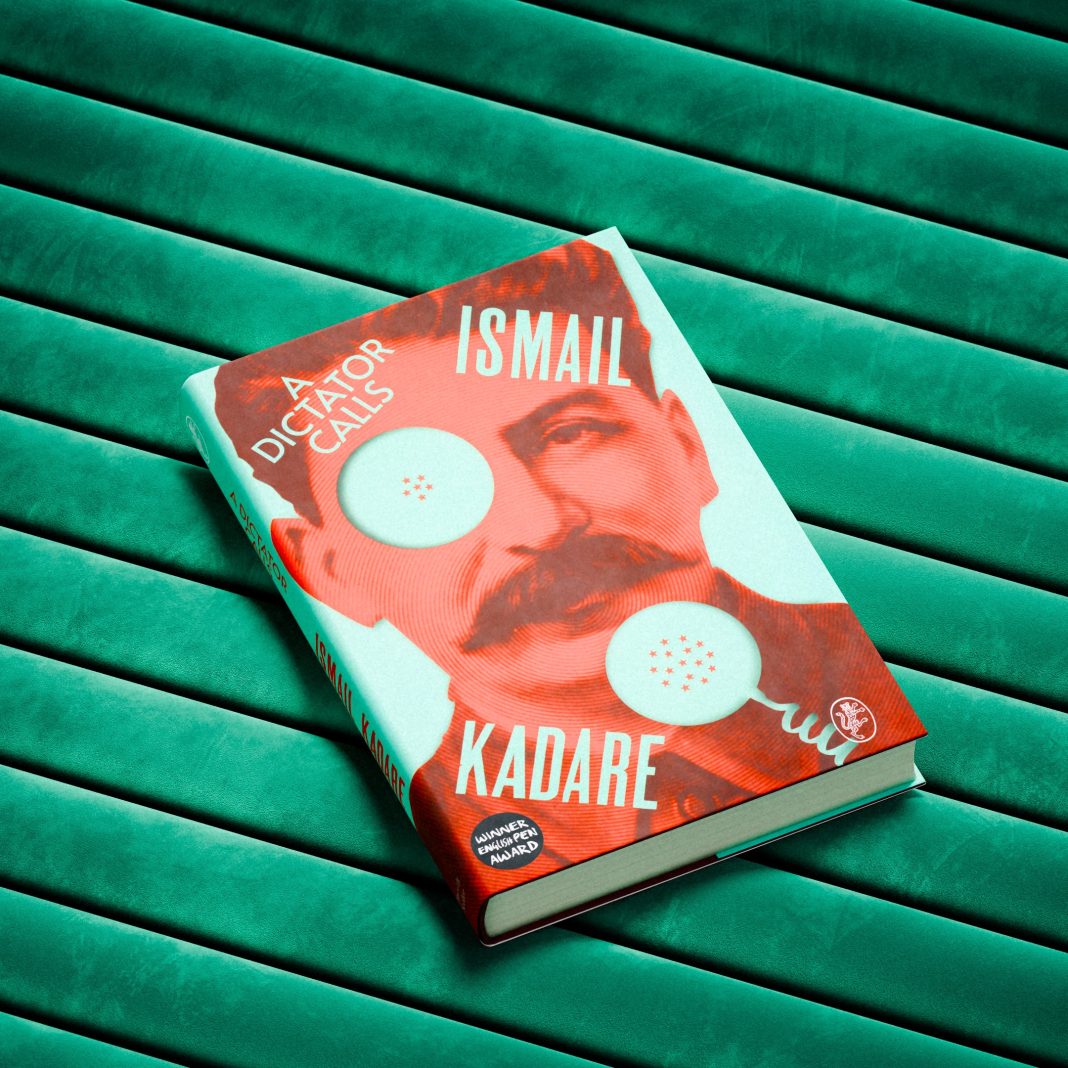
Ismail Kadare’s A Dictator Calls has been shortlisted for the International Booker Prize 2024.
The book, originally published in 2018 in Albania, offers a meditation on Soviet Russia, authoritarianism, power structures and the relationship between writers and tyranny.
In June 1934, Joseph Stalin reportedly telephoned the famous novelist and poet Boris Pasternak to discuss the arrest of Pasternak’s fellow Soviet poet Osip Mandelstam – a man who had expressed criticism of the Soviet regime. In a fascinating combination of dossier facts, dreams and memories Ismail Kadare, winner of the inaugural International Booker Prize, reconstructs the three minutes they spoke and the aftershocks of this tense, mysterious moment in modern history. Weaving together the accounts of witnesses, reporters, the KGB and contemporary writers, Kadare tells a gripping story of power and political structures, of the relationship between writers and tyranny. The telling brings to light uncanny parallels with Kadare’s experiences writing under dictatorship (that of Albanian leader Enver Hoxha), when he received an unexpected phone call of his own.
“The core of this brilliant exploration of power is an analysis of 13 versions of a three-minute telephone conversation between the Soviet dictator Joseph Stalin and novelist Boris Pasternak in 1934. Each of these is an attempt to understand or justify Pasternak’s troubling, ambiguous response from a slightly different point of view. The book begins with what seems like autobiographical memories of Kadare’s time as a student in Moscow, setting the tone which hovers continually between fiction and non-fiction, between what is real and what is invented. Kadare explores the tension between authoritarian politicians and creative artists – it is a quest for some kind of definitive truth where none is to be found,” said the International Booker Prize judges on the novel.
Critic Rebecca Abrams wrote for the Financial Times, “What gradually becomes clear is that Kadare is using the Stalin/Pasternak conversation as an extended metaphor to explore the nature of power and the interplay between political power and artistic power. A Dictator Calls is a thought-provoking consideration of the relationship between writers and tyranny, with John Hodgson’s translation gracefully rendering Kadare’s imagination.”
Laura Hackett wrote for Times that, “The book is not really a novel. It’s more like a cross between memoir, dream diary and historical investigation, in which Kadare trawls through reported versions of what was said during the phone call, with meditations on truth, creativity and tyranny. … Seasoned [Kadare] fans will be enthralled by this very personal meditation on the circumstances in which, against the odds, he still managed to thrive.”
“A Dictator Calls is slim, but its themes are not. There’s a fine line between uncertainty and obscurity, but the riddles of this novel are still ringing in my mind,” wrote Orlando Bird for Telegraph.
While Cory Oldweiler said “There are moments of real brilliance in Dictator, but overall it lacks the sustained highs and dramatic pacing of Kadare’s best later work. Part of this inconsistency is due to the fact that the novel seems unable to fully settle on what it is trying to be, slewing between intense introspection, literary theory, fictionalised autobiography, and historical sleuthing. It is, however, a fitting (possible) coda to a remarkable career, and considering its subject matter, it just might win Kadare the Nobel Prize for Literature, the one major award that he has never received,” in his review for Los Angeles Review of Books.
According to the official Booker Prize website, the 13 books chosen by this year’s judges represent the very best in translated fiction, published in the English language in the UK and Ireland. The list includes:
- Not a River by Selva Almada, translated by Annie McDermott
- Simpatía by Rodrigo Blanco Calderon, translated by Noel Hernández Gonzáles and Daniel Hahn
- Kairos by Jenny Erpenbeck, translated by Michael Hofmann
- The Details by Ia Genberg, translated by Kira Josefsson
- White Nights by Urszula Honek, translated by Kate Webster
- Mater 2-10 by Hwang Sok-yong, translated by Sara Kim-Russell and Youngjae Josephine Bae
- A Dictator Calls by Ismail Kadare, translated by John Hodgson
- The Silver Bone by Andrey Kurkov, translated by Boris Dralyuk
- What I’d Rather Not Think About by Jente Posthuma, translated by Sarah Timmer Harvey
- Lost on Me by Veronica Raimo, translated by Leah Janeczko
- The House on Via Gemito by Domenico Starnone, translated by Oonagh Stransky
- Crooked Plow by Itamar Vieira Junior, translated by Johnny Lorenz
- Undiscovered by Gabriela Wiener, translated by Julia Sanches




