

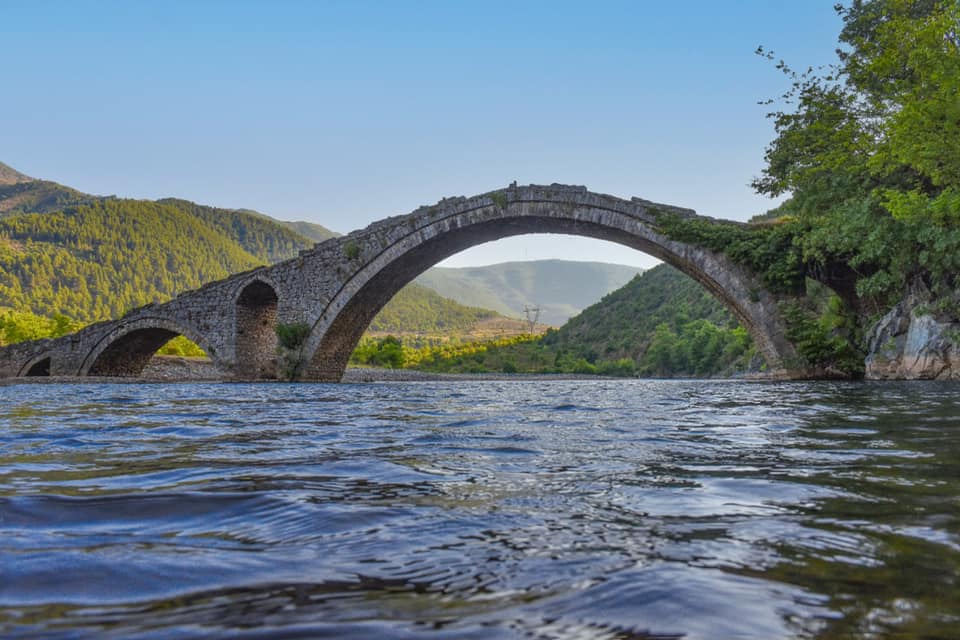
The Bridge of Kamara is one of the most important historical and architectural monuments in the area of Librazhd, valued for its unique characteristics and strategic position above the Shkumbin River.
The Bridge of Kamara is located about 5 km away from the city of Librazhd, in the Administrative Unit of Polis in Miraka, and has a considerable historical and cultural value.
This medieval bridge served as a key element on the ancient Via Egnatia, positioned at a strategic point along the route. This makes the bridge particularly important in the context of transportation and trade during its construction.
For its significance, this bridge was declared a cultural monument of the first category in 1963.
The bridge is asymmetrical and built on three arches made of gray stones taken from the Murrashi mountain.
Built around 1714, the Bridge of Kamara has undergone several construction periods, including a reconstruction during the Ottoman period.
It is about 40 meters long and approximately 3.5 meters wide, with drainage windows in the shape of a boat between them. The large arch of the bridge has a span of 23 meters, and the right arch is in the form of a circular segment.
The base for pedestrians is built with a pavement of rounded river stones. It got its name because of a niche located on its right side. This niche served as a warning for people crossing the bridge. When the weather was bad and the wind blew strongly, the bell would ring as a kind of signal to cross the bridge carefully and not to fall off.
On the left bank, the bridge is supported by the rocky formation of the Polis mountain, while the right support is on the gravel of the riverbed.
During its construction, it connected the medieval road of caravans coming from Elbasan, which crossed to the left of the river from the Bridge of Haxhi Beqari, following the route of the ancient Via Egnatia, continuing to Korça, then to Macedonia, Greece, and finally to Istanbul.
The Kamara bridge was also the starting point for the road branch that connected Elbasan with the Dibra region, passing through Klenja and Zerqan.
Today, the Bridge of Kamara continues to be a point of local history and culture, attracting the attention of visitors and researchers who want to learn more about the rich heritage of this area.
The National Council of Restorations, upon the proposal of the Institute of Cultural Monuments, has approved the protected area of the Bridge of Kamara.
The areas around heritage sites are protected as public property and as an integral part of the landscape and natural scenery, which helps in preserving and highlighting the Cultural Heritage.




