

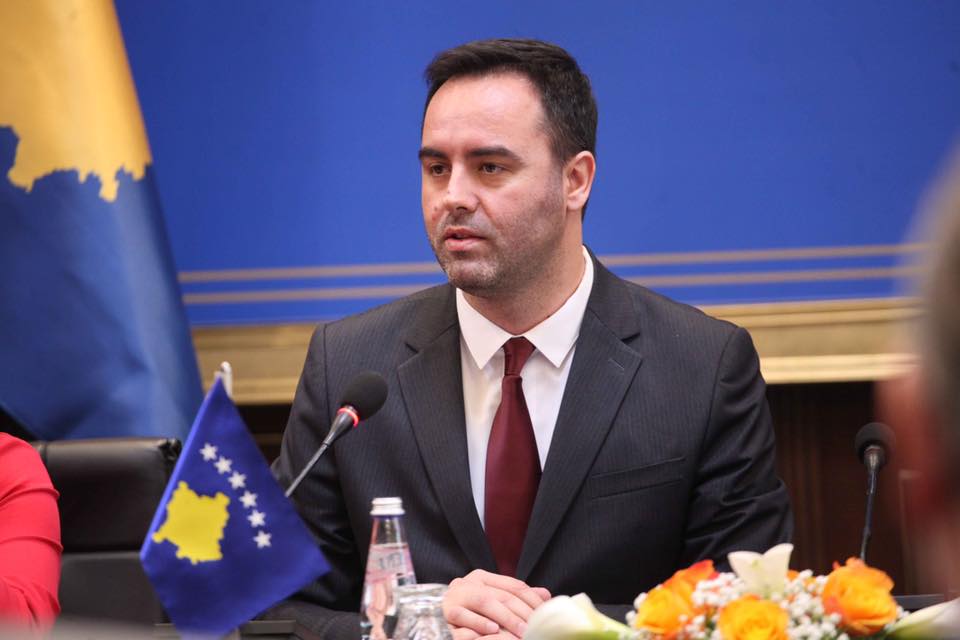
The Chairman of the Kosovo Assembly, Glauk Konjufca, has emphasized that the initial concept of the Agreement on normalizing relations implied that the establishment of the Association of Serb-majority municipalities could only occur in conjunction with mutual recognition.
Konjufca underlined, “Progress in the dialogue can only be achieved by including the Association alongside mutual recognition. Otherwise, there will be no advancement in the dialogue, and this poses a problem”.
He further noted that it is Kosovo’s responsibility to find a way for the Association to comply with the Constitution without violating the legal framework.
According to Konjufca, Serbia’s stance is that Kosovo should establish an Association of Serb-majority municipalities “outside the political context of the current phase of the process”.
He pointed out that the experts who drafted the Annex for implementing the Kosovo-Serbia normalization agreement had expanded the scope. Konjufca also addressed the statements made by Kosovo’s Prime Minister Albin Kurti, who asserted that the dialogue mediator, Miroslav Lajčák, was taking a position against Kosovo.
“The expansion of the framework involves the inclusion of mutual recognition alongside the Association. Currently, Lajčák is advocating for the sole inclusion of the Association. Recognition belongs to Serbia whenever they choose to pursue it; this is Serbia’s position. If Lajčák articulates this and states that it represents the official EU position, then we can conclude that [the EU’s envoy for dialogue, Miroslav] Lajčák has contributed to endorsing Serbia’s official stance,” said Konjufca.
Konjufca argued that Kurti’s statements, where he claimed that Lajčák was an impartial mediator, should not be regarded as accusations, as described by the European Union.
“Firstly, I don’t view them as accusations. They were observations about Lajčák’s approach to work. It has been observed, to be candid, from the outset that Lajčák’s positions tend to align more with Serbia’s standpoint initially, and then he endeavors, through various mechanisms and proposals, to accommodate Serbia’s position as much as possible,” he explained.
On September 18, Kurti stated that during the latest round of talks in Brussels on September 14, it appeared that there was coordination between Serbian President Aleksandar Vučić and Lajčák to devise an “alternative scenario where half of the agreement is implemented”.
He noted that during this meeting, where the Kosovar Prime Minister presented a plan for implementing the Agreement on normalization, which he claimed was rejected by the EU and Serbia, Lajčák took a position that was perceived as unfavorable to Kosovo.
The European Union has characterized Kurti’s remarks about Lajčák as “unfounded allegations”, while the United States has voiced support for the EU’s role as a facilitator of the dialogue process, which commenced in 2011.




