
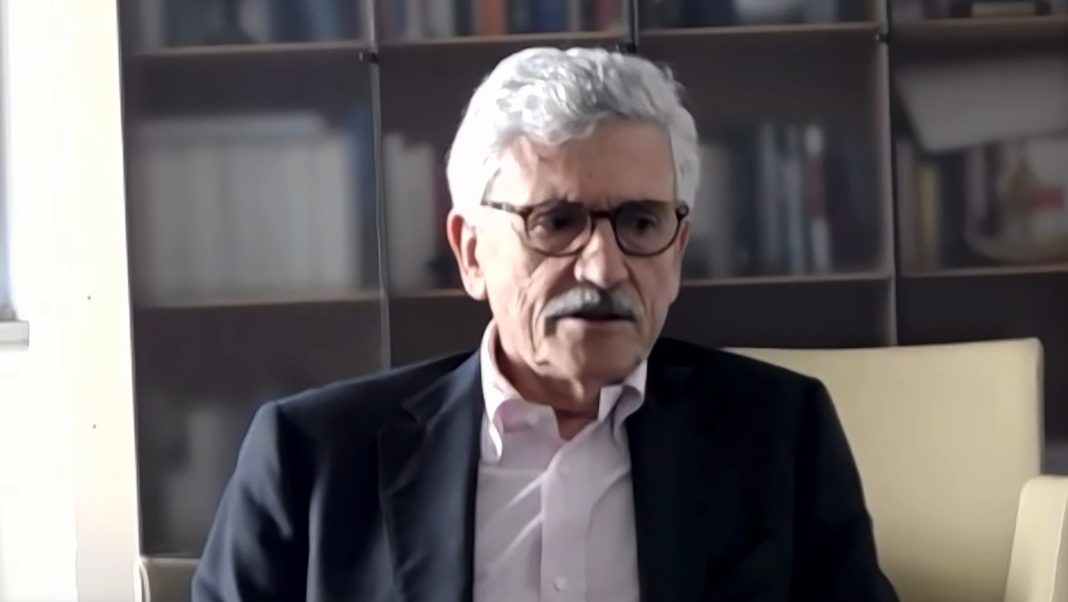
Former Italian Prime Minister Massimo D’Alema spoke of the support Italy gave in the NATO air intervention against the Federal Republic of Yugoslavia in favor of Kosovo. In an interview with journalist Thimi Samarxhiu for Euronews Albania, D’Alema called on Kosovo to do more in the dialogue with Serbia aimed at the final recognition.
Euronews Albania: Prime Minister, thank you very much for finding time for this interview on this very important day for us, Albanians. And the first question that naturally comes to mind is how do you remember March 24, 1999?
Massimo D’Alema: First of all, thank you for this invitation. My memory starts a few days earlier because a few days before that March 24, I believe it was the 15th or 16th, it was Easter, it was the days before Easter, I went to the border point of Kukës and saw the refugees from Kosovo arriving. A stream of vehicles and people fleeing from Kosovo. And I met these people and talked to them, and I immediately understood what was happening and that Italy was organizing aid for the refugees, along with Albanians. I went and met these Italian operators, soldiers, civilians, who, together with Albanians, were helping these refugees; the list of refugees and their stories convinced me that something needed to be done, that action needed to be taken. I had hesitated a lot because the idea of a military intervention seemed negative to me, even for cultural reasons, I am not in favor of war, I am against it, therefore. But I understood that action needed to be taken, so when the military intervention began, of course, I was of the opinion that Italy should play its role.
Euronews Albania: Everyone remembers US President Bill Clinton, who came out in that communication with his citizens, informing them about what was happening. When Clinton came out, were you coordinated with him for what he was doing?
Massimo D’Alema: Yes, yes, we had continuous consultations with the allies. Clinton was very correct in his relations with European allies. Even in directing military actions, Clinton was very, very correct. We had continuous contacts, let’s say, and before military actions, we spoke together, and he told me, “We understand that Italy is close, that it has historical relations with Serbia, it may be in a difficult position”, and he told me if I would prefer to make available air bases without participating directly. But I told him “no”, I told him that I wanted to participate in the political management of the conflict and so I understood that this would also entail assuming full responsibility militarily. But the relationship with Clinton was very close throughout this event. And this event was very complex, even politically.
Euronews Albania: What were your relations with the Kosovo Liberation Army? Did you have contacts with them?
Massimo D’Alema: These contacts were at the military level, but I have to be honest, we… my point of view was that we should work, so that in the end there would be a political solution. And, in the end, there was a political solution. And, according to my vision, the personality that could help for a political solution was [former Kosovo President] Ibrahim Rugova, so we made efforts for his release. And, perhaps there were different ideas among the allies about this, but Clinton supported me, and we managed to release Rugova, and he came to Italy, with his family, and I think this was… the idea was to find a solution and, although Rugova was one of the most important personalities, let’s say, in the struggle of the Kosovar people, he was also a man of peace, a man who could foster a reconciliation process. And, indeed, Rugova later won the elections, that is, this was not an unfair election, but it was a fair election. But unfortunately, Rugova died soon after, due to illness, but at that time, my main interlocutor from Kosovo was Ibrahim Rugova, who also became my guest, with whom we discussed how to conclude this event and how to lead it towards a positive result.
Euronews Albania: In the moments before the start of the campaign but also during the start of the campaign, what was the most difficult moment in the meetings you held with NATO allies?
Massimo D’Alema: Due to having experienced some difficult moments, indeed, surely we also had a moment of disagreement, because neither we nor Germany, Chancellor [Gerhard] Schröder, agreed with the bombings in the cities of Serbia. We were in favor of air strikes against Serbian forces in Kosovo, and for this point, we had a disagreement with the Americans, to the extent that it is true that the bombings in Belgrade were carried out not with NATO assets, but with American and British planes and missiles, because within NATO, some countries, Italy, Germany, did not agree with this. Also, due to the high risk of civilian casualties, which indeed occurred later. Another point, a serious moment of discussion, was that even though this campaign had been ongoing for several weeks, there were no results, so a meeting was held in Washington, during the high-level meeting on the occasion of NATO’s 50th anniversary, after about 70 days. There was a very difficult discussion there, because some proposed a ground troop intervention, in other words, an invasion, which could only be carried out in Kosovo, as it was thought that a war would only be waged against Serbia. We opposed it, the French opposed it, the Germans opposed it, while Clinton ended up saying “we will only do what we all agree on”, so there was a halt, an initiative that I think would have been catastrophic. Because the idea of invading Serbia, to do in Europe what the Americans did in Iraq, would have been a catastrophic idea. We said from the beginning that our troops could only enter Kosovo under the auspices of the United Nations. This is true, even though it is not remembered, but I want to remind you, because it is the absolute truth, that the contingent that entered Kosovo was not NATO’s; it was a United Nations contingent. KFOR was a United Nations force. And the first military contingent to enter Kosovo were the Russians, who occupied Pristina airport, not the Westerners, because this political behavior allowed, later on, NATO action to unfold, but later, the war ended with a resolution of the UN Security Council, and with a mandate from the United Nations, so in the end, the solution was found within the framework of international law. And this became possible because throughout the conflict, we maintained a dialogue with Russia as well, agreeing with Clinton. I remember that the Russian envoy was then Prime Minister [Viktor] Chernomyrdin. He would come to Rome, we would call Bill Clinton, in the evening, and after talking to Clinton, Chernomyrdin would go to Belgrade the next day, to discuss with Milošević and the Serbs. So, I say this, because military actions were carried out, but there was also a strong political action, so that such a solution that would not leave an open wound in the end could be sought. Ultimately, our objective was peace. A peace that respected the rights of the Kosovar people, but a peace. And, in the end, much is said about the Kosovo war, meaning that we waged war. But let’s state things as they are, a war was being waged, not by us, it had started before we intervened, it was a long war; Kosovo had been the last episode of a very long war in the Balkans. We intervened to stop the war, of course, with force, but to create a peaceful balance; that was NATO’s objective, and that was the reason why we agreed.
Euronews Albania: Mr. Prime Minister, it’s been 25 years and some information has come out, many things have been declassified, let’s talk about Albania’s role. What can we reveal from the secret meetings held by NATO with the Albanian government but also your personal ones as prime minister of Italy?
Massimo D’Alema: I remember that our cooperation with Albania was truly exemplary, because we were afraid that the exodus from Kosovo would cause an uncontrollable influx of refugees towards the European Union, this risk existed. If you think about what happened a few years later, with the war in Libya, then we faced a dramatic emergency. Now, in this case, this emergency did not occur, and this, above all, thanks to the cooperation between Albania and Italy, because we managed together – and I would say that the Albanians did this with great generosity and skill – the wave of refugees, they were mostly welcomed in Albania, with the help of the Italian army, but by working together, and thus avoiding a humanitarian catastrophe. If you think about half a million people fleeing, it’s something extraordinary, and not a single boat set sail in the Adriatic. Nothing happened, everything was managed, a part of the refugees, those who needed help the most, were escorted to Italy, but also to other countries, Austria, Germany, etc., while a large part were helped in Albania. So, the first thing I want to say is that it was an important, positive moment of humanitarian cooperation between Italy and Albania, in aid of people, which I believe has been one of the moments that has further cemented our relations. Then, of course, Albania was part of this event, even in seeking a solution. In the end, for example, it was very important that Albania did not embrace the idea of Greater Albania, which would have made everything even more difficult. But it accepted the idea of autonomy, of Kosovo’s independence, Kosovo being administered by the United Nations, without territorial claims. So, I have to say that throughout this event, Albania’s behavior has been very wise, very effective, I found a leadership class that was able to take on its responsibilities.
Euronews Albania: Let’s go back to the campaign, because the role of France is often mentioned in NATO’s bombing campaign. What was France’s actual role?
Massimo D’Alema: You see, everyone did their part, I don’t want… from a military point of view, the heaviest weight was that of the United States, and then of the United Kingdom, and then of Italy, but I believe these data can be found, in the sense that NATO is very accurate, in terms of mission numbers, but I’ll add that we also had all the bases, the air bases, etc., and we took on our responsibilities. The French did their part.
Euronews Albania: I ask about the role of France because everyone knows the connection France has with Serbia and therefore, we always raise questions about France’s role in this campaign.
Massimo D’Alema: I believe that the French government was very determined, especially [former] Prime Minister [Lionel] Jospin himself, maybe the one who had more doubts was [former French] President [Jacques] Chirac, but… anyway, in the end, NATO’s action was decided by all together. We also had good relations with Serbia. I tried to make the Serbs understand that they needed to act to avoid, before the war, I even met confidentially with [Milan] Milutinović, who was then the president of Serbia, he was one of Milošević’s closest people. I organized this meeting at the dentist’s; because he came to Rome, to the same dentist I went to. He came confidentially, my dentist is Istrian, he’s a great dentist, he’s from Istria, so he had a lot of connections with the world of the former Yugoslavia, and he organized this private meeting himself. And I told him, “You are doing unacceptable things, you must withdraw, because this will lead to war.” I told him these things openly, inviting him to take action… and he responded saying, “But no, the West will never engage in a war for these four people…” It made a big impression on me, because it showed a kind of arrogance, a kind of blindness… but we tried to prevent the war, of course by trying to make the Serbs understand that they needed to withdraw, before someone intervened to force them to withdraw. We are friends of Serbia, after a few years, as foreign minister, I went to Belgrade to inaugurate the Italian Cultural Institute, and, of course, I was somewhat tense, because it was the first time after the war that I was returning to Belgrade. But I must say that, by meeting with young people, intellectuals, and then there was also the Belgrade Book Fair, etc., I found many people who told me, “In the end, you also helped us to get rid of Milošević.” I must say that, of course, the war was a tragedy, but in the end, at least a part of the opinion, of the young people, of the intellectuals, etc., understood that through the war a democratic change was also opening up in Serbia.
Euronews Albania: Prime Minister, these last few minutes I want to focus a bit on today’s Kosovo, how do you see Kosovo today?
Massimo D’Alema: Well, you see, I have to tell you the truth… I believe that the authorities of Kosovo should be encouraged not to be influenced by nationalist feelings, and to seek a path of dialogue with Serbia, because, honestly, without compromising Kosovo’s independence, above all, efforts should be made to improve coexistence, because we know that in Kosovo there is a Serbian minority, which is limited, but nevertheless it is important, in a certain area of Kosovo, with which one must coexist. Among other things, we know that there is also an Albanian minority still in Serbia, in Preshevo; we are people who know that part of the world. I also cooperated for a short period of time with the government of Kosovo, during the period when Behgjet Pacolli was foreign minister, but Kosovo must be careful not to be overtaken by the demon of nationalism, because in the end, if Kosovo wants to emerge from these half-conditions, since Kosovo is a country that is recognized by many, but not yet by some others, which cannot be part of the United Nations Assembly, and even the European Union has problems, because there are also countries within the European Union that do not recognize Kosovo… So, if Kosovo wants to achieve full recognition status, this passes through dialogue with Serbia, it is inevitable, meaning it is not something that can be avoided. So, a leadership class is needed that is able to seek this dialogue. It is pointless to feed elements of opposition. Even Serbia is sick with nationalism, but we know that nationalisms in Europe, and especially in the Balkan countries, have always brought tragedy. So, if I have a message, it is that Kosovo needs to work more for dialogue. Sometimes I see much more courage in dialogue in Albanian leadership, because Albania in recent years has played a very positive role in the Balkan countries, it has been a country that has worked for stability, it has worked for cooperation. So, I would like this Albanian example to be followed by Kosovo as well.
Euronews Albania: But how can you negotiate with Serbia when they say they do not recognize the Ohrid Agreement, they will not implement the signed agreement, they will not recognize the points of those agreements… how can you discuss with this Serbia?
Massimo D’Alema: I am not an advocate for Serbia, I know very well that Serbia has some somewhat rigid positions, but a kind of dialogue between [Serbian President Aleksandar] Vučić and [former Kosovo President Hashim] Thaçi was opened. There have been moments when this dialogue should have been more possible, I didn’t open it, they did. And, then, there have been uncertainties even in the Kosovar leadership, and a step back, let’s state things as they are. You are talking to someone who has followed these events very closely… Yes, you are right, but at the same time, I am not talking about… negotiations that should be held tomorrow, I understand there are difficulties, but I believe that if there is a will on the Kosovar side to find paths of dialogue, this position is stronger, and it is also easier for the international community to help Kosovo, to exert some pressure on Serbia, if Kosovar leaders help us to seek a possible basis for dialogue. So, I am not talking about negotiations to be held tomorrow, but I am talking about a stance that must be taken. We have no interest, the world is already involved in terrible conflicts, we should not fuel tension in the heart of the Balkans, which has already experienced many, many conflicts over the years.
Euronews Albania: Prime Minister, among Albanians, the role of [EU’s representative for the Kosovo-Serbia dialogue Miroslav] Lajčák and [EU’s chief diplomat Josep] Borrell as negotiators in this negotiating table is often discussed, with their approaches not often being in favor of Kosovo.
Massimo D’Alema: I don’t know, I don’t want to criticize the High Representative, it is clear that [Josep] Borrell represents European positions, because he is also conditioned by Spain’s position, we cannot forget that Spain is a country that does not recognize Kosovo, so it is clear that he somehow also has to take these into account, but I don’t believe he is against Kosovo. Of course, some weight in his positions is also the Spanish position.
Euronews Albania: Prime Minister, if you were to go back 25 years, would you do the same thing again?
Massimo D’Alema: I assure you that participating in an armed conflict is an experience I wouldn’t want to repeat. It was a dramatic experience, those were very difficult days, also because I felt the weight of responsibility, when I saw the scenes of bombings, of people killed, and all this deeply affects the conscience of responsible politicians, if they are responsible people. But, I still think that at that moment it was the right thing to do, I still think that there were no alternatives, I still think that… I saw the wounded people in Kukës, I saw people fleeing, I saw the elderly with their feet wounded by bayonets, I saw with my own eyes what was happening, so I was convinced then and I remain convinced today that the international community could not stand idly by in the face of this tragedy.