

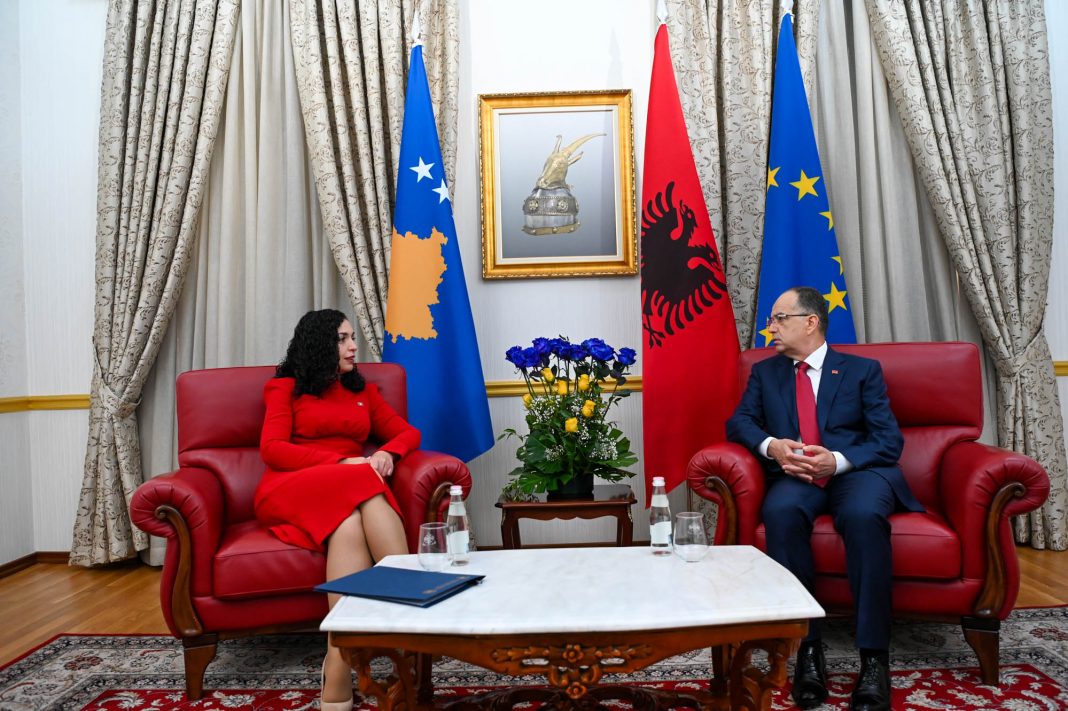
Kosovo’s President Vjosa Osmani has leveled accusations against Serbia, alleging that it is pursuing a destabilization plan in the Western Balkans similar to what she claims Russia executed in Ukraine in 2014.
During an official visit to Albania, Osmani asserted that all democratic states in the region must not permit the implementation of such a plan.
She cited the conflict that erupted in Eastern Ukraine’s Donbas region, fueled by Russia-backed separatists, and Moscow’s annexation of Crimea as reference points.
“The situation in the north is not the root cause of disruptions in the Kosovo-Serbia dialogue. It is Serbia that consistently exacerbates tensions in our region through repeated attacks on Kosovo. There hasn’t been a single week without an incident where someone from Serbia fired at Kosovo police within Kosovo’s territory. By rigorously implementing a plan similar to what [Russian President Vladimir] Putin executed in 2014 against Ukraine, [Serbian President Aleksandar] Vučić and Serbia aim to destabilize the entire Western Balkans. Through destabilizing our region, they seek to undermine the values and value system upon which the EU and NATO are founded,” Osmani stated, referring to the ongoing tensions in northern Kosovo.
Tensions in northern Kosovo, primarily inhabited by Serbs, intensified in late May following the election of new Albanian mayors. These elections were boycotted by the local population and Serbian parties in Kosovo.
Osmani went on to highlight that Serbia consistently and illegally arms Kosovo while also training elements of illegal criminal structures within the Serbian army. These structures are then used to cause trouble by deploying arms illegally into northern Kosovo. Serbia also continuously intimidates, frightens, and attacks Serbian citizens residing in the north, all the while introducing transnational organized crime groups into the area. Osmani characterized this as a challenge for the entire region and emphasized the need for all democratic states to jointly address it. She stressed that they must not allow a plan resembling Putin’s to be implemented by Vučić in the Western Balkans, though she did not provide any evidence to support her claims.
In July, Kosovo and the European Union reached an agreement outlining steps to de-escalate the situation, including reducing police presence in northern municipalities and holding new elections.
As tensions flared in the north, the international community, led by the United States and the European Union, called on Kosovo and Serbia to de-escalate and return to dialogue for normalizing relations, with mediation from the EU.
The EU subsequently imposed certain punitive measures on Kosovo due to non-compliance with its demands, while the United States announced that Pristina would not participate in NATO’s Defender Europe 23 military exercises.
Albanian President Bajram Begaj urged Kosovo and Serbia to work towards implementing the Agreement on the Normalization of Relations reached in February, emphasizing that this agreement could eventually lead to mutual recognition.
However, the 11-point agreement does not include mutual recognition, which Kosovo insists on. Instead, it calls for both Kosovo and Serbia to recognize each other’s documents and symbols, including passports, diplomats, and license plates.
Begaj also called for closer coordination with international partners.
“Despite provocations aimed at escalating the situation in northern Kosovo and hybrid interventions by malevolent third parties, better and closer coordination with our partners, the United States of America and the European Union, is required for all actions taken,” Begaj stated during a joint press conference.
The Albanian head of state reiterated several times that Kosovo is a national priority and that all Albanian institutional structures are working to increase international recognition for Kosovo and its inclusion in regional and international mechanisms.
According to the Ministry of Foreign Affairs and Diaspora, Kosovo’s independence is recognized by 117 states. However, since February 1, 2021, when Kosovo and Israel established diplomatic relations, Kosovo has not been recognized by any other state.




