

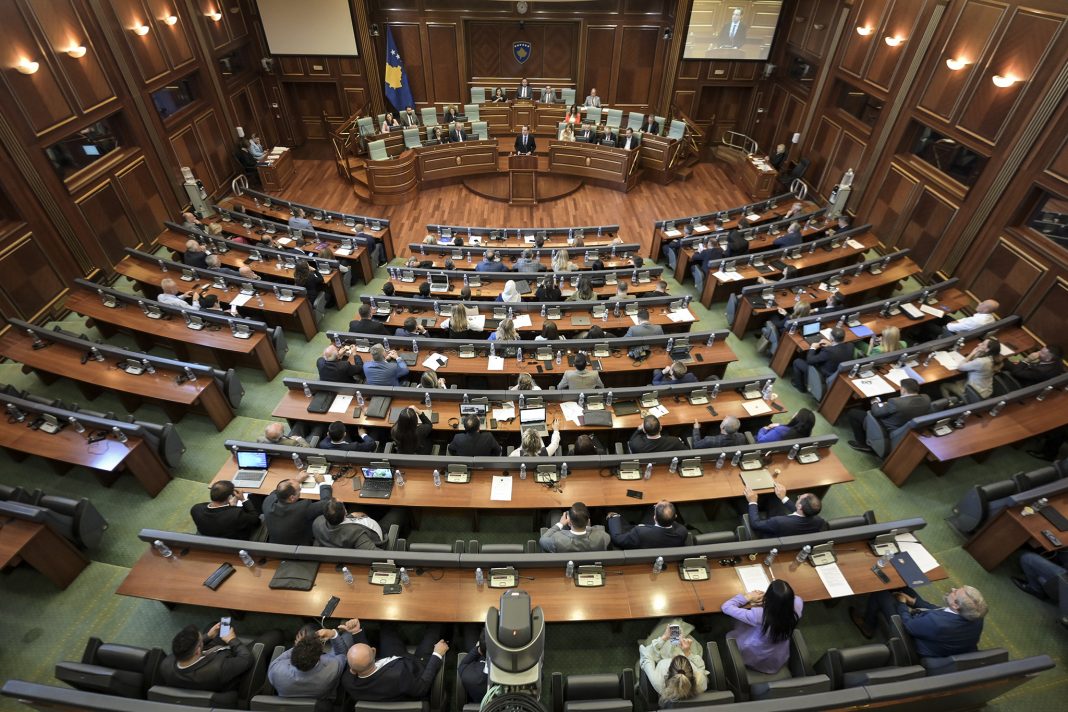
On Thursday, the Kosovo Assembly passed a resolution condemning the assault on the Kosovo Police that occurred on September 24 in the Banjska area of Zvecan and highlighting the necessity of an international inquiry into Serbia’s involvement in the attack.
The resolution garnered unanimous support, with 97 votes in favor and no votes against or abstentions.
The confrontations between the police and an armed group in the predominantly Serbian-populated northern region of Kosovo resulted in the loss of one police officer’s life and the lives of three assailants.
The session held on September 28 in the Kosovo Assembly began with a minute of silence to honor the fallen police officer, Afrim Bunjaku, who was posthumously recognized as a hero.
During the presentation of the resolution, Glauk Konjufca, the President of the Kosovo Assembly, emphasized the institution’s unequivocal condemnation of the attack on the Kosovo Police.
“The organized terrorist attack carried out by the Republic of Serbia against the Kosovo Police calls for international intervention to address Serbia’s role in orchestrating and supporting the terrorist group responsible for the attack in the northern region of the Republic of Kosovo.”
International investigations into Serbia have been formally requested, focusing on “terrorist activities and the continued existence of training camps for terrorist groups in Serbia”.
The resolution also acknowledged the collaborative efforts of the Kosovo Police with the European Union Rule of Law Mission (EULEX) and the NATO mission in Kosovo, KFOR, in their “joint efforts to thwart and eradicate terrorist attacks orchestrated by Serbia in the northern part of our country”.
“If Serbia goes unpunished, it will repeat the crime,” warned Kosovo’s Prime Minister Albin Kurti, as he appealed for international sanctions and penalties against Serbia following the attack on Kosovo Police.
Kurti stressed the importance of holding Serbia accountable during a session in the Kosovo Assembly, emphasizing that failure to do so could lead to a recurrence of such incidents.
He also called for international recognition of the Civil Protection organization and the Northern Brigade as terrorist groups by Kosovo’s partner states.
The Kosovo Government had already designated these two organizations as terrorist entities on June 29.
These groups are believed to operate in north Kosovo and comprise predominantly Serbian members, given the region’s Serbian majority.
Kurti expressed his gratitude for the countries that have condemned the attack on Kosovo Police and extended their support. He reiterated Kosovo’s commitment to fighting against crime and terrorism sponsored by Serbia, emphasizing the ultimate goal of preserving the independence of their state.
While Kosovo authorities have held Serbia responsible for the attack, Serbian President Aleksandar Vučić has countered, alleging that the assailants were Kosovo Serbs influenced by what he termed “Kurti’s terrorism”.
Mimoza Kusari-Lila, the leader of the parliamentary group for Kosovo’s ruling party, Self-Determination Movement, called for political unity in a period when Kosovo’s territorial integrity is perceived to be under threat.
She described the attack on Kosovo Police as an organized and directed assault from Belgrade aimed at instigating a new conflict in Kosovo.
Kusari-Lila emphasized the need for consistent condemnation of terrorism and crime and accused Serbia of remaining unchanged in its approach, comparing it to the era of former leader Slobodan Milošević, albeit with reduced influence and a more limited sphere of operation.
The leader of the opposition party, the Democratic Party of Kosovo, Memli Krasniqi, has urged for an international inquiry to investigate Serbia’s potential involvement in the recent attack.
Krasniqi emphasized that defeating the terrorist group in Zvecan’s Banjska region does not mark the end of Serbia’s ambitions towards Kosovo, which, in his view, entail destabilizing the country significantly.
He firmly asserted that the planning and execution of the terrorist assault on their republic primarily originates from Belgrade.
He further stated that Kosovo should actively pursue the extradition of the individuals responsible for the attack, who are believed to be in Serbia.
Lumir Abdixhiku, the leader of another opposition party, the Democratic League of Kosovo, pointed out that the objective of the September 24 attack was to reshape the landscape in the northern part of Kosovo.
Abdixhiku commended Kosovo’s response to the assault, deeming it the most appropriate course of action.
Abdixhiku underscored the incontrovertible facts: Kosovo did not initiate aggression against Serbia, did not cause harm to a foreign state’s police officer, did not dispatch military assets or troops to another nation, did not harbor armed individuals who had committed crimes abroad, and refrained from stationing armed forces within religious premises.
Ramush Haradinaj, the leader of the Alliance for the Future of Kosovo, voiced his support for a resolution condemning the Banjska attack, stressing the importance of its approval by the Kosovo Assembly.
Haradinaj called for the inclusion of a demand for an international investigation in the resolution to uncover Serbia’s potential involvement and assist the international community in penalizing terrorism sponsors.
Enis Kervan, the head of the multi-ethnic parliamentary group, acknowledged that the tragic loss of officer Bunjaku serves as a poignant reminder of the challenges that Kosovo confronts in its northern region.
The international community, including the United States and the European Union, has unequivocally condemned the attacks on the Kosovo Police and called for the apprehension and prosecution of the culprits.