

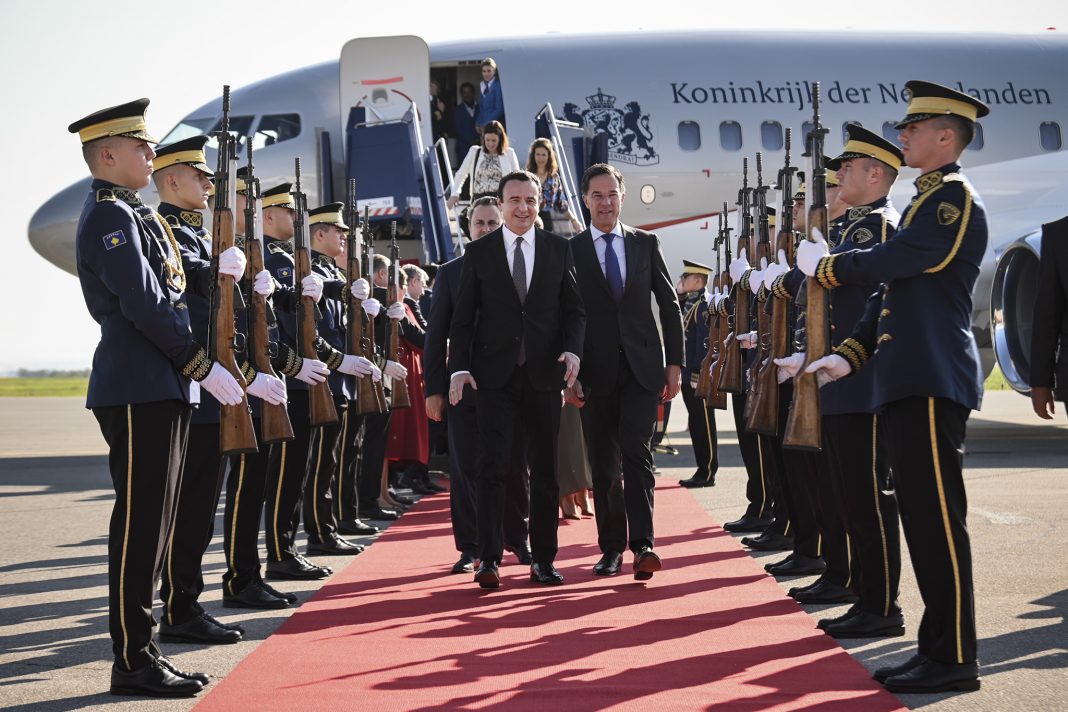
The Prime Ministers of the Netherlands and Luxembourg called on Kosovo to adhere to the European Union’s plan to de-escalate the situation in northern Kosovo, which is predominantly inhabited by Serbs.
On Tuesday, Dutch Prime Minister Mark Rutte and Luxembourgish Prime Minister Xavier Bettel met with Kosovo’s President Vjosa Osmani and Prime Minister Albin Kurti in Pristina.
During a press conference, Rutte stated that the best way to de-escalate the situation is that the parties fulfill the demands presented by the European Union, emphasizing that regional stability is of great importance.
“Today we expressed our concerns about the growing tensions between Kosovo and Serbia, and the Netherlands and Luxembourg are trying to de-escalate the situation through dialogue and normalize relations between the two states. This is important not only for peace and stability in the region but also for prosperity and integration towards the EU,” said the Dutch Prime Minister.
Bettel also called for the reduction of tensions, emphasizing that all parties desire de-escalation.
“The guidance from [EU envoy for dialogue, Miroslav] Lajčák and [EU’s chief diplomat, Josep] Borrell also present important steps for us to move forward. We must avoid any potential new crises,” Bettel said.
Kurti stated that Kosovo desires good neighborly relations with Serbia. The Kosovar Prime Minister mentioned that the implementation of the Agreement on Normalization, reached earlier this year, is required for this purpose.
“We seek a European solution, and for that, we have the 27 February Basic Agreement and the 18 March Implementation Annex that we want to be fully implemented, without delays and conditions,” he said.
Meanwhile, during the meeting of European leaders with President Osmani, she stated that Kosovo has “demonstrated willingness” to de-escalate the situation by “offering to hold snap elections in the northern part of the country”.
Rutte and Bettel’s visit to Pristina came after they stayed in Belgrade a day earlier, where they held talks with Serbian state leaders.
This visit by the two European Prime Ministers was planned several months in advance. However, they used this visit to convey the message of the European Union and the international community regarding the reduction of tensions in northern Kosovo, the pacification of the situation in that area, and the return of Pristina and Belgrade to the Brussels dialogue.
In Belgrade, Bettel expressed hope that progress will be made “in the coming days and weeks and that the situation will de-escalate”, adding that he hopes there will be no need to discuss further pressures to be exerted on the parties to resolve this situation.
Meanwhile, Rutte emphasized the importance of fulfilling the demands presented by the EU, as he believes that their fulfillment is the fastest way to move towards de-escalation.
The EU is seeking the withdrawal of special units of the Kosovo Police from the vicinity of municipal buildings in the north, parallel to the withdrawal of Serbian protesters. Additionally, the European bloc is requesting the removal of newly elected mayors from municipal buildings, the announcement of elections in the north, and the public commitment of Serbs to participate in the voting process.
Belgian Prime Minister Alexander De Croo was scheduled to participate in this visit as well. However, he canceled his participation due to an internal political crisis.
The visit of the Prime Ministers of the Netherlands and Luxembourg comes at a time when tensions between Kosovo and Serbia have escalated.
Tensions increased in late May in Zvečan, Zubin Potok, and Leposavić – municipalities predominantly inhabited by Serbs – as local Serbs opposed the newly elected Albanian mayors.
The new Albanian mayors were elected in the April elections, which were boycotted by local Serbian parties and population.




