

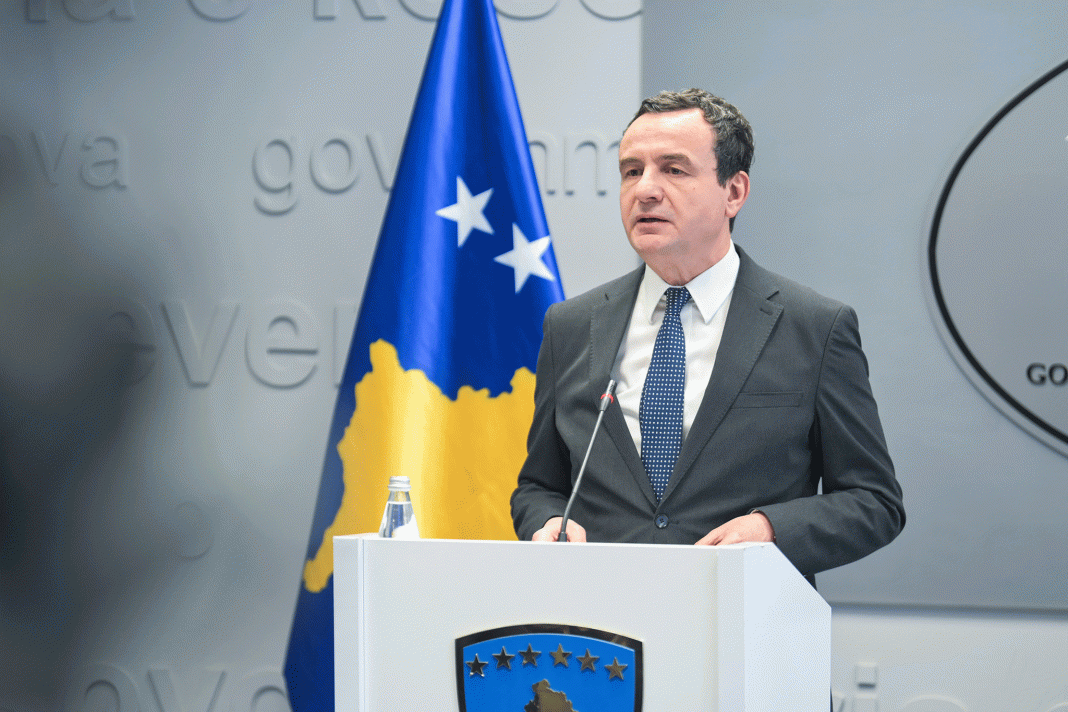
Kosovo’s Prime Minister Albin Kurti has questioned the European Union about why the draft statute of the Association of Serb-majority Municipalities was discussed in Brussels for several years “if the draft statute is an internal matter of Kosovo”.
While responding to journalists’ questions at a press conference on December 27 in Pristina, Kurti referred to the statements of the EU-facilitated dialogue mediator, Miroslav Lajčák, according to whom the issue of the draft statute is “only an internal matter of Kosovo”.
“Now, besides the letter from Serbian Prime Minister Ana Brnabić, there is also a new position that perhaps needs to be addressed. If the draft statute is our internal issue in Kosovo, then why did we mention it at the negotiation table in Brussels? If the draft statute was our internal issue, why have we been raising this for the past two or ten years in Brussels? Let’s move forward,” said Kurti.
This issue and the letter from Serbian Prime Minister Ana Brnabić – submitted to the headquarters of the European Union in early December – in which she confirms that there is a red line when it comes to the implementation of the Agreement on the Roadmap to Normalization of Relations with Kosovo – reached earlier this year in Brussels and in Ohrid – Kurti assessed that these are two elements that need to be taken into account.
“That letter is now in the file. With that letter, Serbia has withdrawn from the Basic Agreement. If you read that letter, Serbia has withdrawn from the Basic Agreement. I should not deal with it; let the mediator deal with the party that withdrew from the Basic Agreement. Why should I deal with this? In Brussels’ file, that letter is a capital obstacle to normalization and further talks. So, let them address that letter because without withdrawing that letter, the withdrawal from the commitment to the Basic Agreement cannot happen,” said Kurti.
On December 13, a summit between the Western Balkans and the EU was held in Brussels. Serbian Prime Minister Ana Brnabić, through a letter sent to Brussels – seen by Radio Free Europe, expressed reservations about the Agreement towards the normalization of relations that the parties reached in Brussels in February and later agreed on its Implementation Annex in March in Ohrid.
“The Agreement on the Roadmap to the normalization of relations and its Implementation Annex, as referred to in this statement, is considered acceptable only in the context in which it does not include the de facto or de jure recognition of Kosovo,” the document stated.
Among other things, the Agreement, consisting of 11 points, envisages a level of self-governance for the Serbian community in Kosovo and mutual recognition of state symbols. It also requires Pristina and Belgrade to implement all previous agreements of the dialogue.
During the press conference, Kurti also mentioned that this year has been challenging, especially in the northern part of Kosovo, predominantly inhabited by Serbs. He referred to the attack by an armed group of Serbs in Banjska against the Kosovo Police, responding to whether there is information about the presence of high-level Serbian state officials in the north a few days before the September 24 attack.
“As for the former chief of the Serbian Security and Information Agency (BIA), Aleksandar Vulin, if he was in north Kosovo before September 24, I cannot confirm such a thing, as I am hearing it for the first time today. So, as far as I know, this is not true, but those who claim otherwise should provide evidence for a different information,” said Kurti.
Meanwhile, Kosovo’s Minister of Foreign Affairs and Diaspora Donika Gërvalla, during a joint press conference with Kurti, said that “our allies and partners understand that [Serbian President Aleksandar] Vučić and [Russian President Vladimir] Putin are ready for any escalation, including war”.
“Both in the European Union and in the United States and the United Kingdom, voices criticizing EU institutions for wrong stances towards Serbia and the lack of punishment for open aggression against Kosovo have increased. Kosovo’s stance has been consistently principled, persistent, and courageous,” said Kosovo’s chief diplomat.
For the attack in Banjska, where a Kosovo Police officer was killed, and three Serbian attackers were killed during armed clashes, responsibility was attributed to Milan Radojičić, former deputy chairman of the Serb List – the main political party of Serbs in Kosovo, enjoying the support of Serbia.
Kosovo blames Serbia for the attack, but Belgrade denies any involvement.




