

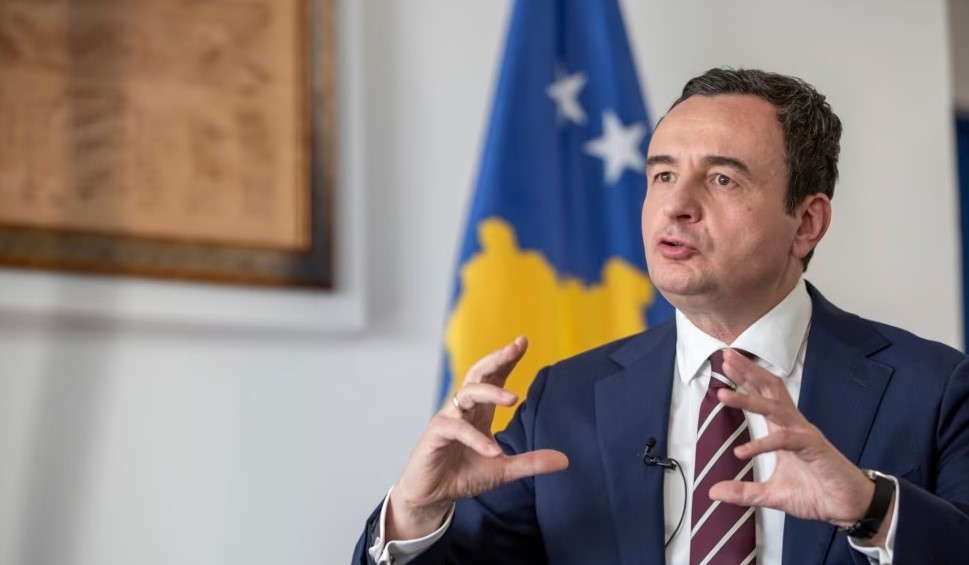
Kosovo’s Prime Minister stated that once the Kosovo Police verifies that Serbia is fully and unconditionally implementing the decision to accept license plates from the Republic of Kosovo, the Kosovar Government will make an “equivalent decision as a matter of reciprocal interstate relations”.
In the Government meeting on December 27, Kurti mentioned that Serbia is using the license plate issue to reduce international pressure on it and to “mask their failure in Banjska on September 24”.
The Director of the Office for Kosovo in the Government of Serbia, Petar Petković, announced on December 25 that the Serbian Government has made a decision to enable the free movement of all vehicles from Kosovo into Serbian territory.
“… this action by Serbia, which is more than constructive and a step towards normalization, is another maneuver not for the sake of the Serbian state, let alone for the sake of Kosovo but for the sake of power in Belgrade,” Kurti said during the Government meeting.
For such a thing, Serbia had agreed to the 2011 agreement reached between representatives of Kosovo and Serbia in the EU-mediated dialogue.
“Our stance regarding the license plate issue has been based on the principle of reciprocity. We will continue to be principled and constructive. Our equivalent decision as a matter of reciprocal interstate relations will be made as soon as our border police documents and verifies that Serbia is fully and without hindrance implementing its decision. We believe that this approach is not only fair but also reasonable,” Kurti said on Wednesday.
Speaking about Serbia’s decision to accept Kosovo license plates, Kurti stated that such a decision comes “after more than a 10-year non-implementation of previous agreements”.
He mentioned that Serbia initially used the license plate issue to escalate the security situation in north Kosovo and is now using it to deflect criticism from the West after “irregularities and fraud in the December elections there”.
“[License plates] are being used to reduce pressure from democratic forces, the European Union, the United States, on Serbia for irregular and undemocratic elections, to cover up the official refusal of the basic Brussels agreement made by Serbian Prime Minister [Ana] Brnabić in a letter addressed to the European Council on December 13, and to mask their failure in Banjska on September 24,” Kurti said.
The European Union welcomed Serbia’s decision to officially recognize license plates from Kosovo within its territory, considering it a positive step towards normalizing relations.
The EU expects Kosovo to take a similar decision, said spokesperson Peter Stano.
“We welcome Serbia’s decision to officially recognize the license plates of vehicles issued by Kosovo. This decision is a positive step in implementing the agreement on the path to normalization and previous commitments within the dialogue for freedom of movement. This demonstrates that progress in the normalization process between Kosovo and Serbia is possible,” Stano said in a written response.
The European Union also assessed that the decision on license plates is a positive step toward the better European integration of the Western Balkans.
“This decision paves the way for the complete removal of the sticker regime. The EU now expects Kosovo to respond in a similar way,” Stano added.
Before the sticker practice, vehicles with Kosovo license plates had to obtain provisional plates at the border with Serbia, which were valid for 60 days and cost 5 euros. However, on September 20, 2021, the Kosovo Government decided on the reciprocity measure, forcing drivers from Serbia to undergo the same procedure to enter Kosovo.
But this measure caused dissatisfaction among the Serbian population in Kosovo, which blocked the roads leading to the border crossing points with Serbia in Jarinje and Bërnjak.
To ease tensions, with the mediation of the blockade, on September 30, 2021, a temporary agreement on license plates was reached.
This agreement allowed drivers with Kosovo and Serbian license plates to affix stickers to the state symbols on the plates each time they crossed the border between these two states.




