

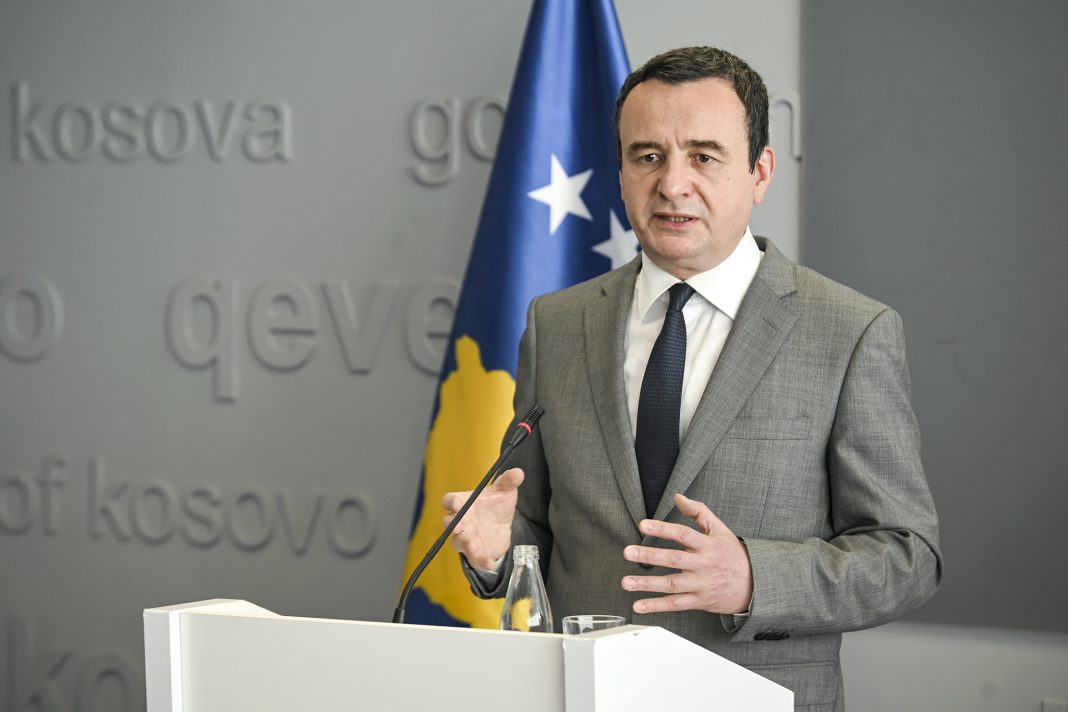
Kosovo’s Prime Minister Albin Kurti stated that holding snap elections in the four municipalities in northern Kosovo is the only way to change local power in these predominantly Serbian-populated communities.
He mentioned that he agrees with holding elections but emphasized the need for preparations to ensure a fair and open campaign “so that there are no threats and, in the end, another boycott and low turnout”.
“The change of power cannot be achieved through violence, by injuring NATO soldiers, Kosovo police, or journalists, but only through snap elections. Article 72 on local self-government clearly explains how to start by gathering 20% of the comprehensive electorate’s signatures on a petition to initiate the process for those early elections,” Kurti said during a press conference following the Government meeting held on 5 July.
Kurti dismissed claims that tension is not being reduced and relations with Serbia are not being normalized due to a lack of agreement. He stated that the Agreement on the Normalization Process, signed by both parties in Brussels in February and its annex in Ohrid a month later, exists and needs to be fully implemented.
“Yesterday, I requested that everything in the Basic Agreement be included in the sequence of implementation. So, we shouldn’t leave anything aside,” Kurti said, adding that he made this request during his meeting in Pristina on Tuesday with the EU Special Representative for the Kosovo-Serbia dialogue Miroslav Lajčák.
The Kosovar Prime Minister also addressed the three requirements that the EU has presented to him for reducing tensions in northern Kosovo.
“For these three points, I practically told them that the Government has expressed its readiness to a considerable extent because we agree on early elections, and early elections also resolve the issue of the mayor in the municipality of Leposavić because the mayor is removed through elections,” he said.
Since the end of May, Serbs have been protesting in Zvečan, Zubin Potok, and Leposavić, opposing the work of new Albanian mayors from municipal buildings. Local Serb residents are also demanding the withdrawal of special units of the Kosovo Police from the vicinity of the buildings.
Kurti stated that the Government of Kosovo “by no means contributes to the escalation” of tensions in the north.
He emphasized the need for preparations for potential new elections so that Serbian parties can participate in them as well.
“It’s very easy to say snap elections, and I am in favor of them, but on the other hand, if you have no guarantee that the events of 23 April will not be repeated in the next elections, we need to think and prepare better,” Kurti said.
In the local elections on 23 April, Serbian parties did not participate, and the voting was boycotted by the Serbian population.
The international community has called on Serbia to ensure the participation of Serbs, unconditionally, in possible new elections in the north.
In the past, Belgrade has played a key role in the participation of Serbs in the elections organized in Kosovo.




