
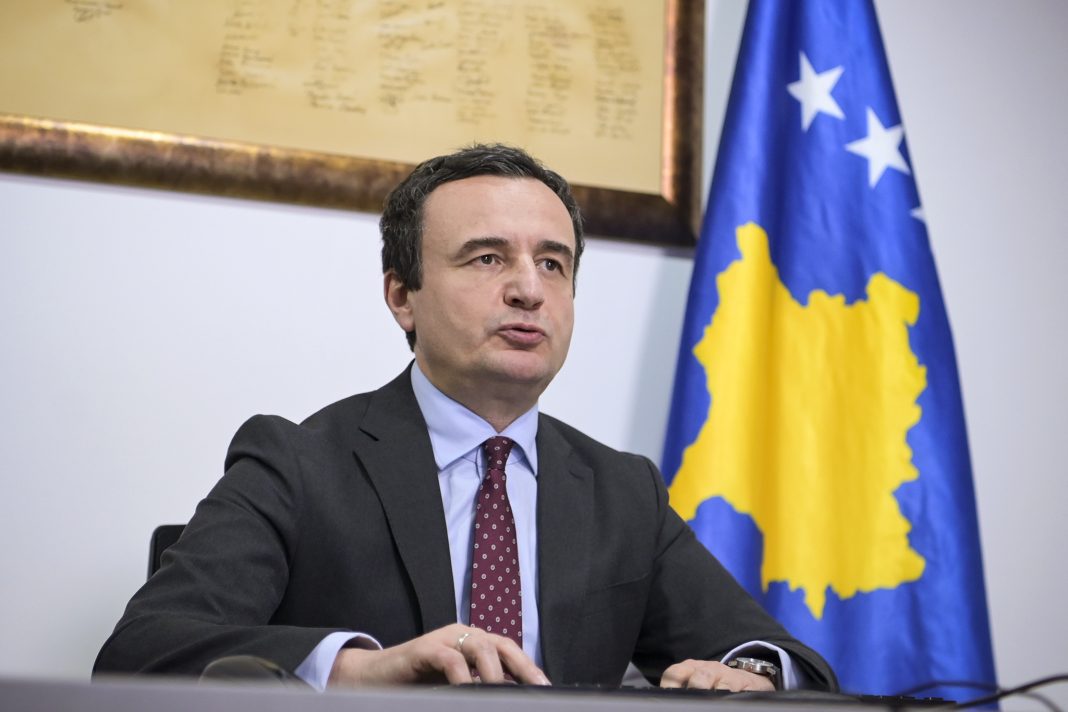
Kosovo’s Prime Minister Albin Kurti said on Saturday that neighboring states cannot feel secure from Serbia until they are part of the European Union.
Asked during the Peace Forum in Paris about Serbia’s intentions towards Kosovo, Kurti emphasized “its division or territorial compensations”.
“The neighbors of Serbia, as long as they are not part of the EU, are not secure from Serbia, and this should be taken into account in Brussels. They are resentful about the breakup of Yugoslavia; they thought they could destroy it and take half of it, but it didn’t happen that way,” said Kurti.
Kosovo has accused Serbia of attempting to annex the northern part of Kosovo after an attack by an armed group of Serbs in the village of Banjska in Zvecan on September 24, where a police officer and three attackers were killed. Serbia has denied the accusations, although responsibility for the attack was claimed by Milan Radojičić, the former deputy leader of the largest Serb party in Kosovo, the Serb List.
“I think, on the one hand, they [Serbia] want to see the division of Kosovo; they would like territorial compensations for their mistakes, but it is not possible,” Kurti said in Paris on Saturday.
A few years ago, former President of Kosovo Hashim Thaçi and Serbian President Aleksandar Vučić had discussed the possible exchange of territories between the two countries, but this issue had sparked numerous debates, both in Kosovo and on the international stage.
Kosovo is the only neighboring country of Serbia that has not yet received candidate status for EU membership.
Negotiations for accession have been ongoing for years for Montenegro and Serbia, while in July 2022, Albania and North Macedonia started the process. Bosnia and Herzegovina obtained candidate status in December of the previous year.
Kurti believes that the reason Kosovo has not yet received candidate status has been the lack of visa liberalization until now, which the European Commission approved earlier this year, before it takes effect on January 1, 2024.
“We have no other alternative; Europe is our continent, the EU is our future, and we want to benefit and contribute to the EU,” added Kurti.
Kosovo’s path to the EU depends on its dialogue with Serbia, European officials announced last week.
Although Kosovo has applied for EU membership, the EU’s Commissioner for Enlargement, Oliver Várhelyi, said on November 8 that the Council had not yet asked the Commission to give its opinion on this.
“We are ready to give our opinion,” he said.
“Our feeling is that for Kosovo, the path to the EU is coming through a successful dialogue. They need to double their efforts to make the dialogue successful,” Várhelyi added.
On November 8, the President of the European Commission, Ursula von der Leyen, said that the implementation of the agreement to establish the Association of Serb-majority municipalities could be a significant step forward for Kosovo.
In the Progress Report for Kosovo, in most of the evaluated areas, the European Commission stated that Kosovo has made “limited progress”.