

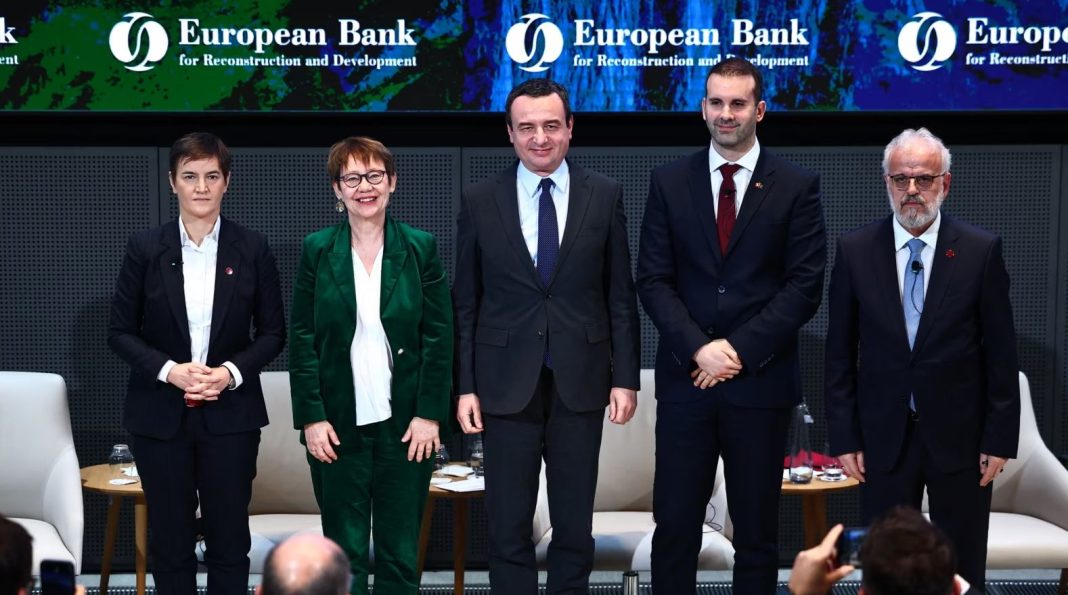
Kosovo’s Prime Minister, Albin Kurti, said that the key trading partners of Kosovo are the European Union member states.
At the summit for investments in the Western Balkans, held in London, Kurti was asked about the trade partnership with countries that do not recognize Kosovo. He said that one of them is Russia, with which, according to him, Kosovo will not have a partnership.
“Our key trading partner is the EU, and we want to strengthen and deepen this cooperation,” Kurti said at the summit organized by the European Bank for Reconstruction and Development (EBRD).
“We have no relations with the Russian Federation, we have imposed sanctions on the Russian Federation. We want Ukraine to win, and we need all of democratic Europe and the world to see the Kremlin and the despotic president [Vladimir] Putin defeated. We are not cooperating with them, even if they wanted to, we don’t want to. We have some imports from China, but the EU countries are our key trading partners,” he added.
During the panel discussion, attended by six prime ministers of Western Balkan states, it was stated that improving road, rail, and sea infrastructure, transitioning to green energy, and implementing reforms to improve the business environment are the three key priorities for these states in attracting foreign investments.
In London, the leaders of the six Balkan states said that their geographical position, which serves as a link to various parts of Europe, makes the region attractive to foreign investors.
Kosovo’s Prime Minister, Albin Kurti, said that his country has a young workforce and competitive trade costs.
“Our government is focused on the rule of law, combating corruption, and in line with the United States, the EU, and the United Kingdom geopolitically and in business values,” he said.
His Serbian counterpart, Ana Brnabić, said that her country is focused on improving road infrastructure and transforming into a technological innovation economy.
From the EBRD, Albania and Serbia were praised for their work on transitioning to green energy. Albania said it now relies entirely on solar and wind energy, while other countries in the region, including Kosovo, announced their plans to use renewable resources for energy.
Prime Minister Kurti mentioned the completion of an auction for a solar energy park in Kosovo with a production capacity of 100 megawatts per hour. He announced a similar project, but with wind energy, later this year.
“We need more [foreign direct investments]. But Kosovo is a place where investments can be made because they are already happening,” Kurti said.
Better relations between the region’s states, it was said at the summit, help the Western Balkans move towards the common market of the European Union. In this regard, the six Balkan states mentioned their road and rail projects that better connect with each other and the rest of Europe.
During the summit, Serbian Prime Minister Brnabić, while referring to investment figures and economic growth, said they refer to Central Serbia, excluding “Kosovo and Metohija”, which she said is part of Serbia.
Kurti responded to this statement:
“The name of my state is the Republic of Kosovo. It is not as you referred to it as ‘Kosovo and Metohija’. If I followed this example, it would take a lot of time because instead of Serbia, I would say: Serbia and Vojvodina and Sandžak, Toplica, Raška, the Preshevo Valley, and the Timok region,” Kurti said, as Brnabić was heard saying that such a statement does not correspond to reality.
Kosovo declared independence in 2008 and is recognized by 117 states, but Serbia continues to consider it part of its territory.
Tensions between the two states have recently escalated due to a decision by Kosovo to stop using the Serbian dinar for cash payments.
The European Union, which mediates the dialogue for the normalization of relations between Kosovo and Serbia, has called for the issue to be resolved in this process.
The United States, which does not participate directly in the process but supports it, has called on Kosovo to postpone the implementation of the decision, saying that the decision did not take into account the negative effects on the Serbian community.
The United States and the EU also urge the parties to reach a solution through dialogue, with the US saying that an agreement from the dialogue would eventually lead to mutual recognition.




