

Albanian political parties can only factorize the Albanian electorate’s vote if they manage to group together and compete as two blocs, political analysts emphasize.
These comments have preceded intensified meetings between the leaders of Albanian opposition parties, Besa Movement, Alternativa, and the Democratic Movement, which recently split from the Democratic Union for Integration (DUI) in power and is currently represented in Parliament by three deputies.
Political analysts say that the unification of Albanian parties under a common cause can be achieved through a strong regional figure among the Albanians. This perspective also pertains to the announced informal visit of Kosovo’s Prime Minister Albin Kurti to Skopje on August 11.
Kosovo’s Prime Minister’s Office has emphasized that Kurti has been invited by the Mayor of Cair Municipality in Skopje, Visar Ganiu, to promote a road named after Adem Demaçi and in Tetovo, upon invitation from the Mayor of Tetovo, Bilall Kasami, to discuss the Tetovo-Prizren road connection.
“The visit of Prime Minister Kurti to North Macedonia will be carried out upon an invitation from the Mayor of Cair Municipality, Visar Ganiu, and the Mayor of Tetovo, Bilall Kasami, on the occasion of renaming a road in Skopje after Adem Demaçi and inaugurating a significant road segment connecting Prizren and Tetovo,” said Përparim Kryeziu to Radio Free Europe, without specifically addressing why this time he is not meeting with the leader of DUI, a part of the ruling coalition.
“In the context of the Prespa Forum in Struga, Prime Minister Kurti had meetings with Albanian officials of North Macedonia, including the leader of DUI, Ali Ahmeti. Meanwhile, communication between government cabinets is regular,” said Kryeziu.
Cair Municipality and Tetovo are led by the Albanian opposition in North Macedonia. Visar Ganiu has already joined the faction that split from DUI, the Democratic Movement – a new party that is forming – while Tetovo is led by Bilall Kasami, the leader of Besa Movement.
- Open Balkan Initiative brings Albanian opposition in North Macedonia closer to Prime Minister Kurti
Izet Mexhiti, who initiated the formation of the new party Democratic Movement, told Radio Free Europe that the informal visit of Kosovo’s Prime Minister Albin Kurti scheduled for Friday (August 11), serves the purpose of deepening the cooperation between the Albanian opposition and the Self-Determination Movement, and will also discuss political topics such as the Berlin Process.
“Political topics will also be discussed, where there will be a distinction between those who are in favor of the Open Balkan Initiative and those, namely us, as well as Kurti, who are in favor of the Berlin Process. Naturally, we will also discuss topics that enhance cooperation between the Albanian opposition front in North Macedonia and the Self-Determination Movement in Kosovo,” Mexhiti added.
The Open Balkan Initiative has been criticized several times by Bilall Kasami as well.
- Rama-Kurti rivalry is demonstrated in North Macedonia too
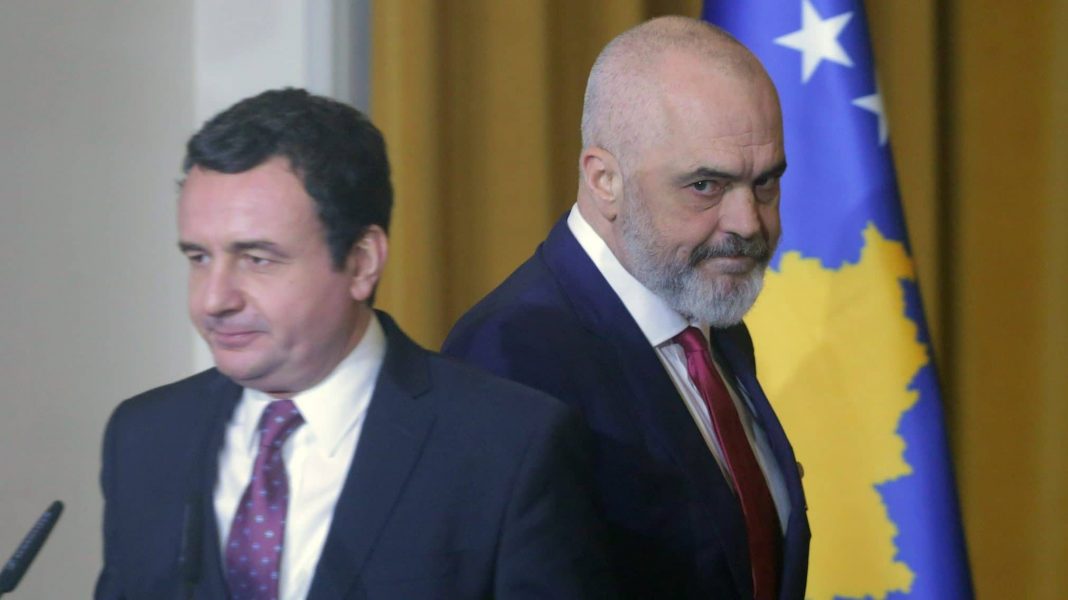
For political observers, Kurti’s arrival in Skopje is seen as a push for the Albanian position by Prime Minister Kurti to cooperate as a common front, but at the same time, it is also a demonstration of rivalry with the Prime Minister of Albania, Edi Rama, who was one of the promoters of the Open Balkan Initiative.
“Mr. Rama and Mr. Kurti, their rivalry for influence or political dominance in the Albanian-speaking space, extends to North Macedonia,” says Xhelal Neziri, a political analyst, recalling that it was Rama who invited the leaders of the major Albanian parties in North Macedonia for a meeting before the Albanian Alliance for Albanians joined the government.
“Meanwhile, we know that from 2015 onwards, we have a very close cooperation between the Self-Determination Movement and the Besa Movement. This rivalry (between Rama and Kurti) is evident in North Macedonia too. But, the positive aspect of all this rivalry is that, perhaps, finally, in the upcoming elections, we will have a competition between two blocs or coalitions of Albanian political parties – one in power and the other in opposition – and surely we will have more substantial offers,” Neziri evaluates for Radio Free Europe.
North Macedonia is facing an important process related to the change of its Constitution, specifically the inclusion of Bulgarians in the preamble. Otherwise, the integration process of the country is at risk of being blocked.
The Macedonian opposition says that the lack of votes to advance constitutional changes shows that the government lacks legitimacy.
The Albanian opposition is also calling for early elections, as North Macedonia and its European future remain “hostage to certain power structures captured by corruption”.




