

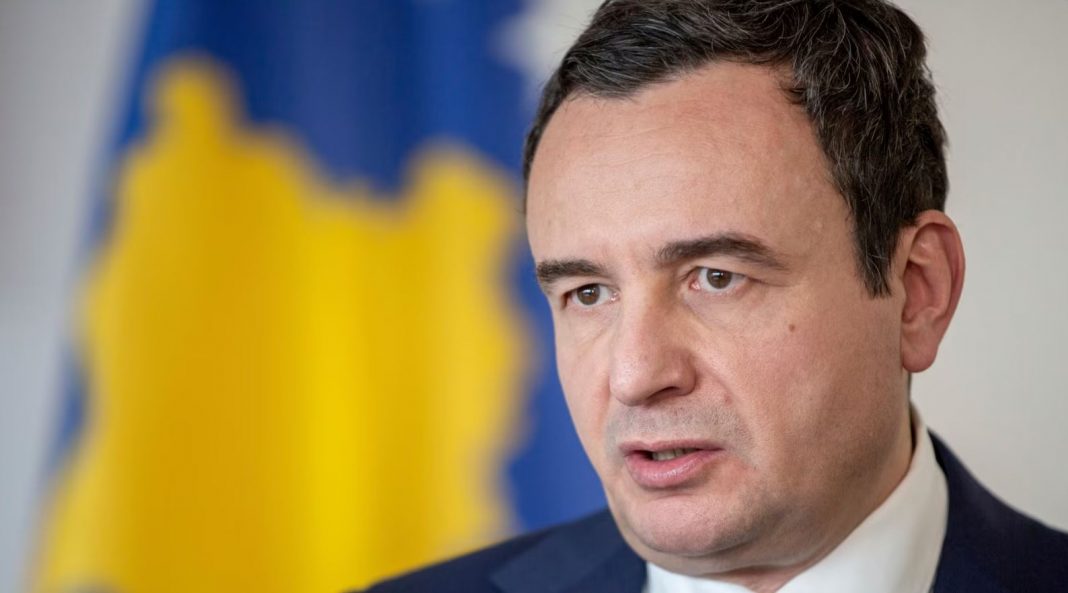
Kosovo’s Prime Minister Albin Kurti has asserted that Russia is actively seeking to create a crisis “in the backyard of the European Union” with the aim of diverting attention away from NATO.
In a Facebook post, Kurti expressed growing concern over the “threat posed by Russia and Serbia to regional stability, peace, and security”.
Kurti’s comments about Russia’s alleged intention to provoke a new crisis come shortly after Ukrainian President Volodymyr Zelensky warned that Moscow is attempting to instigate a conflict in the Western Balkans.
“Pay attention to the Balkans. Believe me, we are receiving information. Russia has a long-term plan. [First, we had] the Middle East – the second distraction will be the Balkans,” Zelensky stated on November 15.
These concerns raised by Zelensky have found support within the EU, while the U.S. State Department has informed Radio Free Europe that Washington is collaborating with Western Balkan states and European partners to promote governance, rule of law, and anti-corruption reforms. This joint effort aims “to diminish the potential for Russian influence and foster long-term peace, stability, and prosperity in the region”.
Conversely, according to Kurti, Serbia’s objective is to fulfill territorial ambitions toward its neighboring countries. He referenced the group of Serbs responsible for the attack on Kosovo Police officers on September 24 in Banjska, Zvecan, resulting in the tragic death of a police officer.
Milan Radojičić, the former deputy leader of the Serb List, the largest Serbian party in Kosovo supported by Belgrade, has assumed responsibility for this attack.
Although Kosovo has accused Serbia of supporting the assault, Belgrade has vehemently denied any involvement.
“Even after international pressure, Serbia has not withdrawn all troops and artillery from the vicinity of Kosovo’s territory. It continues to threaten the security of the Republic of Kosovo with the operational bases of the Serbian Armed Forces along our border. Furthermore, Serbia has deployed anti-aircraft systems near the border with Kosovo,” Kurti stated, albeit without providing concrete evidence for these claims.
Kurti has called for sanctions against Serbia in response to the Banjska attack. He asserted that on November 10 in Raška, Serbia, Radojičić led a meeting with numerous Serbian politicians and officials from parallel Serbian municipalities. According to Kurti, the head of the Office for Kosovo in the Serbian Government, Petar Petković, and representatives of the Serb List also attended the meeting.
Kurti claimed that the meeting sought mobilization for the ruling Serbian Progressive Party in the upcoming Serbian parliamentary elections on December 17.
However, the Serb List has refuted the assertion that such a meeting took place in Raška. The newly appointed leader of the party, Zlatan Elek, told the Kossev portal in North Mitrovica that he is “hearing about this for the first time”.
“I don’t understand what connection Radojičić has with the Serb List,” he remarked.




