

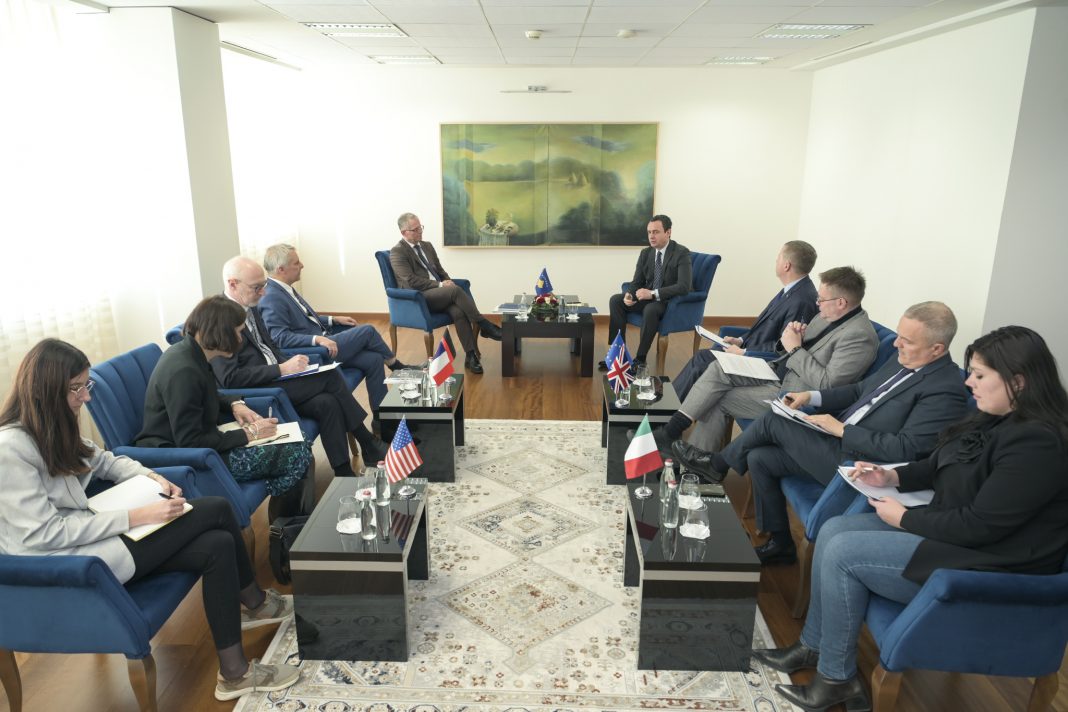
The Prime Minister of Kosovo, Albin Kurti, told the ambassadors of the QUINT states and the head of the European Union Office in Kosovo during a meeting on Friday that the only permitted currency for use in cash transactions is the euro, following the decision of the Central Bank of Kosovo to cease the use of the Serbian dinar.
Last week, the Central Bank of Kosovo issued a regulation requiring all cash transactions anywhere in Kosovo to be conducted in euros, starting from February 1.
Kurti urged the QUINT countries to respect the decision of the Central Bank, according to a statement from the Government of Kosovo released later on Friday.
“In the meeting, Prime Minister Kurti emphasized the importance of respecting constitutionality and legality in the country by all, while at the same time respecting independent authorities, in this case the Central Bank,” the statement said.
Kurti’s meeting with the ambassadors of the United States, the United Kingdom, Germany, France, and Italy comes a few days after the U.S. called on the Government of Kosovo to reconsider the Central Bank’s decision regarding the dinar, while the European Union sought clarifications.
For more than two decades, encouraged by Belgrade, residents of ten Serbian-majority municipalities in Kosovo used the Serbian currency for everything – from salaries and pensions to payments in shops and restaurants.
According to the Central Bank’s decision, dinars will now only be allowed to be held in bank accounts or exchanged for euros.
For this decision, it was referred to the determination of the Constitution of Kosovo for “a single currency” as legal tender.
In this part of the Constitution, which includes Article 11, Kosovo’s Deputy Prime Minister Besnik Bislimi also referred to on Wednesday.
“The Constitution, either it is sacred and must be applied, or then we do cherry picking. If we have to do cherry picking, we are doing it. If it has to be applied, then insist that it be applied in all cases,” Bislimi said in a press conference with Czech Minister for European Affairs Martin Dvorak in Pristina on September 24.
For years, dinars entered Kosovo through the National Bank of Serbia, which has a branch in the municipality of Leposavic, in north Kosovo. Those funds were then transported by the money transport company “Henderson”.
The largest Serbian party in Kosovo, the Serb List, did not welcome the decision of the Central Bank and, through a statement issued on January 18, said that it jeopardizes the survival of Serbs in Kosovo.
According to the Serb List, Kosovo policymakers are trying to expel Serbs “without using weapons”.




