

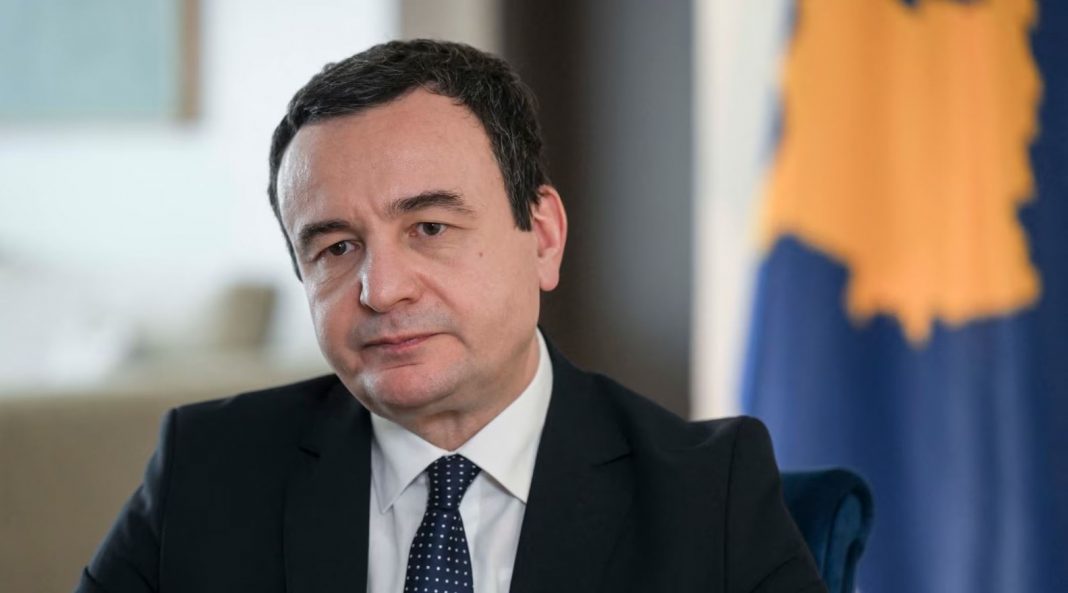
Kosovo Prime Minister Albin Kurti stated that the events of September in Banjska of Zvecan, the May protests in north Kosovo, and the increased Russian presence in the Western Balkans make the signing of the Agreement for the normalization between Kosovo and Serbia more “urgent than ever”. However, with the refusal of Serbian President Aleksandar Vučić to sign this agreement, according to Kurti, he leaves open the possibility of “the occupation of Kosovo”.
Last February, Kosovo and Serbia agreed in Brussels on this agreement, while in April, agreement was reached in Ohrid for its implementation annex. However, the parties did not sign the agreement, but the European bloc, which mediates the dialogue for the normalization of relations between Kosovo and Serbia, said it is binding on the parties.
“I can’t see any other reason for the refusal to sign [by Serbia]. Then, they want to keep this door open [to Kosovo’s occupation] and have a possibility window to return and commit aggression,” Kurti said during a panel discussion organized by Chatham House on February 13.
The Agreement for the normalization road, with 11 annexes, among other things, also provides for a level of self-governance for the Serbian community in Kosovo and mutual recognition of state symbols, while requiring Pristina and Belgrade to implement all previous agreements reached during the dialogue.
In the discussion panel, Kurti said that Serbia’s “authoritarian regime” is “holding back the entire region”. According to him, Belgrade largely recognizes Kosovo de facto, but not de jure.
The Kosovar Prime Minister said that Serbia uses Kosovo to maintain good relations with Russia and China.
“There is a general thesis that Serbia maintains good relations with the Russian Federation and China to use them in aggression against Kosovo. But I think it’s the opposite. Specifically, Serbia uses its aggression against Kosovo to maintain good relations with the Russian Federation and China. Because with dictators who don’t trust anyone, you have to constantly show yourself. I think Vučić is doing that. With his aggression against Kosovo, he is trying to maintain good relations with the Kremlin,” Kurti said.
Referring to the events in Banjska in September, when a group of armed Serbs attacked the Kosovo police, killing one officer, Kurti again accused Serbia of the incident, which Kosovo considers a terrorist attack.
During the clashes on September 24, three Serbian attackers were also killed. Milan Radoičić, former deputy mayor of the Serb List, the main party of Serbs in Kosovo enjoying the support of official Belgrade, was responsible for the attack.
Kurti said that through Serbia, Russia is increasing its presence in the Western Balkans.
“So, Serbia’s alliance with Russia is not just a theoretical threat to Europe and the Balkans. It’s a real threat that Kosovo, but not only, constantly experiences. Through Serbia, we have seen the increase of Russian presence in the Balkans, whether through media, intelligence, or other forms of intervention”.
Authorities in Kosovo had declared after the attack in Banjska that they were investigating possible Russian involvement in it.
At the end of last year, in a report by the Balkan Investigative Reporting Network (BIRN), it was stated that Kosovo is exposed to disinformation and narratives coming from Russia and China, which aim to incite ethnic and interfaith warfare in Kosovo.




