

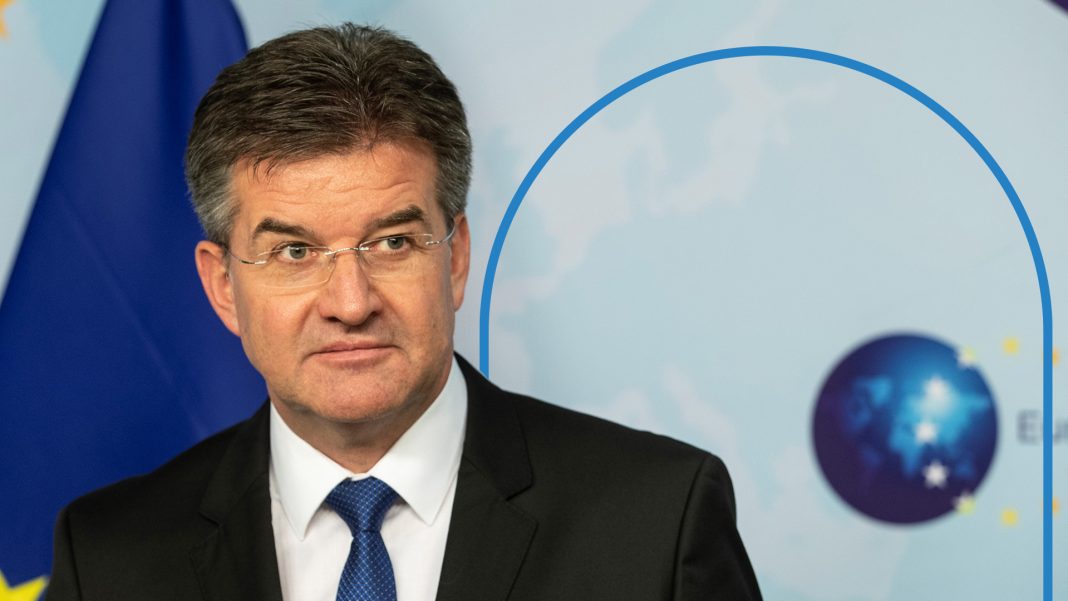
The European Union’s Special Envoy for the Kosovo-Serbia dialogue, Miroslav Lajčák, has emphasized the necessity for Serbia to fulfill all the provisions of the Agreement on the path to normalizing relations.
In addition to Kosovo’s obligation to establish the Association of Serbian Majority Municipalities, Lajčák stressed that Serbia must also comply with other unmet obligations outlined in the Agreement.
Lajčák described the latest European proposal for the Association’s status as a modern European approach to resolving the sensitive issue of minority protection in accordance with the highest European standards. He assured that this proposal respects the boundaries set by both parties.
Lajčák further confirmed that Kosovo and Serbia have shared comments and queries about the European proposal, and the European bloc will address all these questions and concerns in the coming weeks.
He announced an upcoming meeting between the chief negotiators of Kosovo and Serbia to discuss the next steps in implementing the Agreement towards normalization.
Lajčák underlined that the “focus should now be on advancing the implementation of the agreement without preconditions and delays, as urged by European leaders. Formalities should not hinder this important process,” he emphasized.
In late October, leaders of France, Germany, and Italy, along with EU representatives, held separate meetings with Kosovo’s Prime Minister Albin Kurti and Serbia’s President Aleksandar Vučić.
Despite high-level political involvement, the parties failed to reach an agreement on implementing earlier accords.
Kurti expressed his willingness to sign an Agreement on normalization, which would include the European proposal for the formation of the Association. However, he pointed out that Vučić was not prepared to do so. Vučić indicated his readiness to implement the provisions of the Agreement towards normalization that exclude respecting Kosovo’s territorial integrity and Kosovo’s United Nations membership.
On February 27, Kurti and Vučić reached an Agreement towards normalization, and on March 18, the parties agreed on the Implementation Annex. Nonetheless, the agreement has not been signed by the parties due to President Vučić’s refusal, citing “Serbia’s international recognition and Kosovo’s lack of it”.
The agreement comprises 11 articles, providing a level of self-governance for the Serbian community in Kosovo and mutual recognition of state symbols. It also calls for the implementation of all previous dialogue agreements by both Pristina and Belgrade.
A day after the meetings in Brussels, France, Germany, and Italy called on Serbia to acknowledge Kosovo de facto, while urging Kosovo to establish the Association.
Kosovo and Serbia initially agreed on the Association in 2013 and later in 2015 on the principles governing its establishment. In 2015, the Constitutional Court of Kosovo ruled that the agreement was not entirely in line with the country’s Constitution.
Kosovo has so far refrained from establishing the Association of Serb-majority municipalities, expressing concerns that it might disrupt the functioning of the state. On the other hand, Serbia insists on the Association’s formation.




