

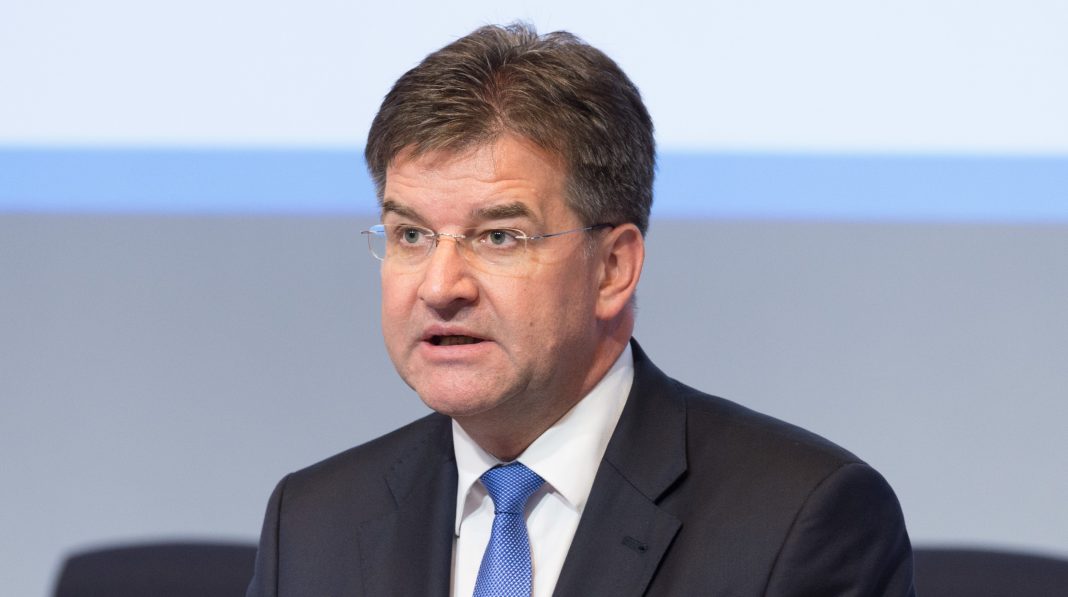
The European Union’s Special Envoy for Kosovo-Serbia dialogue, Miroslav Lajčák, is scheduled to arrive in Pristina on Monday evening for discussions with Kosovo’s leaders on various matters, including the draft statute of the Association of Serb-majority municipalities. This information comes from Radio Free Europe.
Lajčák will meet with Kosovo’s Prime Minister Albin Kurti, Deputy Prime Minister Besnik Bislimi, as well as representatives of the opposition in Kosovo.
Lajčák’s visit follows meetings held in Brussels on October 26, where Kosovo’s Prime Minister Albin Kurti and Serbian President Aleksandar Vučić had separate meetings with the leaders of Germany, France, Italy, and other EU officials.
Around ten days before his Pristina visit, Lajčák, along with five other Western envoys, visited Pristina and Belgrade on October 21.
During this visit, they presented a draft statute for the Association to Kosovo and Serbia. The content of this draft statute was not disclosed until now, but it is described as a modern European model.
Kurti has expressed his willingness to accept and sign the draft statute for establishing the Association. In contrast, Serbian President Vučić has been clear that he will not accept any provisions implying the de facto recognition of Kosovo.
Both Kosovo and Serbia are aware that implementing these agreements is crucial for their EU integration.
There are also efforts in Brussels to organize a new meeting as part of the high-level dialogue. Lajčák’s visit to Pristina may be related to the preparations for this meeting. Lajčák mentioned recently that a high-level dialogue meeting could take place “soon”.
The Association agreement was initially reached in 2013, and in 2015, both parties agreed on the principles for its establishment.
In 2015, the Constitutional Court of Kosovo found that the agreement was not entirely in line with the Constitution, causing Pristina to withhold implementation.
However, Belgrade insists that the Association should be formed as agreed in Brussels, without adjustments to align with Kosovo’s Constitution, as suggested by the Constitutional Court of Kosovo.
Kosovo and Serbia have been engaged in the EU-facilitated dialogue for normalizing their relations since 2011.
While they have signed various agreements, not all of them have been fully implemented.




