

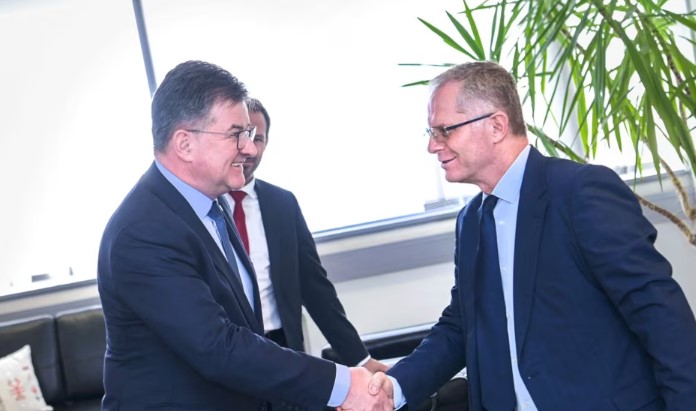
The European Union’s special representative for the Kosovo-Serbia dialogue, Miroslav Lajčák, is expected to visit Kosovo on Friday, September 6, Radio Free Europe learns from its sources in Brussels.
This visit, as Lajčák himself stated last week, is aimed at preparing a meeting at the level of chief negotiators within the dialogue between Kosovo and Serbia.
This time, according to sources, Lajčák will not visit Belgrade after Pristina. Last week, while participating in the security forum, Globsec, the European emissary met with the president of Serbia, Aleksandar Vučić, in Prague.
Meanwhile, the EU spokesperson, Peter Stano, repeated the calls to the Kosovo authorities to refrain from unilateral and uncoordinated steps, which according to the bloc could increase tensions in the north of the country.
The EU, but also the United States, France, Britain and Germany have criticized Kosovo for, as they said, unilateral and uncoordinated actions in the north inhabited by a Serbian majority. These criticisms were made after on August 30, Kosovo closed five institutions that operated according to the Serbian system.
Stano has also spoken about the invitation to interview Serbian politicians from the institutions of Kosovo, who have led the Serbian parallel structures, which were closed from Kosovo.
They are suspected of “falsification of documents”. However, the Serb List party described the interview invitation as “political persecution” of Serbs.
“The EU is in constant contact with the Kosovo authorities and we convey our messages clearly. We have nothing to add to what we said earlier. The situation is very sensitive and the message is to avoid steps that could increase tensions. We hope to resolve these issues where appropriate. The country is in the dialogue process”, said Stano.
On August 30, Kosovo authorities closed five parallel Serbian institutions in northern Kosovo that had been operating under the Serbian system.
According to state officials in Kosovo, those institutions have violated the constitutionality and laws of the Republic of Kosovo”.
The institutions closed on August 30 were: the District of Mitrovica of Kosovo, the parallel Municipality of Mitrovica, the parallel Municipality of Zveçan, the parallel Municipality of Zubin Potok and the parallel Municipality of Leposaviq.
In Kosovo, there are municipalities, companies and public enterprises, kindergartens, primary and secondary schools and public universities that are directly financed by the Government of Serbia, and which are located in the cities and settlements where the Serbian community lives, writes REL.
According to the laws in Kosovo, these institutions are illegal.
In 2013, Kosovo and Serbia, in the dialogue for the normalization of relations in Brussels, reached an agreement on the extinction of parallel institutions, but this agreement has not yet been fully implemented.




