

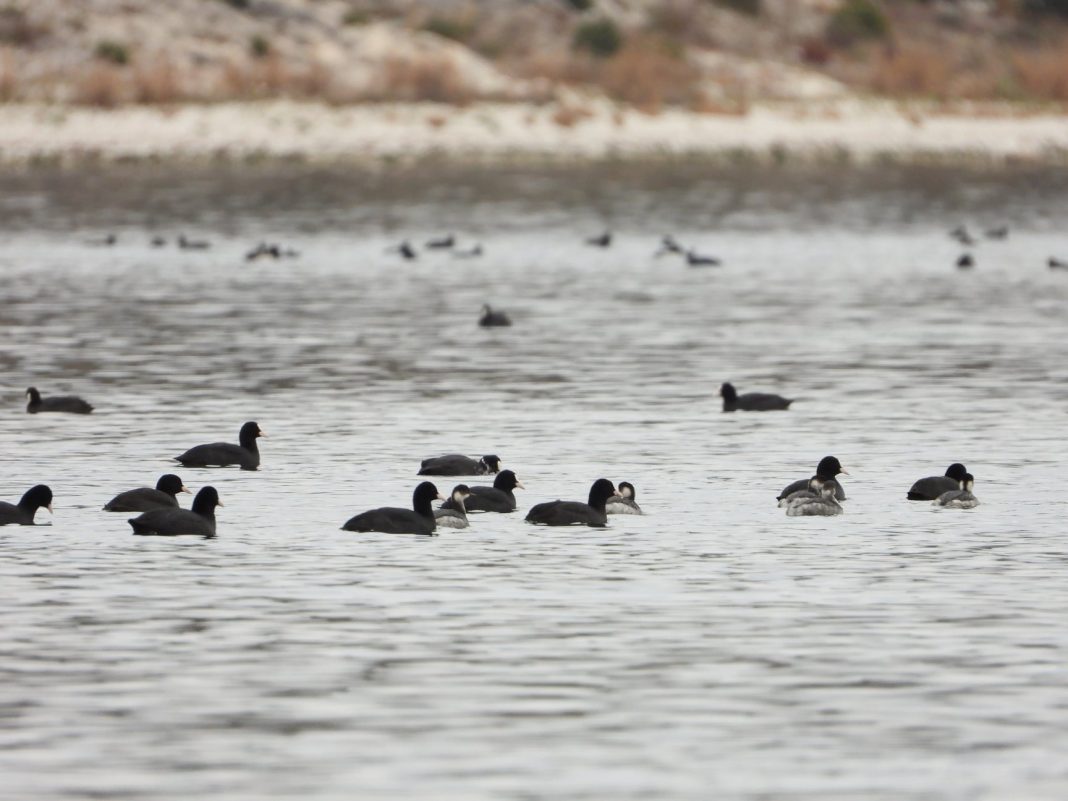
The conclusions of the Waterbird Census in Albania, part of the International Census conducted on January 13-14 in about 143 countries worldwide, showed that this year, too, a smaller number of waterbirds wintered in the wetlands of Albania.
The census was conducted in 33 wetland areas of Albania and involved 91 specialists from the National Agency of Protected Areas together with 11 bird experts, part of non-governmental organizations.
“The result of the Census is that Albania this year has about 100,000 waterbirds wintering in its wetlands, starting from the north towards the south, but from the perspective of importance, Divjaka-Karavasta is the most important area followed by Lake Shkodra, Vjosë-Narta, Kune-Vain, and so on. If we look at the figures from 1996, which we have been monitoring, there has been a decrease in the number of waterbirds, which means that policies need to be oriented to better protect the wetlands to increase the number of waterbirds,” says Taulant Bino from the Albanian Ornithological Association.
In the 38 counting sites of wintering waterbirds in Lake Shkodra, Vau i Dejës, Buna River, and Velipoja Lagoon, according to the expert from the Agency of Protected Areas in the Shkodra Region, Tonin Macaj, there was a noticeable decline in the number of wintering waterbirds, which also indicates the health of these areas.
“Throughout Europe this year, there has been a very mild winter, and the waterfowl that migrate to seek better conditions have not found it necessary to move. This has influenced the number of wintering waterfowl this year, which has been about 30 percent lower than in previous years,” he says.
For biologist Aurora Piroviq, a careful observer of changes in Lake Shkodra, waterfowl are indicators of the impact of climate change, but also of the consequences of human interventions in the environment.
“Waterbirds are the indicator showing the impact of climate change, but it is also the human factor. There are still illegal activities that bring concern to the waterbirds, habitat destruction, or interventions and threats to these waterbirds,” she says.
During the last 80 years, Albania has seen continuous interventions in the wetlands, which are also the areas with the rarest and richest natural ecosystems in terms of biological diversity.
In recent years, says ornithologist Mirjan Topi, these areas are also threatened by the trend towards urbanization.
“We have about 2.7 percent wetland systems, of which 1.5 percent are coastal wetlands and about 1.2 percent are inland wetlands with freshwater. Although they represent the rarest ecosystems, they also represent the most threatened ecosystems in Albania. A large part of the investments has been focused precisely on these areas, investments related to energy, transportation, etc.,” says Topi.
Last November, 12 deputies submitted some changes to the law on protected areas in Albania to the Assembly to give municipalities the right to manage about 20 percent of these areas. This has encountered opposition from the environmental group, as Taulant Bino points out, the changes pave the way for the urbanization of these areas, further damaging the biodiversity of protected areas, as a national asset.
“Many of the proposed changes in the law are not sustainable, and especially some of the articles that allow activities that do not coincide with some categories of protected areas. Some principles of the draft law are unacceptable, but there are also tendencies such as the administration of at least 20 percent of the area by municipalities, which, on the one hand, does not hold because there are protected areas located in the territory of more than 5 municipalities. Thus, it does not make sense even from a numerical point of view”.
Taulant Bino, the director of the Albanian Ornithological Association, says that environmental experts hope to be heard so that these changes are not approved and that protected areas in Albania are not endangered.




