

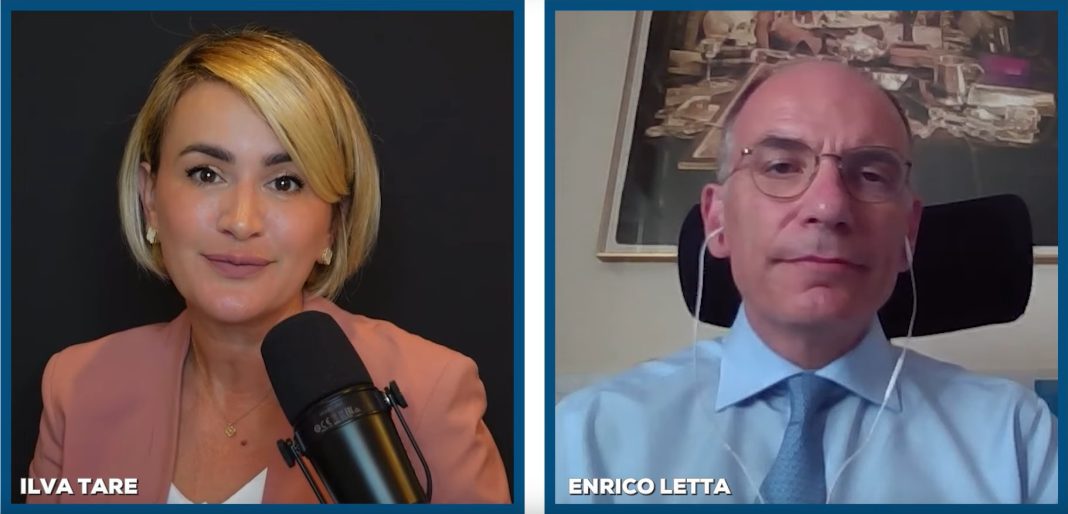
Former Italian Prime Minister Enrico Letta praised the European Union enlargement that happened in the previous 20 years and considered it successful even though it was “a sort of Big Bang”, where 10 countries became part of the EU all at once.
Mr. Letta spoke with Ilva Tare on “Balkans Debrief”, explaining the best method for Western Balkans countries to enter the EU.
“We need to have an enlargement where once you are ready, you can get in. And this is decisive also because it’s the way to give incentives to countries to go fast, to be effective and to be compliant. Enlargement is an enormous accomplishment for one country. For all the Western Balkans, accession to the European Union can be as transformative as it was for other countries. So maybe my first point is to consider that the regatta method is better than the Big Bang method,” said Mr. Letta.
There are some scenarios regarding how the Western Balkans should be treated as members of the EU. One is depriving them of the veto power.
While this is not what he endorses, Enrico Letta told Ilva Tare of another idea regarding the veto issue.
“I think the correct idea is to have a change in the veto power for all the member states. My idea is to move from an individual veto to a collective veto. So, a veto that can be effective only if three countries together are putting the veto on the table on one issue,” said Mr. Letta, arguing this would avoid slowing down processes and using this power to blackmail.
Veto is not the only issue Enrico Letta thinks should change.
The fear of benefiting less from EU economy because of increasing members, he says, makes the idea of enlargement very unpopular amongst member states. To deal with this, Mr. Letta proposes a solidarity enlargement facility.
“I put in my report the idea of having a solidarity enlargement facility for the countries that are today presently net beneficiaries at the European level. Net beneficiaries are starting thinking they will lose benefits because of the next enlargement. And if this trade-off is starting to consolidate in public opinions, that will make enlargement in different countries unpopular. So, we need to create a phasing out, a solidarity enlargement facility to help the present net beneficiaries not to fear enlargement, but to consider that even with the enlargement, they will continue to benefit from European Union structural funds or agricultural policies and so on,” he concluded.
You can watch the full interview here.




