

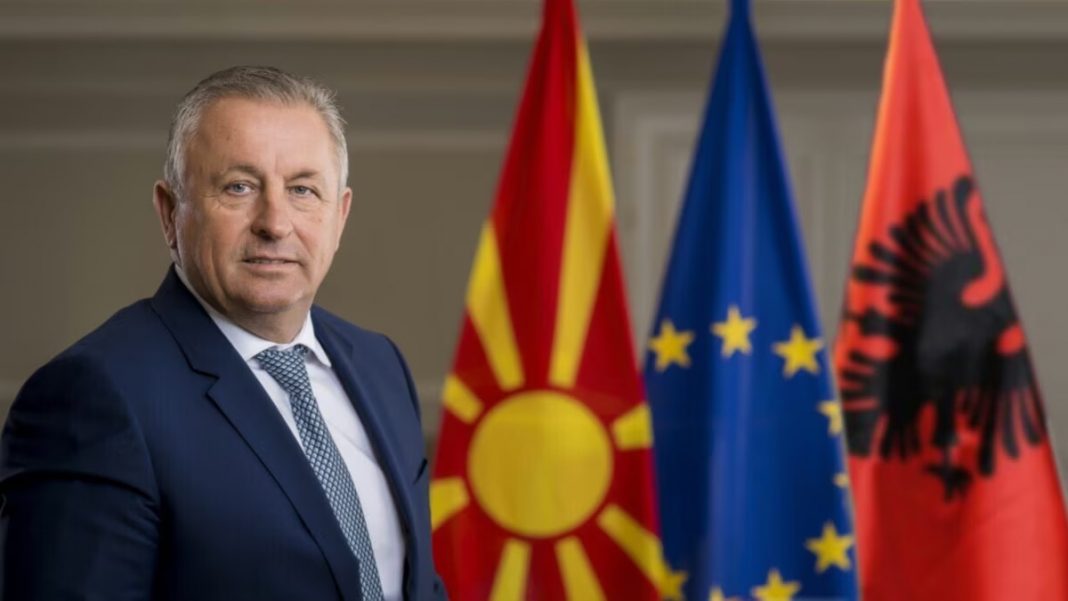
The U.S. Department of State has designated Ramiz Merko, the mayor of Struga Municipality in North Macedonia, as persona non grata.
Washington will not allow him entry into the United States due to his involvement in significant corruption.
The State Department’s announcement states that the mayor of Struga Municipality has embezzled funds illegally and interfered in judicial processes and other public proceedings, undermining public trust in North Macedonia’s democratic institutions.
The statement further emphasizes that this action sends a message that the United States stands alongside North Macedonia in promoting stability through strengthening democratic institutions and addressing deficiencies in the rule of law.
According to the announcement, Ramiz Merko’s spouse, Shpresa Merko, as well as their three adult children, Genci, Nazmije, and Drenusha, will also be denied entry into the United States.
This determination reaffirms the United States’ commitment to combating corruption, which harms the public interest, hinders economic prosperity in countries, and diminishes governments’ ability to effectively meet the needs of their people, concludes the U.S. Department of State announcement.
Richard Nephew, Coordinator for Anti-Corruption at the U.S. Department of State, was interviewed by Arben Xhixho, Chief of the Albanian Service of Voice of America, regarding the designation of the mayor of Struga Municipality.
Part of the interview
Voice of America: Mr. Nephew, Mr. Escobar, the Department of State has designated the mayor of Struga Municipality Ramiz Merko, as a major corruption figure, declaring him persona non grata. As we have seen with such designations in the past, the announcement lacks specific details. Could you provide more information on why this decision was made?
Richard Nephew: The decision was made because the Secretary of State had reliable information suggesting that Mr. Merko was involved in major corruption. And so, under the laws, when the Secretary reaches that conclusion, the designation of someone is legally required.
Voice of America: Can you share with us any concrete evidence on which this determination was made?
Richard Nephew: Yes, the information released as part of the press release shows that it involves embezzlement of funds and interference in judicial processes. And you know, given the nature of designations and their legal basis, this is the information we can make public about this case.
Voice of America: Are there political implications to be expected, following this designation?
Gabriel Escobar: We hope that this decision will help the government of North Macedonia continue its efforts to fight corruption.
Voice of America: We have seen that designations made in the past have raised questions about their effectiveness and whether they serve their intended purpose. Could you comment on the effectiveness and impact of such designations?
Richard Nephew: One of the key objectives of these designations, the primary goal of the Congress that passed the law, is to demonstrate our support for the rule of law and efforts against corruption worldwide. And by publicly identifying them, designating them under Section 7031(c) of the law and denying them entry into the United States, we believe we are assisting in supporting the principle of the rule of law. We also believe that we are strengthening norms against corruption in activities and practices worldwide. Whenever visa restrictions or sanctions are discussed, questions arise about their effectiveness and impact. Overall, we have had very good results in helping civil societies and other activists by showing them that they are not alone, that when they encounter corrupt individuals, they have the support of the international community.
Voice of America: In your decisions, does it matter whether a designated person is in power or not? In most cases, those designated are former officials, and rarely individuals who are in power.
Richard Nephew: This has to do with the legal perspective. The law states that when the Secretary of State has reliable information indicating involvement in major corruption, the Secretary is obligated to impose sanctions by denying visas to these individuals. So legally, we act when we have information. This is part of the investigations conducted to reach a determination. Whether someone is an official or a former official does not matter much for what the law requires us to do.
From a practical standpoint, identifying and responding to a former official involved in corrupt acts has its merits. Part of the reason behind our actions is to support civil society, to support those who seek to hold corrupt individuals accountable. So that even after they have left power, they are unable to benefit from what they did while in power.




