
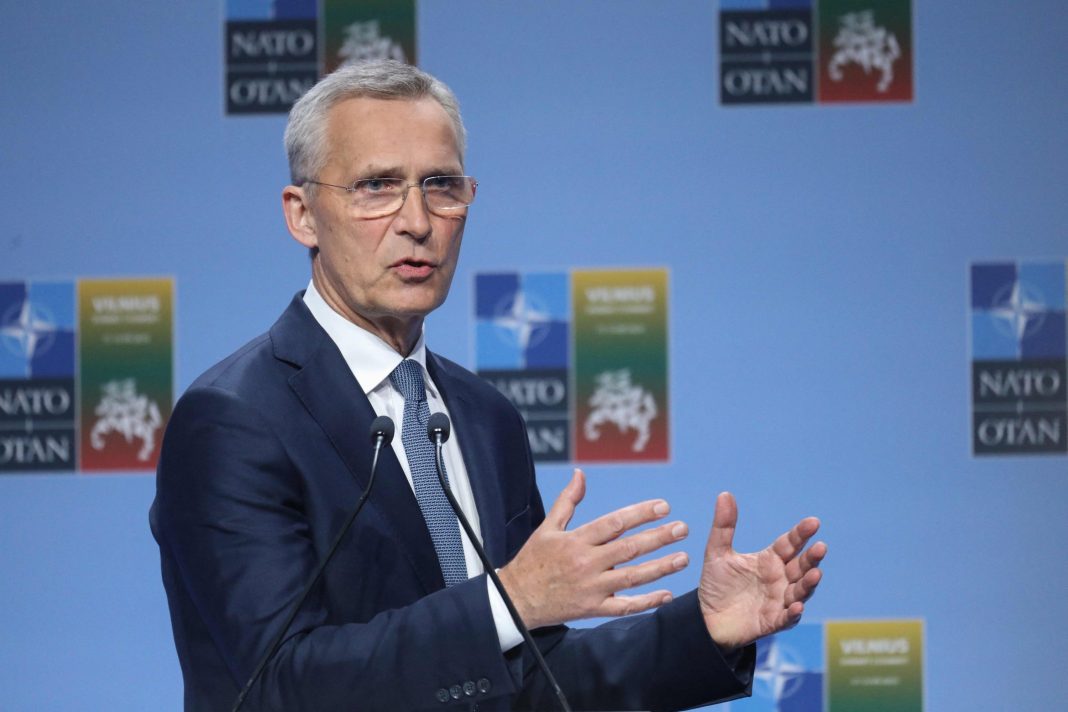
NATO Secretary General Jens Stoltenberg said he is ready to meet with Serbian President Aleksandar Vučić, while calling for a de-escalation of the situation in northern Kosovo.
The Serbian President announced on 6 July that he would request a meeting with Stoltenberg after the NATO summit in Vilnius, followed by an emergency session of the United Nations Security Council due to the situation in Kosovo.
“I am in constant contact with [President of Serbia, Aleksandar] Vučić, and I am certainly ready to meet. We are concerned about the increasing tensions in Kosovo and call on all parties to de-escalate [the situation] and refrain from any actions that could further escalate the situation in the region,” Stoltenberg said.
Speaking at a press conference before the start of the NATO summit in Vilnius, Lithuania, Stoltenberg reiterated that NATO is in Kosovo to ensure security and stability in the region.
“NATO is there to ensure security and stability for the people of Kosovo. We are implementing our mandate in an impartial manner. We have increased our presence due to the instability, violence, and tensions we have seen in recent weeks,” he said.
Leaders of the NATO military alliance have gathered in Vilnius, Lithuania. The summit is taking place at a critical time for security in Europe as the war in Ukraine is in the midst of a counteroffensive by Kyiv.
Kosovo is not expected to be discussed at the summit, despite escalating tensions in the northern, predominantly Serbian-populated part of the country.
Recent unrest there has led to attacks by Serbian protesters against NATO’s Kosovo Force (KFOR) troops, but nevertheless, Kosovo is not on the official agenda for discussions.
Since late May, Serbs living in the northern municipalities of Zvecan, Leposavic, and Zubin Potok have been protesting against newly appointed Albanian mayors working from municipal buildings. They are also demanding the withdrawal of special units of the Kosovo Police from the north.
Since then, several incidents with Molotov cocktails and hand grenades have occurred in the north, and on 29 May, in Zvecan, Serbian protesters clashed with KFOR members.
These clashes have left dozens of people injured on both sides. Among the injured soldiers were 19 Hungarians and 11 Italians.
Three Hungarian soldiers were wounded by gunfire.
The European Union has presented three requests to Kosovo and Serbia to reduce tensions.
Due to their failure to comply, the EU has started implementing several punitive measures since the end of June.
Following the increase in tensions in northern Kosovo, NATO has deployed an additional 700 troops to Kosovo, in addition to the 4,000 troops already stationed there.