

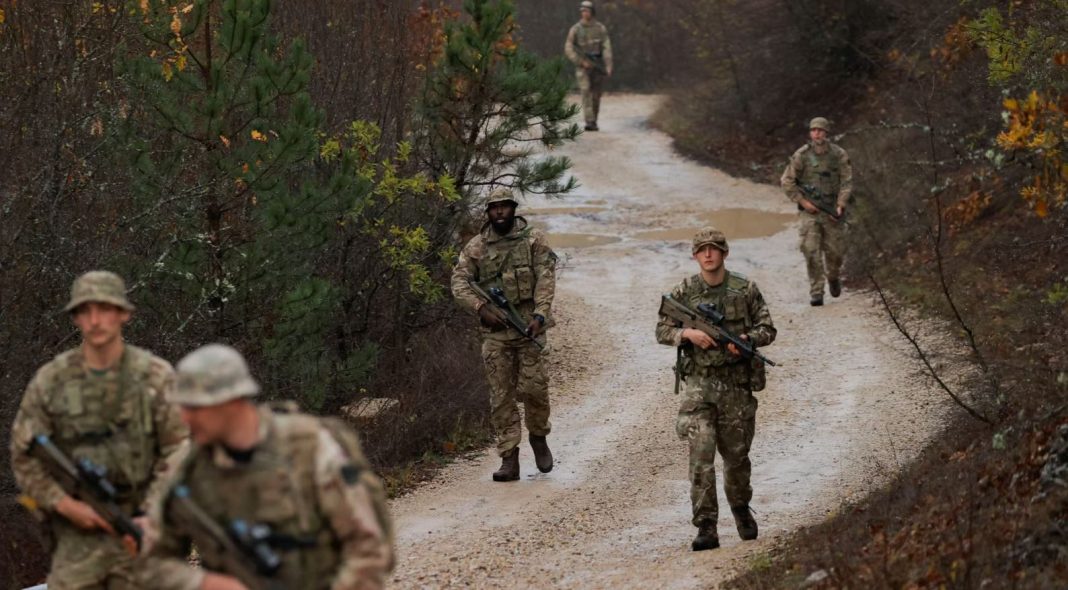
Military presence of the North Atlantic Treaty Organization (NATO) in Kosovo is essential for maintaining peace and stability throughout the Western Balkans region, says the annual NATO report, which will be presented on Thursday in Brussels by the alliance’s secretary-general, Jens Stoltenberg.
The report emphasizes that for years NATO’s peacekeeping mission in Kosovo, KFOR, has maintained a secure environment and freedom of movement for all communities in Kosovo, in cooperation with other international organizations such as the European Union, the United Nations, and others.
“In 2023, KFOR played a key role in ensuring stability in Kosovo following the escalation of tensions in the north of Kosovo. After outbreaks of violence in May and September, allies deployed around 1,000 reserve forces for the mission, representing the largest increase in a decade. This enabled KFOR to triple the number of patrols and quadruple its presence in northern Kosovo,” the report says.
Tensions in northern Kosovo began to rise at the end of May 2023, after the newly elected mayors of the municipalities of Zveçan, Zubin Potok, and Leposavic, accompanied by the Kosovo Police, entered municipal buildings.
Serb residents opposed this and organized protests that culminated in violence on May 29 in Zveçan, where dozens of demonstrators and KFOR soldiers were injured.
They escalated several months later, on September 24, when the Kosovo Police was attacked by a group of armed Serbs in Banjska, Zveçan in the north of the country, leaving one policeman and three attackers dead.
As a result, NATO increased its troop numbers in the peacekeeping mission, KFOR, in Kosovo.
According to Thursday’s report, KFOR now has 4,700 personnel in Kosovo, including reserve forces.
In his annual report, Stoltenberg also mentions NATO’s assistance to security organizations in Kosovo for capacity building, especially in logistics, medical support, procurement, and human resources management.
Also in this report, NATO expresses support for the European Union-mediated dialogue for the normalization of relations between Kosovo and Serbia.
“NATO remains committed to supporting the dialogue facilitated by the European Union between Belgrade and Pristina. Dialogue is the primary platform for reaching a solution that respects the rights of all communities and building sustainable peace, which is in the interest of Kosovo’s security and the stability of the entire Western Balkans region,” the report states.
This comprehensive report mentions NATO’s key activities in the past year, from engagement in assisting Ukraine to counter Russian aggression, increasing presence in the eastern flank to ensure the defense of all member countries’ territories, increasing investments to strengthen the alliance’s military capabilities, to engagement in missions such as KFOR in Kosovo.
NATO regularly presents an annual report on its activities.
The report presented on Thursday in Brussels is considered the last one presented by the current Secretary-General Stoltenberg, as it is expected that soon, possibly before the summit in Washington in July, allies will agree on the appointment of Stoltenberg’s successor.