

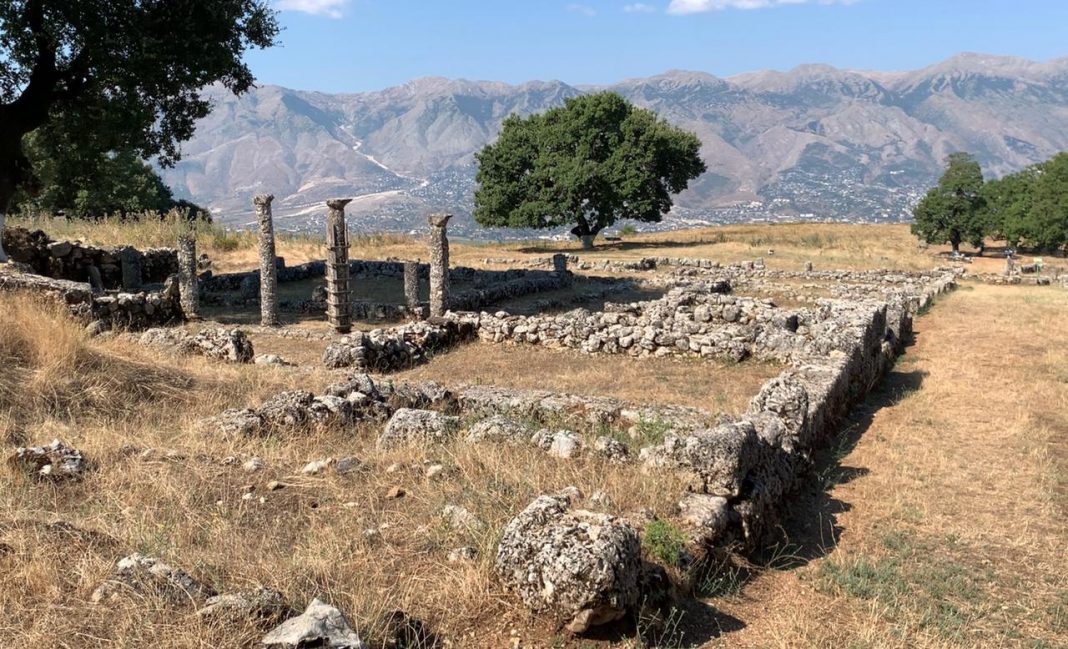
Archaeologists have returned to the Drino Valley in Gjirokastër, Albania, to conduct fresh excavations in the ancient cities of the region.
This year, the archaeological digs are centered in Antigone Park, situated at the heart of the city, where they have unearthed new residential structures.
The primary goal of this research campaign, according to archaeologists, is to create a comprehensive archaeological map, with an eye toward promoting tourism.
In the Drino Valley in Gjirokastër, an area hosting roughly 20 ancient cities and settlements, Albanian and Italian archaeologists have come together for new exploration.
Archaeologist Sabina Veseli explained that the excavations are taking place in the public square of the city, where the initial findings were made.
“We are currently digging close to the Agora, and our excavation efforts extend into the residential sector, where we commenced our excavations last year. Within the residential sector, we are focused on the house of coins, where several previously undiscovered rooms have come to light,” stated Veseli.
She added that the objective of the excavation is to gain insights into the functioning of the city.
“Our aim is to decipher the city’s functioning, the dynamics of urban planning within this city. Our attention is on the city’s public square, the Agora, where we aim to uncover potential additional monuments beyond the promenade and investigate the evolution of residential urban development in Antigone,” she further elaborated.
Albanian archaeologists are collaborating with Italian counterparts under an agreement now in its third year, established between the University of Macerata in Italy and the Albanian Institute of Archaeology.
Italian archaeologist Roberto Perna discussed the research efforts for this year.
“We are actively excavating both public and private spaces, as part of a comprehensive project initiated 15 years ago in partnership with the Albanian Institute of Archaeology. The project aims to unearth historical data pertaining to the entire territory of the Drino Valley. Our excavation at Antigone is not only intended to uncover Antigone but also to provide insights into life throughout the valley. In 2016, we conducted significant excavations at the Adrianopolis Theater, located nearby,” Perna explained.
The archaeological discoveries are not only of academic interest but also serve to bolster tourism. Antigone is recognized as one of the most prominent archaeological sites in the Gjirokastër Region.
Shkëlqim Guça, the Director of the Archaeological Park, emphasized the goal of having year-round activities to attract both local and international visitors.
“We are making concerted efforts to host promotional activities throughout the seasons. These comprehensive activities are held within the park, focusing on local ethnography; celebrating women’s artisanal products, featuring history, archaeology, and folklore. Our primary focus remains the conservation and protection of these historic monuments,” Guça stated.
Antigone, founded by King Pyrrhus in honor of his wife Antigone, existed for less than two centuries before being razed by the Romans.
Archaeologists believe that the city’s protective walls were erected in the 3rd century BC, and they do not rule out the possibility of an earlier settlement in the same location.
Antigone is situated approximately 15 kilometers from the city of Gjirokastër, where the already uncovered ancient area spans 45 hectares, while the archaeological park covers an expansive territory of over 90 hectares.
The historic monuments seamlessly blend with the natural surroundings and are encircled by about a thousand oak trees that stretch alongside the ancient city.




