

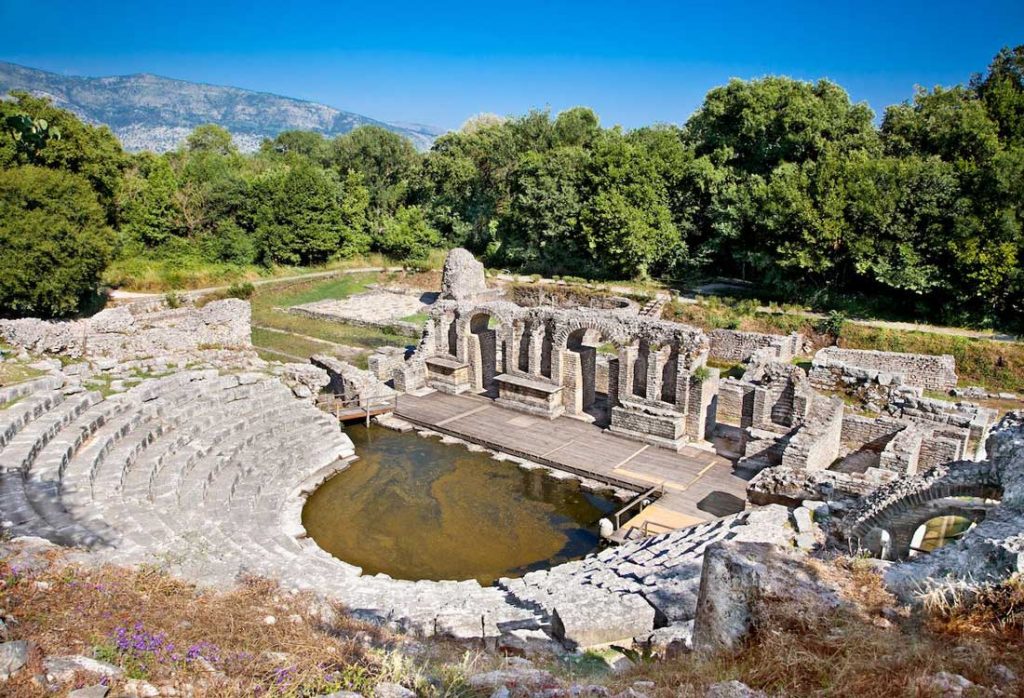
This year’s excavation campaigns have unearthed a well-preserved structure, showing signs of long and layered habitation. For the first time, photographs and topographic surveys have documented the pillars of a Roman-era bridge connecting the promontory where the ancient settlement stood with the Vrina plain.
The submerged remains of an ancient Roman bridge and a partly collapsed structure featuring mosaic-tiled floors, also from the Roman era but used extensively, even in the late antique and medieval periods. The archaeological site of Butrint in Albania continues to reveal surprises.
Sponsored by the University of Bologna, with the Department of History, Cultures, and Civilizations, and the Ministry of Foreign Affairs and International Cooperation, in collaboration with the Institute of Archaeology in Tirana and the Butrint National Park, the excavation and investigation project began in 2015. Since then, it has launched a series of missions to rediscover the many artifacts of this rich city in ancient Epirus.
In particular, since 2019, the research group led by Professor Enrico Giorgi of the University of Bologna and Professor Belisa Muka of the Institute of Archaeology in Tirana has been engaged in the stratigraphic excavation of the acropolis. Over several excavation campaigns, various pieces of evidence of the site’s long life have come to light, inhabited almost without interruption from the late Bronze Age to the 18th century.
While the 2021 research documented the initial phase of the site’s structuring in the Archaic period, likely centered around a sacred area surrounded by imposing polygonal walls, the two excavation campaigns this year, in June and September, revealed evidence from later and equally significant periods.
“Last year, thanks to a series of non-invasive methodologies, especially geophysical investigations using Ground Penetrating Radar, we identified some ‘anomalies’ in the subsoil indicating the presence of possible buried structures,” explains Professor Giorgi. “During this year’s campaign, we decided to excavate to verify the nature of one of these anomalies”.
With unexpected results: the anomaly turned out to be the perimeter wall of a building still well-preserved in its lower portion, thanks to the collapse of the roof marking its definitive abandonment. Once the collapsed materials were removed, clay floors decorated with mosaic tiles from the Roman era came to light, along with many other materials dating back to the late antique and medieval periods. All these elements indicate a long and stratified history of the building.
But the surprises are not limited to the subsoil. Subaquatic surveys in the lagoon surrounding the archaeological site, conducted in collaboration with Professor Stefano Medas of the Department of Cultural Heritage at Alma Mater (Ravenna Campus) and the company Idra from Venice, have identified the pillars of a Roman-era bridge.
“The bridge connected the Butrint promontory with the Vrina plain, also allowing the passage of the aqueduct that supplied the heart of the Roman city,” says Enrico Giorgi. “This is a very relevant moment for research on this center of ancient Epirus, as, for the first time, the submerged remains of the bridge have been documented with photographs and topographic surveys”.
This year’s campaigns also concluded the topographic laser scanning of the Hellenistic-era city wall circuit. This activity, essential for assessing the current state of conservation of monuments in the archaeological park, was the starting point in 2015 for the broader collaboration project between the University of Bologna and the Institute of Archaeology in Tirana at the Butrint site. With the upcoming phase of processing the collected data, it will be possible to provide the park with a useful tool for planning future conservation activities.
You can read the original article here.




