
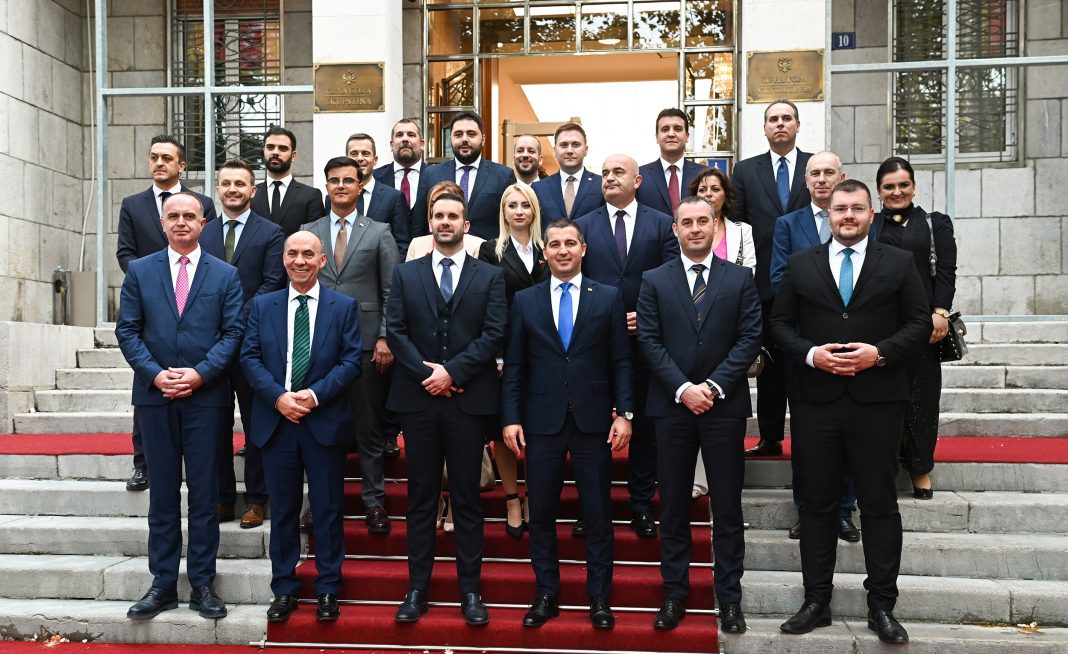
The Montenegrin Parliament elected on the morning of October 31 the new Government under the leadership of Prime Minister Milojko Spajić. This came after an all-night plenary session.
The new Government received its mandate with the backing of 46 deputies from the ruling party, the Movement Europe Now, as well as support from the pro-Russian Democratic Front, which had recently disbanded, the Democrats, the Socialist People’s Party, and various Albanian political parties.
These political parties will assume key ministerial positions in the new Government, with the exception of the Democratic Front, which has agreed, per an arrangement with Spajić, to enter the Government after a one-year interval. The executive branch will comprise 18 ministers and five deputy prime ministers.
The appointment of the Government saw 19 opposition deputies vote against it, one abstain, and five deputies absent during the voting process.
This development marks the conclusion of the technical mandate of the previous Government led by Dritan Abazović, who was ousted through a vote of no confidence in August 2022.
In his address to the deputies, Prime Minister Spajić outlined the four primary goals of his administration: “full membership” in the European Union, an “active and trustworthy” NATO membership, fostering improved regional relations, and playing a more proactive role in various multilateral organizations.
The Movement Europe Now, a center-right coalition, emerged victorious in the early parliamentary elections held in June. However, the coalition fell short of securing sufficient support to independently form the Government.
The selection of the new Montenegrin Government followed an agreement with the pro-Serbian and pro-Russian alliance “For a Better Montenegro”, led by Andrija Mandić. This alliance supported Spajić’s election, in return for Mandić being elected as the Speaker of Parliament.
During the election campaign, Andrija Mandić advocated for closer relations with Russia, criticized Montenegro’s NATO membership, and voiced opposition to the 2006 referendum that resulted in Montenegro’s separation from Serbia.
Upon his election as Speaker of Parliament, Mandić pledged to work towards bridging divisions, although critics argue that his appointment may hinder Montenegro’s aspirations for European Union membership.
Montenegro became a NATO member in 2007 and continues to work towards EU accession. Since 2002, the country has adopted the euro as its official currency, despite not being a part of the eurozone.
After Russia’s invasion of Ukraine in February 2022, Montenegro joined the European Union’s sanctions against Moscow, expelling several Russian diplomats and extending support to Kiev. Moscow, in response, categorized Montenegro as a “non-friendly state”.
Ursula von der Leyen, President of the European Commission, is expected to meet with Prime Minister Spajić in Podgorica on October 31.