

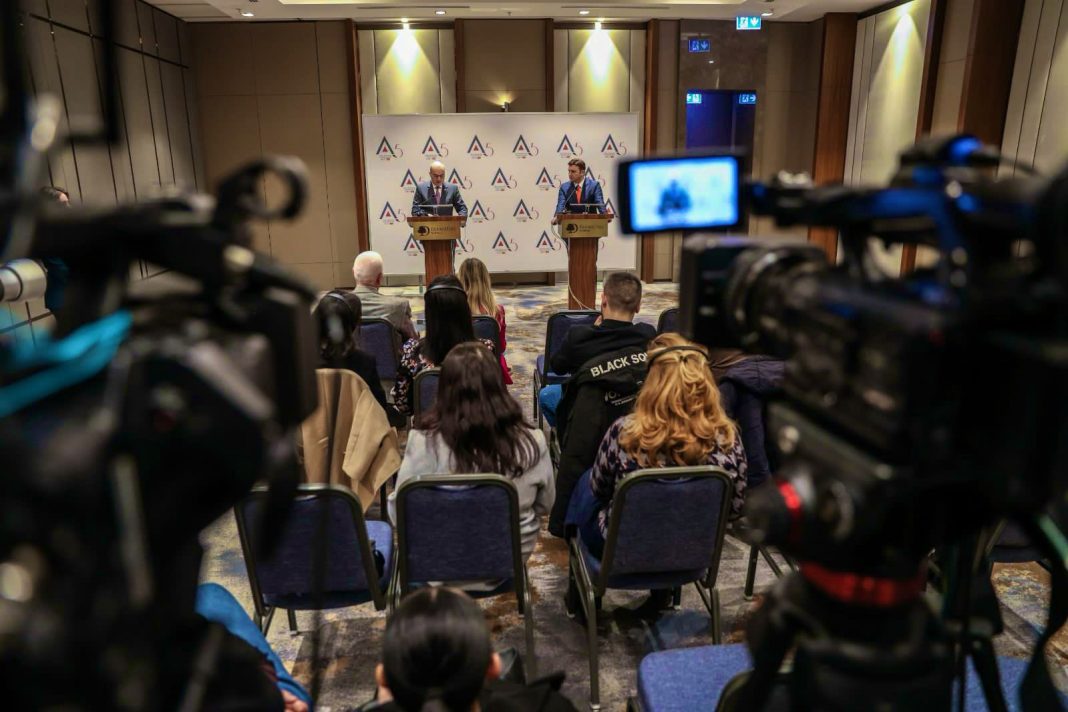
The meeting of the Adriatic Charter Partnership Commission took place in Skopje, concluding North Macedonia’s leadership of this initiative. Participants emphasized that the integration of the Western Balkans into Euro-Atlantic structures remains a top priority. Albania will assume the leadership of the initiative from the beginning of next year.
The Adriatic Charter Partnership Commission, known as A5, acknowledged the role of North Macedonia during its leadership of this initiative, which enjoys strong support from the United States.
The meeting was attended by the two foreign ministers, Bujar Osmani of North Macedonia and Igli Hasani of Albania, which will take over the A5 leadership from January 1, 2024.
The discussion focused on the achievements and future of the Charter, as well as the current situation in the Western Balkans.
Igli Hasani, the head of Albanian diplomacy, stated that since its signing 20 years ago in Tirana, the Adriatic Charter has served efforts toward full Euro-Atlantic integration and the strengthening of further regional cooperation in the field of security.
“We emphasize the role of the United States in consolidating democracy and stability in the region, as well as their invaluable assistance on our Euro-Atlantic journey,” said Hasani.
Charter members expect observer countries such as Kosovo, Serbia, and Slovenia to be included as full members of A5. Hasani stated that Albania will strive to best adapt the Charter in strengthening common responsibilities towards current security threats and challenges.
The ministers highlighted the negative and detrimental influences in the Balkans from Russia’s aggressive attack on Ukraine, emphasizing the need for continuous attention and engagement from NATO and the EU.
Both ministers condemned the attack by an armed Serbian group in north Kosovo, calling for impartial investigations.
“We strongly condemn the terrorist attack on September 24 in Banjska, Zvecan carried out by Serbian paramilitaries against the Kosovo Police and firmly demand that the orchestrators and authors of this attack be held accountable before the law,” Minister Hasani emphasized.
His counterpart, Osmani, expressed a similar sentiment, adding that it is crucial “to identify the perpetrators and hold them accountable for their actions”.
While Hasani emphasized that Albania will work for Kosovo’s membership in the Adriatic Charter, North Macedonia’s Foreign Minister, Bujar Osmani, proposed further action for the Charter, which will involve better coordination among A5 member countries in NATO to create common positions and support for countries in the NATO accession process.
“For example, Kosovo is initially a candidate for membership in A5, and here North Macedonia fully supports its membership. We believe that in this way, we will increase stability even more and encourage the Euro-Atlantic path of Bosnia and Herzegovina and Kosovo,” said Osmani.
Officials from A5 believe that the integration of the Western Balkans into NATO and the EU is the best way to achieve peace, stability, and promote comprehensive reforms in the region.
The Adriatic Charter includes North Macedonia, Albania, Croatia, Bosnia and Herzegovina, Montenegro, while the United States attaches special political and strategic importance to this initiative.




