
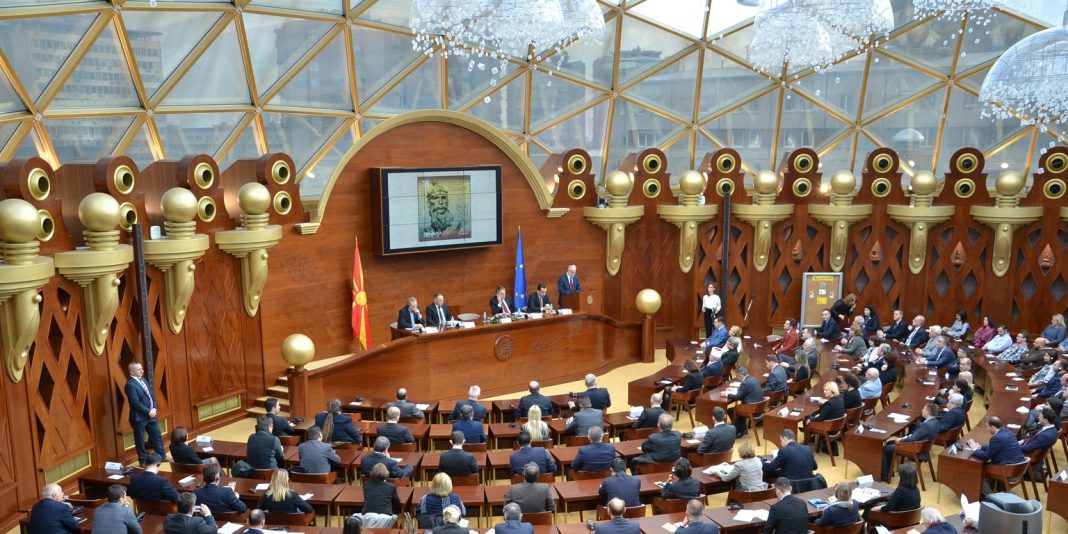
The Constitutional Affairs Committee in North Macedonia’s Parliament approved the Government’s proposed constitutional changes on Tuesday. The amendments are now set to be voted on during the plenary session scheduled for August 18.
The proposed amendments primarily focus on the recognition of the Bulgarian minority as a constituent people in the Constitution’s preamble, in line with the “French proposal”. This initiative aims to address longstanding issues with Bulgaria, pertaining to identity, language, and historical aspects.
The agreement reached with Bulgaria based on the “French proposal” had led to North Macedonia’s official commencement of accession negotiations with the European Union on July 19, 2022.
However, the EU accession talks cannot proceed to subsequent chapters unless North Macedonia includes the Bulgarian minority in its Constitution. Failure to do so might prompt Bulgaria to exercise its veto, as it did in 2020 when the start of negotiations was blocked.
Apart from the Bulgarian minority, the proposed constitutional changes also seek to acknowledge other minority groups, including the Croatian, Montenegrin, Slovenian, Hebrew, and Egyptian minorities, in the Constitution’s preamble.
In an address to the deputies, North Macedonian Prime Minister Dimitar Kovačevski emphasized that these changes would further reinforce the country’s multi-ethnic character. He reassured that the amendments would not compromise the “Macedonian identity and language”.
Kovačevski stressed that the constitutional changes are pivotal for the nation’s European future and the well-being of its citizens. He urged fellow parliamentarians not to miss the opportunity for EU membership, which would bring European quality to their homes.
“Constitutional changes are not harmful as claimed by the opposition. The Macedonian language is guaranteed, and this has been clearly stated by top EU officials,” said Kovačevski.
Opposition party VMRO-DPMNE declared that none of its deputies would support the changes, citing opposition to the “Bulgarian dictate”. The party contends that including the Bulgarian minority in the Constitution will not resolve existing “Bulgarian conditions” and insists on postponing the approval until negotiations with the EU conclude or until formal accession to the union.
However, this stance contradicts EU officials, who maintain that the changes should be implemented as part of the accession negotiation framework.
Another opposition party, “The Left”, also opposed the constitutional amendments and demanded that only Macedonians should negotiate matters concerning the Macedonian people. They further called for the dismissal of Foreign Minister Bujar Osmani.
Meanwhile, Albanian parties requested that the constitutional changes also encompass a revision of the definition of the Albanian language, spoken by 20 percent of the population. These parties argued that the opportunity should be seized to address perceived injustices in the treatment of the Albanian language, which they claim is defined with “offensive terminology”.
Representatives from the Alliance for Albanians, a party in the Government, along with the opposition parties Besa Movement and Alternative, voiced the need for equal treatment within the EU, respecting each other’s languages and unique characteristics.
Support for the constitutional changes has been consistently voiced by EU and US representatives, who believe that these amendments are essential in ensuring North Macedonia’s European future and fostering regional peace and stability.
Constitutional changes need to be approved by two-thirds of the deputies, or 80 votes. The current parliamentary majority has 64 deputies, meaning that 16 votes from opposition parties are needed for their approval.